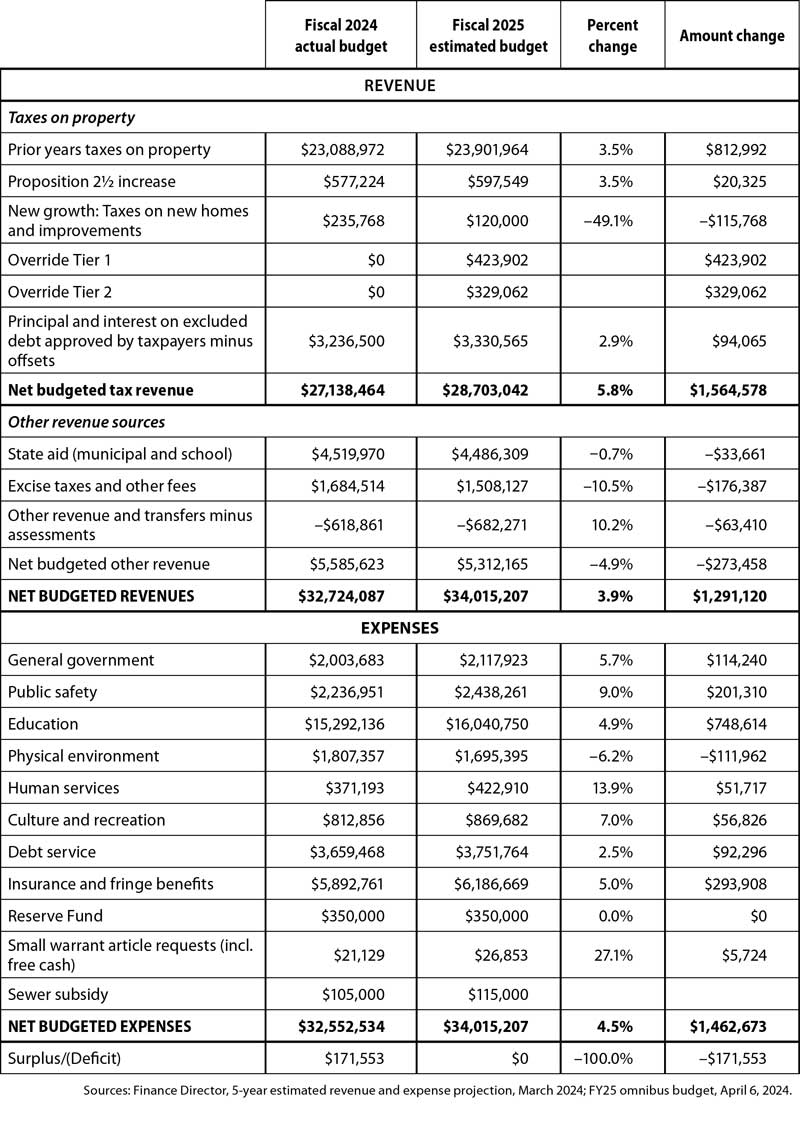
Readers who seek a one-page overview of the fiscal 2025 budget—and assurance that it balances—should turn to Harvard’s five-year budgeted revenue and expense projection, sometimes referred to as the “recap.”
The recap is prepared by the Finance Department and updated as the coming year’s budget takes shape. It’s a weather report of sorts, forecasting the income that the town’s financial planners expect to collect in fiscal 2025 and the five years that follow, offset by anticipated expenses. By law, the two must balance.
A copy of the recap is on page 18 of the warrant book. A Press version, Budget in a Nutshell, appears at right. The Press version condenses the recap’s list of outstanding town debt and expands its list of anticipated expenses. The numbers in both versions are identical and reflect what was known last month at the time the warrant booklet was assembled.
Here are three key financial takeaways.
1. Without overrides, the fiscal 2025 budget does not balance.
State law says a town’s budget must balance—that its income must equal its expenses. As the recap shows, the two overrides—labeled Tier 1 and Tier 2—are necessary to balance next fiscal year’s budget. Without them, the town will be left with a $752,964 deficit, requiring cuts to town expenses to bring the deficit to zero.
2. Harvard has a “structural deficit.”
A “structural deficit” exists when a town’s expenses are rising faster than income. Harvard has one. Without overrides, the tax revenue provided by the Prop 2½ levy in fiscal 2025 is projected to grow 3.5% but the recommended budget—4.5% higher than a year ago—is growing faster. To make matters worse, state aid has remained stagnant, and will even decline slightly next year. Benefits and insurance are forecast to climb more than 5% a year. The town’s five-year forecast predicts that even if this year’s overrides pass, next year’s financial planners will face a $1.1 million deficit as they begin work on a fiscal 2026 budget.
3. Residential taxpayers continue to foot the bill.
The money that fuels Harvard’s municipal engine comes mostly from the town’s property owners. In fiscal 2025, Harvard taxpayers will pay 84% of Harvard’s expenses, approximately $29 million, with 95% of that amount coming from residential property owners, the same percentage as in fiscal 2023. This money is supplemented by income from sources that make up the other 17% ($5.5 million), largely state aid, excise taxes, and other forms of relief, sources that are forecast to decline next fiscal year.
A final fiscal note: The recap treats the principal and interest due on the town’s loans as both income and expense. That’s because the debt is paid with taxpayer money that is added to the town’s levy and is part of a property owner’s tax bill. Those dollars, known as “excluded debt,” offset the expense of the principal and interest due on the town’s loans, which appear in the expense portion of the recap.