Article 22 asks voters whether Harvard should designate an 8-acre overlay district on Ayer Road where multifamily homes could be built by right. To create the zone, a new bylaw must be passed by two-thirds vote.
The impetus for the bylaw is the MBTA Communities Act, a 2021 law meant to encourage more apartment and condominium development in communities that either have an MBTA station or are near one. It is part of the state’s strategy to address the severe statewide housing shortage, which according to the Warren Group, an independent provider of real estate data, has driven home prices to a median price of $570,000—one of the highest in the nation.
In Harvard, 2022 Warren Group statistics put the town’s median home price at $910,000. And for the first six months of 2023, the median price climbed to $930,000, more than 50% higher than five years earlier, according to the 2024 Housing Production Plan. Because mortgage interest rates are at a 20-year high, the plan said, “Monthly principal and interest payment on a median-priced home is double what it was in 2019 (assuming an 80%, 30-year mortgage).”
The law affects 177 towns: Harvard is one of 34 classified by the state as an “adjacent small town”—the category with the lightest obligations. The state’s deadline for the small towns to pass the zoning is December 2025. According to the town planners in Stow, Carlisle, and Sterling, also MBTA-adjacent small towns, their plans for multifamily zoning are in the planning stages.
The bylaw was written by the Harvard Planning Board using a template provided by the state and with the assistance of a planner from the Montachusett Regional Planning Council.
Bylaw in a nutshell
The requirements of the law and its associated regulations, as specified by the state’s Office of Housing and Livable Communities, are as follows.
By right:
At least one zone must be created in which multifamily homes—buildings containing at least three units—can be built via site plan review, a process more predictable and simpler than the special permit process.
Density and units:
Multifamily districts must allow a minimum gross density of 15 units per acre; that’s density based on all the land in the district, not just the building lot. Harvard must zone for a minimum of 113 units.
Town-owned land, wetlands, and age restrictions:
Multifamily zones cannot include town-owned land or wetlands, and they cannot carry age restrictions such as restricting the homes to those older than 55.
Affordability:
It’s not required, but communities that want to include affordable units can mandate up to 10% affordability in any one development. Harvard’s bylaw requires the maximum of 10%.
Location:
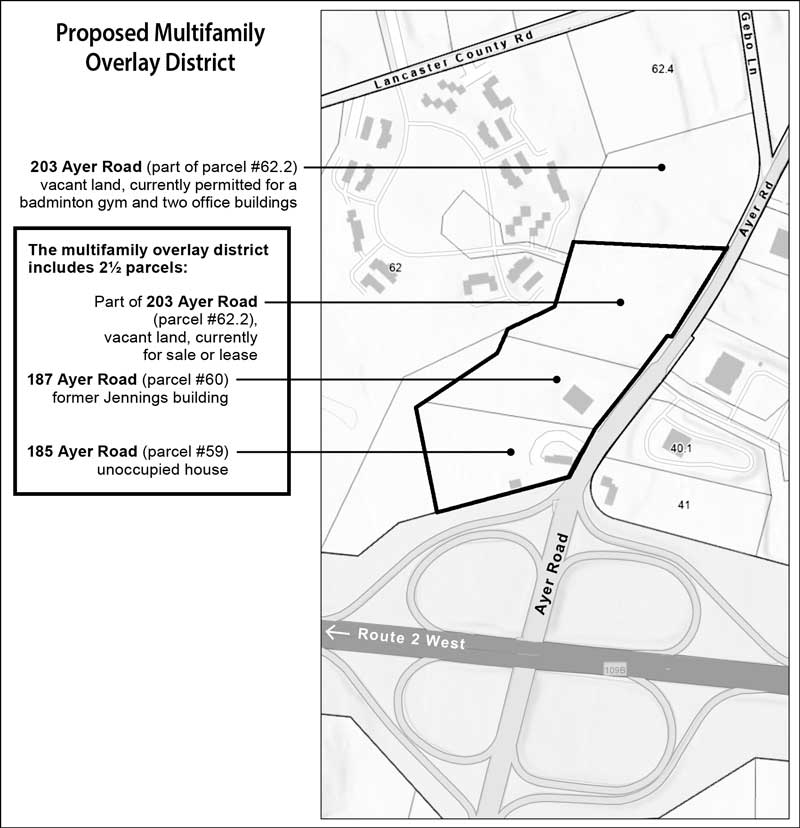
MBTA-adjacent small towns can locate their districts anywhere in town; they need not be within a certain distance of a station. Harvard’s bylaw proposes one multifamily overlay district of 8 acres on Ayer Road (see map below) for an allowable density of 120 units. The height limit is three stories.
Additional development by special permit only:
Harvard’s bylaw proposes that more than 120 units could be allowed if 25% of the additional units were affordable, but only with a special permit.
How the multifamily district was selected
The Planning Board chose the site on Ayer Road in the town’s commercial district after an “exhaustive search of more than a year,” Planning Board Chair Richard Cabelus said at a lightly attended hybrid hearing on the bylaw at Town Hall Monday night. The 4 acres abutting the proposed district zone have already been permitted for a badminton gym and two office or mixed-use buildings, though permits have not been pulled.
Two other parcels were also considered, narrowed down from a longer list. One was agricultural land on Ayer Road on the town line near AllFresh, the other the former Friendly Crossways, now an upscale wedding venue called The Farmstead on Littleton County Road. According to members of the board, it settled on the site across from Dunkin’ for its proximity to the Route 2 interchange. The site is also likely to be connected to water and sewer: Harvard and Devens officials, along with the landowner, have discussed connecting the site to water and sewer at Devens over the past year.
Consequences of failing to enact the zoning
A town complies by creating the multifamily overlay district in accordance with the MBTA Communities Act and its associated regulations. The penalty for towns that defy the law is ineligibility for state funding from the Housing Choice Initiative program, the Local Capital Projects Fund, and the MassWorks infrastructure program. MassWorks provided $1 million to Harvard in 2021 for improvements to Slough Road; a MassWorks grant for Stow Road is pending. The town has not received funds from the housing choice or capital projects programs, according to Assistant Town Administrator Marie Sobalvarro.
The town will not be penalized if it enacts the zoning but builders do not use it. However, according to a recent market study of the Ayer Road commercial district by the Boston-based design firm Utile, the current real estate market in Harvard favors residential over commercial development.
Over and above the by-right requirements: Special permit provisions in the bylaw
A separate section of the bylaw offers developers an opportunity—via special permit—to build housing units in excess of the 120 units allowed by right, either in a mixed-use or residential-only setting. And 25% of the additional units must be affordable.
Planning Board members say the advantage to the special permit option is twofold. First, the mixed-use option could attract businesses in the town’s commercial district that residents would like or find convenient. The mixed-use option would allow small-scale commercial uses such as a medical office, dry cleaner, nursery school, fitness facility, pharmacy, grocery store, or other retail of up to 10,000 square feet. Residences could be on any floor in a mixed-use development, but the commercial component must be on the first floor.
The second advantage, board members said, is the 25% affordability requirement that applies to the additional units: That could push the town closer to its state-mandated goal that 10% of its housing stock be affordable to those earning no more than 80% of the area’s median income, which in eastern Worcester County is $79,700 for one person and $113,800 for a family of four. Affordable rents would be set at around $1,775 for a one-bedroom unit.
According to the town’s 2024 Housing Production Plan, Harvard is at 5.3% percent of its 10% affordability goal with a shortfall of 103 affordable units.
The all-rental special permit option would most benefit Harvard’s state-mandated affordability goal. This is due to an allowance in the state’s affordable housing law that lets all rental units in a building with 25% affordable units be counted as affordable, including the 75% that are rented at market rates.
Frequently asked questions about the proposed multifamily zoning law
Q: Does the new multifamily district cancel out existing zoning at the site or require a landowner to build new housing?
A: No, and no. The commercial zoning that underlies the multifamily overlay district remains an option for the landowner-developer. Nothing prevents a landowner of the multifamily zone from filling part of the acreage with 120 housing units (say 1.5 acres or 2 acres, via the multifamily bylaw) and then building out the remaining land according to the commercial zoning or with the Ayer Road Village Special Permit zoning that is allowed in the commercial district, if the lot size and setbacks are adequate.
Q: What would happen if the multifamily overlay district is not built out with multifamily units but is instead built out according to the underlying commercial zoning? Would the town need to create another multifamily district?
A: According to Planning Board Chair Richard Cabelus, the answer is “No.”
Q: Could land within or adjoining the multifamily zone be combined with the Open Space Conservation-Planned Residential Development bylaw, passed by Town Meeting last fall, to create more housing than had been intended?
A: No. OSC-PRD zoning is allowed only in the agricultural-residential district, not in the commercial district.
Q: Is a town required to build infrastructure to support the housing that could be built?
A: No. That is up to the developer who builds in the zone. The proposed multifamily district could be a candidate for municipal water and sewer, however. Its landowner has explored connecting to Devens’ systems via Lancaster County Road.
Q: Will the multifamily homes be rentals or ownership units?
A: The bylaw cannot specify whether the homes are for sale or for rent; it will be up to the private entity that builds them.
Q: How are the requirements of the multifamily overlay districts related to those of the state’s affordable housing law, 40B?
A: They are not related and are separate laws governed by separate regulations. The purpose of the MBTA Communities Act of Chapter 40A is to encourage denser housing for families and with an optional, minimal affordability component. It requires a town to create by-right zoning.
The purpose of Chapter 40B, the affordable housing or comprehensive permit law, is to encourage affordable housing by allowing developers to override local zoning via comprehensive permits as long as 25% of the housing units meet regional affordability standards. It requires towns to accept, under most circumstances, 40B developments if less than 10% of its housing stock is affordable.
How might new housing affect the Harvard public schools
The Press has yet to find a single formula for predicting the number of school-age children that would be generated by new housing. Whether 120 units were built under the by-right part of the multifamily bylaw, or whether more than 120 were built via special permit, a firm answer is elusive.
The National Association of Homebuilders, citing data from the U.S. Census’ American Community Survey, estimates about one student for every three units of housing. But that estimate doesn’t compute for the recently built, 20-unit Craftsman Village, which generated 13 students: 10 students for Hildreth Elementary School and three for Bromfield, according to School Superintendent Linda Dwight. This works out to about .6 students per unit. Yet the U.S. Census’ 2018 survey estimates multifamily housing generates .22 students per unit, while single-family detached housing has the highest average number of any housing type, .39.
A spokesman for the Mass. School Building Authority told the Press it does not estimate how many students might be introduced to a district with new housing. MSBA guidelines, however, require newly built schools to “have a possible expansion option identified for its building projects,” said SusanMary Redinger, who chaired the elementary school’s building committee and confirmed that Hildreth Elementary was designed with such an option, “Out toward Mass. Ave.,” though it “didn’t drive the design.”
Asking how many new students would enroll if more housing is built “is a fair and important thing to address,” said Tim Reardon of the state’s Office of Housing and Livable Communities in a Feb. 28 webinar sponsored by CHAPA, the Citizens Housing and Planning Association. “But it’s not so simple as saying, OK, if we build 100 units … there’s a school-age student in every two units, .5 [per unit].”
“You have to take context into account,” Reardon said, including turnover of units, demographics, and availability of new units. Citing regression and statistical analysis, 2010 to 2020, from the Metropolitan Area Planning Council, Reardon said the data did not show correlation between housing production and school enrollment.
He offered the example of Hopkinton, which added 30% to its housing stock when Weston Nurseries was redeveloped; school enrollment increased by 11%, he said.
An increase of 120 units in Harvard, which has 2,199 year-round housing units according to 2020 census data, would mean a roughly 5.5% increase in the town’s housing stock. The answer to how many students the development would generate depends on which number one chooses, be it the number that seems to apply to Harvard-—at least based on Craftsman Village (.6 ) or the U.S. Census’ yearly survey of 2018, (.22).
According to Dwight, and using the schools’ current class size policy, HES can accommodate 518 and Bromfield 810. According to 2024 statistics from the Department of Elementary and Secondary Education, enrollment at HES is now 442 and Bromfield’s is 577. This leaves capacity for 76 students at HES and 233 at Bromfield.
–VH