
A few days ago, the 12-year-old in my household dismissed something as so phantasmagorical that it belonged in Area 51. He of course meant the Area 51 of the popular imagination: an unimaginably secret facility housing the bodies of extraterrestrials, flying saucers, and other unidentified objects that do not belong traversing Earth’s skies.
The perhaps disappointingly sober reality of Area 51 is that it houses an aeronautical research facility that gave us, among others, the U2 spy plane. In other words, flying objects from Area 51 are actually quite identifiable to those in the know, and they are fully meant to fly by their unquestionably human designers. Or so we are told.
Fellow sky walkers, our stellar destination for today encompasses both connotations of Area 51 and includes a handful of celestial denizens that are meant for Earth’s skies, as well as one that most assuredly isn’t. This is a sky walk suited to the hard-to-predict weather of these October nights, intended for naked eye and binocular observations, as the hazy weather patterns of early fall are not friendly to telescopes.
The Summer Triangle
For the past few months, the evening skies have played host to a hard-to-miss threesome of bright stars. Perched at the zenith for most of the summer and lying right on the star fields of the Milky Way, the Summer Triangle borrows one star from each of three major constellations: Deneb from Cygnus (the Swan), Altair from Aquila (the Eagle), and Vega from Lyra (the Lyre). Figure 1 prominently highlights these three stars and shows the outlines of their affiliated constellations, plus a few more.
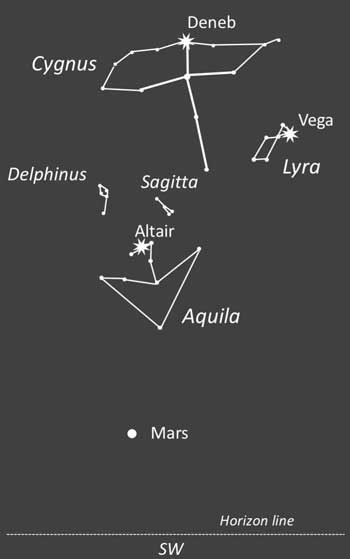
Figure 1: The southwestern sky, stretching from horizon to zenith. Shown here as it will appear around 8 p.m. in mid-October. Summer triangle marked with *. (Illustrations by Marc Vilain)
To locate the Summer Triangle, just look straight up after sunset. Deneb, Vega, and Altair form an isosceles triangle that spans much of the sky around the zenith, with Altair at the pointy end. To give you a sense of scale, if you extend your arm and spread your fingers, the short end of the triangle (Deneb to Vega) is about one hand’s width in length, and the long sides that reach for Atair span roughly two hands’ widths. Once you have found the three stars of the triangle, use the chart to identify their respective constellations.
Two elegant birds
The easiest of the three constellations to parse out of the night sky is Cygnus, the Swan. Look for the familiar shape of a kite, the crossed-sticks kind that Charlie Brown usually guides into a tree. To help you find Cygnus, note that Deneb is at one end of the long stick in the cross. The name Deneb itself is a shortened rendering of Dhanab ad Dajaja, Arabic for the tail of the hen (our swan), with the head at the other end of the long stick. Once you’ve found the cross, try pulling in the additional stars that make up Cygnus’ wings. To my eyes, this is one of the most aptly named and elegant constellations in the sky, truly deserving of a better flight experience than Charlie Brown’s kites.
Our second flying constellation is the magnificent Aquila. I locate this constellation by imagining Altair as the Eagle’s eye, and I picture it on a short line of three stars making up the beak, eye, and forehead of the bird. The rest of the eagle’s body then becomes apparent on its own. The chart shows Aquila as I connect the stellar dots: like an eagle rising into the sky with wings caught in mid-flap. Other renderings, such as the one on my smartphone app, picture the eagle gliding through the sky with foreshortened neck and more of a tail.
Around Aquila’s wings
We will return to Lyra, the third of the Summer Triangle’s constellations, in our next column. Today’s visit instead continues with two more constellations gifted with flight of a kind. Both dance ahead of Aquila’s widely spread wings.
Delphinus (the Dolphin) lies above the eagle’s left wing. Look for a knuckle-sized diamond shape to which is added an obvious tail. The whole constellation is not quite the size of your thumb held at arm’s length. Delphinus always makes me smile. I can’t help picturing the likes of Flipper and her cousins jumping out of the water, going airborne with grins on their faces.
Delphinus is one reason to bring binoculars to this particular sky walk. The naked-eye view shows only the five stars in the chart, but raising your binoculars to the sky reveals many more stars that add sparkle to the dolphin: Maybe they’re water droplets glistening off her sides. Try playing a game of now-you-see-it, now-you-don’t with Delphinus’ fainter stars by alternating between naked-eye and binocular views.
In front of Aquila’s right wing lies pinky-sized Sagitta, the Arrow. The stars that form Sagitta are dimmer than those in the nearby eagle, especially Altair, but the distinctive shape of the constellation makes it easy to spot on moonless nights. Sagitta lies right along the Milky Way, making for spectacular views in binoculars.
An astronomical sight gag
Once you’ve got Sagitta in your binoculars, shift your view to the right and slightly upward, away from the tail feathers of the arrow. Look away by roughly the distance of one binocular field of view. There you will stumble upon a grouping of stars (or asterism) that should give you reason to go “huh?” This asterism looks for all the world like an upside-down coat hanger, an object of far lesser magnificence than our Eagle and Swan, and one that only belongs flying through the air only if you’re perhaps purging your clothes closet or arguing with your spouse.
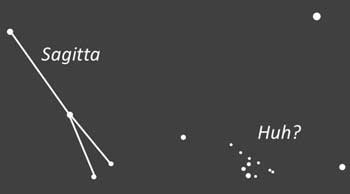
Figure 2: The Coat Hanger, with nearby Sagitta.
Over the next few months, the constellations of the Summer Triangle will slowly drift horizonward to spend the winter out of our skies. While they’re still with us, fellow sky walkers, I wish you clear nights that allow your imagination to travel the setting star fields of the Milky Way, and I hope that you find there your own stellar flights of fancy.
Marc Vilain walks the night sky from the roadways and fields of Harvard.