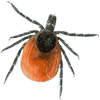
Even if you sneeze in his face, Fido won’t catch your cold. But pets suffer from the same tick-borne diseases that humans do, and they tend to spend a lot more time outdoors in tick habitats. Last week, the Press examined spraying properties to control the tick population. This week, we look at tick preventives for pets.

Dogs need to be constantly monitored for ticks. Puppies like George Hays have an advantage with light-colored fur. (Photo by Lisa Aciukewicz)
Megan Suokko, owner of the Woof Wagon, a Fitchburg-based mobile dog-grooming service, said in an interview that her groomers see a lot more ticks in Harvard and Bolton than in any of the other towns in their service area of north-central Massachusetts. Suokko, who has 10 years’ experience in mobile dog grooming, said, “We spend an hour checking over every inch of skin. We see a lot of dog ticks, not as many deer ticks, but the dog ticks carry diseases as well.” Deer ticks carry Lyme and anaplasmosis, and dog ticks carry ehrlichiosis and babesiosis. And although Lyme disease is uncommon in cats, they are susceptible to the other tick-borne diseases. “You need to be diligent about prevention,” Suokko said.
Dr. Timothy Foster, veterinarian and owner of Shepherd Veterinary Clinic in Boxborough, said that while pet owners expect a preventive to keep ticks off their pets altogether, veterinarians are more concerned with preventing tick-borne diseases. “The goal is to kill the tick as quickly as possible before it can bite and transmit a disease,” said Foster, “and that’s hard to do safely.” In the past, he said, the chemicals that were used in tick preventives paralyzed ticks quickly so they couldn’t bite. But those chemicals were unsafe and have since been banned by the U.S. Environmental Protection Agency. Today’s preventives still kill ticks, but they do it more slowly, so ticks still have a chance to bite and infect their host.
Chemical-based tick preventives for dogs and cats come in various forms: topical treatments, collars, and a new oral treatment called NexGard, available for dogs only. Natural sprays and collars are available, but they tend to be less effective (see “Do-it-yourself repellents” below). Foster said that topical treatments, such as Frontline and K-9 Advantix, are effective if used properly: “When people tell us that the topical treatment they are using isn’t working, we go over how they’re using it. The vast majority of the time, the product is not being used correctly. Either it’s not being applied properly or not being applied at the recommended intervals.”
How preventives work
The chemicals in topical preventives spread over the pet’s body in the oils on their skin. The chemicals are then stored in the pet’s oil glands and released continuously for a month through hair follicles. When ticks come in contact with the hair, they die within 48 hours. Near the end of each monthly cycle, the chemicals start to degrade, and Foster said that pet owners may see more ticks during those last few days of the cycle. Frequent swimming and bathing may cause the chemicals to degrade more quickly.
Tick collars work the same way as topicals, but the collar releases a continuous application of the product for six to eight months, depending on the brand. Foster said that the collars are more effective because they are constantly recharging the chemical onto the pet. Also, because of the constant recharging, swimming and bathing are not as much of an issue. He recommends replacing the collars just before spring and late in the fall for the most effective tick prevention.
Fairly new to the market is NexGard, a chewable tablet given to dogs once a month to kill ticks. Some dog owners like this treatment because they don’t have to worry about exposing their family to the chemicals in topicals or collars. But, Foster said, the tick has to bite the dog in order for the chemical to kill it. He added that the long-term effects of introducing these chemicals into a dog’s system are unknown.
Know the ingredients
Foster said that pet owners should pay attention to the active ingredients in tick preventive products. Permethrin (used in K-9 Advantix) and flumethrin (used in Seresto collars) not only kill ticks, but also repel them, making it less likely that ticks will hop onto a pet in the first place. Fipronil, the tick-killing ingredient in Frontline, does not repel ticks, nor does it degrade as quickly as permethrin. Some products also contain chemicals to kill fleas and flea eggs. “Ask your vet before using anything,” said Foster. “We’re safety oriented. There are situations where one chemical might not be good for a specific pet.” Also, products containing permethrin are dangerous for cats, so care should to be taken when applying topicals containing permethrin to dogs in homes with cats.
When asked about rumors that ticks are becoming resistant to products such as Frontline, Foster said that there was no scientific evidence to back that up. He added, “It’s hard for a population to develop resistance. The number of ticks killed by the chemical in Frontline is so small compared to the total tick population, it doesn’t bear out that ticks would develop a resistance to that chemical.”
And speaking of tick populations, Foster said that no amount of spraying will put a dent in it. “If you have deer on your property, you are likely to have a substantial tick problem,” he said. “The number of ticks that are on people and dogs is miniscule compared to the number of ticks on deer. They’re like walking salt shakers, dropping ticks, including females with eggs, onto your property as they walk through. They are constantly replenishing the supply of ticks faster than you can kill them.” He said that he does like the option of “tick tubes,” cardboard tubes that contain permethrin-treated cotton that mice carry back to their nests (see “Roll your own tick tubes” below). “You get the ticks at the youngest stage before the Lyme organism gets into the tick,” said Foster. “And it’s localized; you’re not spraying the whole yard.” He added that if homeowners do choose to spray their yards, they should ask for the “material safety data sheets” that companies are required by law to give them. These sheets provide detailed data on each product in the spray, including potential health effects and first-aid measures.
Suokko said that the consensus among Woof Wagon customers is that the Seresto collar and NexGard are currently providing the best tick protection for their dogs. Bev Pero, Harvard resident and owner of the pet-care service Your Pets and Us, said that most of her customers are using the Seresto collar and are very satisfied with its performance. But Foster pointed out that no tick preventive is guaranteed to be 100 percent effective. And while companies tout how effective their products are for killing ticks, Foster said that none of them talk about how effective those products are for preventing disease. “We’re assessing all options available to stop tick-borne disease,” said Foster. “To date, we don’t have anything that is ideal.”