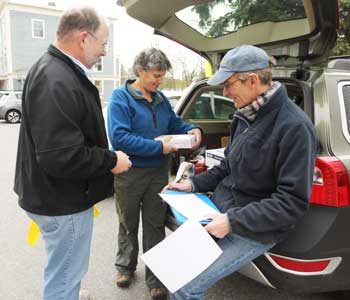
From left: Chip deVillafranca gets bags from two of the event organizers, Libby Levison and Brian McClain. (Photo by Lisa Aciukewicz)
After 292 bags of roadside litter were collected by volunteers and brought to the Transfer Station by Harvard’s Department of Public Works, the citizen organizers of the townwide cleanup—Libby Levison, Brian McClain, and Paul Green—were above all pleased by the event’s success. “We are overwhelmed with the turnout and support from citizens and the DPW, and we will do this again next year,” Levison said, speaking for herself, McClain, and Green. At the same time, organizers agreed that the cleanup’s high yield of so-called nips, beer cans, and liquor and wine bottles was troubling. “The preponderance of alcohol containers was disturbing on two counts: the drinking and driving, and the apparent feeling of liberty by those drivers to litter,” said Green.
Miniature alcoholic-beverage bottles (known as “nips” or “airplane bottles”), beer cans, pint liquor bottles, and even full-size alcoholic-beverage bottles were found all over town, but especially on roads used as shortcuts by commuters, such as Poor Farm, Littleton, Pinnacle, Stow, East Bare Hill, and Littleton County roads. Fast-food trash, soda and energy drink containers, and cigarette butts were also frequently found on these same roads, while snack wrappers and water bottles were more commonly found near playing fields. A few roads, including Scott, West Bare, Candleberry, and Barton, together generated only a few bags of litter. (See map below).
Unusual finds
Some of the more unusual finds included an inflatable outdoor Christmas snow globe in the swamp on Still River Road, urine-filled bottles on Stow, Shaker, and Old Mill roads, a fender on Gebo Lane, and a car hood on Woodchuck Hill Road. Ayer Road generated the greatest number of trash bags, while Still River Road was the runner-up. An actual dumping site, complete with computer monitors, carpeting, a recliner, and a grill, was discovered by volunteers in a Littleton Road gully.
With more than 200 people participating, including the Girl Scouts, the cleanup covered all the roads in town except Woodside and Bowers roads, and a portion of Mass. Ave. that will be cleaned by the state Department of Transportation. A separate cleanup of the town center was undertaken, as it is yearly, by the Harvard Cub Scouts.
Organizers say that next year’s cleanup may take place with town sponsorship but will carry on in any case. The high number of volunteers, McClain said, indicated to him a “pent-up demand” for a townwide cleanup. Under consideration for next year is the incorporation of recycling into the litter pickup, and perhaps even garlic mustard eradication, given that the invasive plant often grows roadside and is best pulled up in early spring.