In coming weeks, the Harvard Historical Society will present two events that relate to important periods in the town’s history: a walking tour of Historic Shaker Village later this month and a “living history” tour of the Town Center Cemetery by moonlight.
Harvard Shaker Village Walking Tour
On Sunday, May 22, the Historical Society will sponsor a walking tour of Harvard Shaker Village as part of Freedom’s Way Hidden Treasures 2016. From May 14 to May 22, many of the 45 communities within Freedom’s Way National Heritage Area will share a unique natural, cultural, or historic “treasure.” Harvard’s treasure this year is the village that was home to Harvard Shakers from 1782 to 1918. Tammy Alfano and Judy Warner will lead visitors through the village, stopping outside certain homes to tell stories the buildings hold. This family-friendly tour will meet at the Harvard Shaker Cemetery on South Shaker Road at 1:30 p.m. Visitors should bring umbrellas in the event of rain.
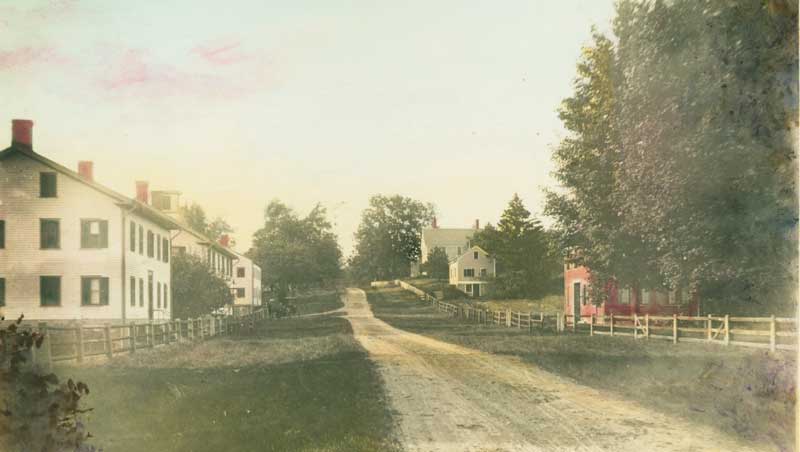
Shaker Village in 1908. (Painting by Eleanor Merrifield, courtesy of Harvard Historical Society)
Harvard is fortunate that the village did not meet with a fate similar to that of other Shaker communities in the Northeast and Ohio. Three were taken over by other religious orders; two others, including Shirley, had prisons built on grounds formerly theirs; and one was turned into a state mental institution. Another two are museum restorations. Four communities, including Harvard’s, were sold into private hands, with one subsequently torn down for suburban housing.
Harvard Shakers held on longer than those of many other settlements. However, by the late 1800s, faced with declining population and with economic and social changes, the community was no longer able to sustain itself. The Shakers had to consolidate, lease, and even sell off many of their buildings. By 1918 only 10 Shakers remained in the village, and they had no choice but to allow the Central Ministry to negotiate the sale of land and buildings. Fiske Warren, a wealthy social reformer already living in Harvard, seized the opportunity to expand his single-tax experiment. According to the deed, he paid $60,000 for 623 acres of land and buildings, mostly in and around the village.
A move to Prospect Hill
Warren sold the 1794 Shaker office building to Clara Endicott Sears, who had it moved to Prospect Hill, where it became the second building at Fruitlands Museum and the first Shaker museum in the country. The rest of the buildings were to be an expansion of Warren’s Utopian community. But upon his death, Warren’s heirs discontinued the experiment, and the Shaker Village buildings began to be bought as private residences.
In retrospect, it is perhaps fortunate that Warren’s Utopian experiment failed, as it is doubtful the buildings would have received the same kind of care under rental agreements as they did through private ownership. In reflecting on a village tour two years ago, Alfano stated, “Each generation of ownership has brought a new era of stewardship and varied and unique approaches to the balance of function and preservation.”
In the 1960s the town began to make formal preservation efforts in order to help the village homeowners. In 1972 citizens voted to create a historic district of the Church Family and Holy Hill areas, and two years later the district was expanded to include the South Family buildings on South Shaker Road. Aided by state and federal funding, the Harvard Conservation Commission saved 103 acres of land in the area of Holy Hill from development and embarked on a restoration project. The site was dedicated in May 1976. The late Erhart Muller, who had long lived in the village and was a leader in promoting the project, spoke at the ceremony and reflected the sentiments of many in saying, “This land was sacred to the Shakers, and it is sacred to us.”
Moonlight Cemetery Tour
On Saturday, June 4, at 7:30 p.m. the Harvard Historical Society will host a living history tour by moonlight (with some electrical help) in the Center Cemetery. The event is a fundraiser to support public programming and maintenance of the society’s buildings and collections.

Judy Warner portrays Julia Willard Haynes Keyes, the widow of a Civil War soldier from Still River.
(Photo by Lisa Aciukewicz)
Upon the town’s incorporation in 1732, the first requirement was to “settle a learned and orthodox minister” and to “erect an house for the public worship of God.” When these matters were settled, the next order of business was to set aside land for a burying ground, parade ground, and town pound. Four acres of the original 30-acre Meetinghouse Plain purchased from Lancaster were set aside for the burial ground, approved by a vote of townspeople in March 1736. In 1766 the town voted to build a wall around the burying ground, with each man either paying 15 pounds for the wall or constructing a section of it for his share.
Among Harvard residents buried in the old burying ground are some whose lives were directly or indirectly affected by the Civil War, and they will tell their stories to visitors on June 4. Sarah Sprague will read letters that her 22-year-old brother sent from the war front. A wartime nurse, Florence Burt, will share her experiences and talk about medical practices of the time. Listeners will feel the tension as Arathusa Sawyer Atherton recounts how as a child she watched her father participate in the Underground Railroad. Battle-tested Forrest Dadmun will reminisce about wartime camaraderie among soldiers and about the meals they shared. There will be others, too, who will tell their stories of a tragic period in our country’s history.
Reservations encouraged
The first cemetery tour will begin at 7:30 p.m. at the Still River Road entrance to the cemetery, and subsequent tours will start every 10 minutes or so. To help with logistics, the Historical Society is asking people to make reservations by emailing curator@harvardhistory.org or by leaving a message at 978-772-6772. The cost is $10 for members and $15 for nonmembers with a reservation and $5 more on each price the evening of the event. Should there be heavy rain that night, the tour will be held on Sunday, June 5, at 7:30 p.m.
Carlene Phillips is a member of the Harvard Historical Society.