
The town of Harvard was not innocent of the blight of slavery during its colonial years, but there are signs that the practice was tempered by a moral compunction and gestures toward liberation.
According to Henry Nourse (“History of Harvard”), there are numerous citations of the existence of slavery in the town records. In 1735 “Zilpah a Negro Servant Girl to Eleazar Robbins” was baptized. An item of Justinian Holden’s 1756 inventory was “One Negro,” valued at 25 pounds, and Joseph Hutchins in his will of 1757 bequeathed his slave Neptune to a kinsman. In 1773 “A negro man belonging to Elijah Houghton of advanced years” died. The census of 1765 reported 12 black inhabitants, the majority of whom were probably “servants for life,” a euphemism for slavery.

A stop on the Underground Railroad: Deacon Reuben Whitcomb’s pillared mansion and barn that stood on the corner of the Common across the street to the east of the General Store. (Photos courtesy of the Harvard Historical Society)
Colonel Henry Bromfield, one of Harvard’s wealthiest and most influential residents, had a servant, Othello, who, Nourse says, “was an eccentric character, as well known in Harvard as his master.” He is said to have “shadowed the majestic red-cloaked colonel by about 10 feet as they walked down the avenue of elms to meeting” (Larry Anderson, quoted in Robert Anderson’s “Directions of a Town”).
Moral compunctions
There is evidence that along with the practice of human ownership came a moral compunction against it. Thomas Wheeler, having owned a man-servant named Caesar for some time, drew up a document in 1744 in which he granted that “my servant is to have his time and be freed of me and under me” after serving him faithfully for four more years.
Another slave owner, Ephraim Robbins, met with disapproval from the town for his treatment of Cyprian. After years of service, “Sip” became unable to perform his duties, and Robbins gave him the dubious reward of freedom. For a while Sip lived outdoors in Shabikin (now Devens) until the town was called on to provide for his care. Robbins was notified to appear at town meeting to apologize for abandonment of property. The demand for public apology suggests that there was moral indignity on the part of the town, not just outrage at the expenditure.
Protests were made outside the boundaries of town as well. In 1774 Joseph Wheeler, who had served as Harvard’s minister for nine years and was then a squire active in town affairs, presented a letter to the First Provincial Congress. In it he suggested that while legislators were attempting to save themselves from slavery to a British ministry, they should “also take into consideration the state and circumstances of the Negro Slaves in the Province.”
In 1783 Massachusetts courts outlawed slavery. Colonel Bromfield gave Othello his freedom, but he chose to remain with the family and to serve the colonel, and Bromfield became increasingly dependent on him for companionship in his retirement years. At Othello’s death, two years before that of Colonel Bromfield, “the faithful friend of Henry Bromfield” was buried in the northwest corner of the center cemetery.
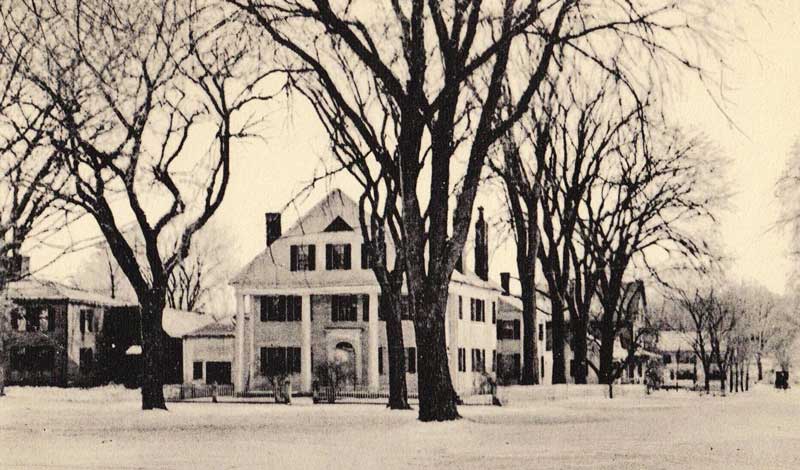
The Reverend Whitcomb’s house burned in 1917, along with the house to its east.
The abolition movement gained steadily in Harvard during the 30 years leading up to the Civil War. In 1837 some support for slavery resulted in a ban on abolitionist lectures at the 1828 Town Hall. Two years later, lectures opposing slavery were allowed. Finally at a meeting of the Congregational Church in 1843, the reverend declared slavery a “physical, social, political, and moral sin of vast magnitude” and drew up resolutions for publication in The Boston Recorder. In the presidential election of 1860, 75 percent of Harvard voted for Lincoln.
The Underground Railroad
While there is no authentic documentation, oral tradition has it that Harvard was an active stop on the Underground Railroad. Many slaves escaping from the South stowed away on cargo ships bringing cotton to Boston. Sympathetic crews sent them west to Leominster and to the railroad in Fitchburg on the route to Canada. Because of the great fear of capture and the penalties for both runaway and abettor, slaves were transported only short distances at a time, so there were several stops between major stations.
According to an article by Jack Cushman quoted in “Directions of a Town,” two of Harvard’s main agents of the “railroad” were Tower Hazard, a member of one of Harvard’s oldest black families, and Reuben Whitcomb, a deacon of the Harvard Congregational Church, who lived on the Common. A story goes that Whitcomb set out late one night for the Hazard home on East Bare Hill to beg Tower’s help in comforting two terrified runaways. “I have two fugitives at my house who are so frightened and homesick for their own people that you must come and give them courage and faith to go on with their journey, for I must take them on tonight,” he is said to have pleaded. Tower was understandably empathetic to the runaways, but if he were caught, his punishment would be far harsher than that of a white man. But he was undaunted, and he helped that night as he must have done on so many other occasions. Tower’s granddaughter, Carrie Blue, recalled in 1975, “My mother had been told as a child never to speak of the late nights when there would be a knock at the door … and her father would go out for a while and then return with no explanation.”
In a paper presented at a Harvard Historical Society meeting in 1937, member Estelle Hersey recalled that her grandfather, John Dodge, Congregational minister from 1854 to 1866, was a leader in abolitionist activities. He lived at 1 Elm Street. Her father told her that when he was a boy in his teens, “mysterious happenings always took place on stormy nights. A wagon load of something would arrive, and his father would unload part of it in the barn. Later he, himself, would be given a bag or basket of food and told to climb the ladder in the barn and creep along to the eaves. Sometimes he would drop the bundle in a hole; other times a hand shot out and took it.”
Visitors on the recent Historical Society house tour may have seen the purported secret passage for runaways through a small door in a bedroom of the house at 12 Oak Hill Road.
Jared Wollaston, current owner of 1 Elm Street, attests that the barn shows clear evidence of likely hiding places for runaways.
Other acknowledged stops on the railroad are Captain Thaddeus Pollard’s mansion in Still River, three homes on East Bare Hill, and one on Brown Road. Given the high level of secrecy needed to avoid capture by the anti-abolitionists, there are doubtless many other homes on the Underground Railroad that will never be known.
For a thorough and excellent discussion of this topic, see “A Guide to the Black Freedom Trail in Harvard, Massachusetts,” written by resident Nancy Reifenstein, published in 1998 by Freedom’s Way Heritage Association.