I stood in my kitchen, contemplating the instructions I had been given. “Bring a little bread,” she had said. But what did that mean? The end slice of a loaf of Pepperidge Farm? Or a new, crusty loaf homemade for the occasion? Socially, I had never before had to determine what kind of bread to bring to a ceremony honoring an apple tree, and I was at a bit of a loss.
Hedging my bets, I tucked a hard heel of bakery bread in one pocket and a few soft oatmeal slices in the other. I patted my pockets through my coat, feeling reassured that whether the priority was freshness or whole-grain artistry, I was prepared. It was time to get my wassail on.

Wassail participants offer a toast to the apple trees at Old Frog Pond.
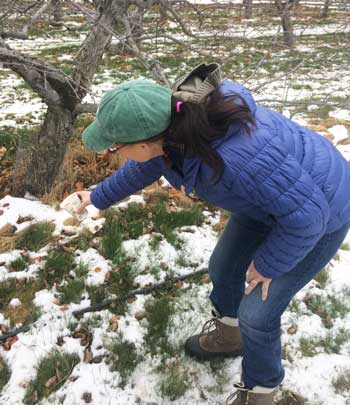
Paige O’Brien pours cider at the base of an apple tree. (Photos by Lucinda Bowen)
The tradition of wassailing is an ancient English one, thought to predate the Norman conquest of England in 1066. The website www.historic-uk.com describes wassailing as “the blessing of fruit trees, involving drinking and singing to the health of the trees in the hope that they will provide a bountiful harvest.”
But what does this have to do with the bread stuffed in my pockets? Though wassailing ceremonies vary from orchard to orchard, there are some core elements these traditions share. One of these is the toasting of the tree: Bits of toast are dipped in cider and hung in the apple tree’s branches, though whether the bread is put out for the birds or for favorable spirits depends on your interpretation.
Other elements of a standard wassail include pouring cider around the trees as a libation and making some kind of joyful ruckus by banging sticks and pots, chanting, or singing. There’s also an emotional component to the wassailing ritual. In his essay “Wild Apples,” Thoreau reminded his readers to not neglect this, writing, “It would be well, if we accepted these gifts with more joy and gratitude, and did not think it enough to simply put a fresh load of compost about the tree.”
A bountiful harvest
For local orchardist Linda Hoffman, owner of the organic apple orchard at Old Frog Pond Farm, it was her sense of celebration and gratitude for this year’s bountiful harvest that created the desire to hold the farm’s first-ever wassailing ceremony. “The apples were amazing last summer,” she remarked to the small but merry crowd of poets and friends gathered around a single Golden Delicious tree in her orchard last Saturday, a comment that elicited shouts of agreement and at least one voice calling back, “They still are! I had one yesterday!”

Linda Hoffman reads a poem during the wassailing ceremony.
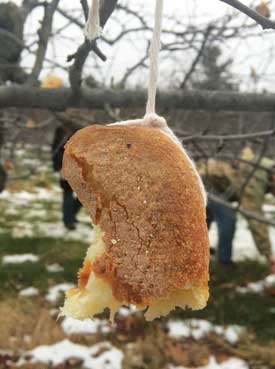
A cider-soaked piece of bread hangs from an apple tree.
Most in the crowd, like me, had not wassailed before and were curious. A voice called out to ask, “Why did you pick this tree?” Hoffman described walking through the orchard with Kevin, the farm’s cider-maker, to choose the perfect spot. “This tree yelled the loudest—pick me, pick me!” she explained, and the group laughed. Hoffman believes the trees benefit from our celebration. She described how, in preparing for this ceremony, she learned about the oldest known fruit tree in the country, which stands nearby in Danvers and is known as the Endicott Pear Tree. “Scientists don’t know why [after nearly 400 years] it is still giving fruit,” she explained. “They gave a few reasons, like it gets a lot of light, or because it is isolated in its own space and not shaded by other trees. And then finally the last idea was, maybe because it is so celebrated. So you can understand why all the trees here wanted us to celebrate them. This is this year’s tree.”
Like other events held at Old Frog Pond Farm, Hoffman planned the wassailing ceremony around her values of art, agriculture, and community. After a familiar opening song (“Here we come a-wassailing among the leaves so green …”) and a blessing, cold and hot cider made from Old Frog Pond apples was poured into cups and held up to toast the trees, while bits of bread hanging from string were dipped in a bowl of cider and woven into the branches. Ten poets read from original pieces composed for the occasion, and after each poem, the crowd shook tambourines and noisemakers in appreciation. After singing a final song together, participants poured libations of cider around the trunks of the trees and then met in Hoffman’s farmhouse for bowls of hot soup, leaving the wassailed tree with bits of bread hanging from its bare branches like crunchy holiday ornaments.
Gestures of gratitude
In the farmhouse, as in the orchard, the mood was festive. My worry about bringing the right kind of bread had evaporated in the warm atmosphere of celebration. This was a group of people joyfully making space for gestures of gratitude, in a season often marked by grim resolutions to cut back, give up, and wrestle those wild, difficult parts of ourselves—our weight, our finances, our flossing habits—finally under control. After the abundance of another holiday season, I too had resolved to run more, eat less, and floss regularly, but as Thoreau might say, these goals were me merely putting another load of compost around the tree. There was a better choice still before me. Wassailing reminds us that the proper response to abundance is not anxiety, but gratitude. It is the gratitude that changes us, as in the song, from beggars to neighbors, who take the time to raise a glass and say—or sing—thank you, and invite others around us to do the same.