
After what has been a mild winter so far, this week’s crust of snow and biting wind have come just in time to help set the scene for Friday’s Warner Free Lecture, a talk that will focus on a group of British explorers who disappeared mysteriously more than 160 years ago. On Jan. 22 at 7:30 p.m. in Volunteers Hall, scholar and Arctic historian Dr. Russell Potter will deliver a talk on the Franklin expedition, in which 129 men, including Franklin himself, perished in the Arctic ice while they were searching for the Northwest Passage.

Sir John Franklin. (Courtesy illustration)
The Northwest Passage, which connects the Atlantic and Pacific oceans through the Arctic Ocean, was sought for hundreds of years as a possible trade route from Europe to Asia. According to the “Nova” documentary “Arctic Passage,” which Potter appears in, this route was one of the last unexplored waterways in the world and was considered extremely perilous when Sir John Franklin led his 1845 expedition to chart the unmapped areas of the Arctic coast. Franklin was confident he would discover the route: His expedition contained new technologies, including a ship powered by a locomotive engine and thousands of pounds of canned food, which many believed would make their success a certainty. Instead, the ships HMS Terror and HMS Erebus became icebound near King William Island in the Canadian Arctic, and after years of enduring hardships such as scurvy, starvation, lead poisoning, isolation, and exposure, all 129 men died.
‘How could that be?’
Potter, who is a professor of English and media studies at Rhode Island College, first encountered the story of the Franklin expedition in the early 1990s when he heard a folk ballad, “Lord Franklin,” performed by Mícheál Ó Domhnaill. As a musician and music historian, hearing the folk song’s haunting lyrics and melody offered him a personal entry point into this tale of adventure, endurance, and failure. Potter followed his curiosity to the library, where what he learned both intrigued and horrified him. “Usually you hear a ballad and it’s exaggerated for purposes of drama,” he said in a phone interview this week. “But here was this story and it was even more dramatic than the song indicated. The story turned out to be quite amazing. You realize there were 128 other people, and these two enormous ships, and not a single one of them returned home. How could that be? How could you be trapped for three years in the ice and not get out?”

Dr. Russell Potter, speaker at the Jan. 22 Warner Free Lecture. (Courtesy photo)
Potter was working as a medievalist at Colby College when he first learned about the Franklin expedition, and his interest in the story changed the focus of his professional research and writing. The library at Colby held many original editions of search narratives from people trying to find the lost Franklin expedition, and Potter’s work as a medievalist had prepared him well to read and transcribe the tight Victorian handwriting that characterized so many of these early records. And he was used to expanding on limited findings. “In the Middle Ages, 80 percent of what had been written has been lost. It’s similar with Franklin. You have a certain amount of evidence, but you have to extrapolate from that. My curiosity about the Middle Ages prepared me well for those aspects of the Franklin story.”
Potter has made a career of his passion for the Arctic. In 2007 he published his book “Arctic Spectacles: The Frozen North in Visual Culture, 1818–1885,” and he has maintained a blog called Visions of the North since 2009, which is concerned with a variety of “polar issues, in particular news and notes about the ongoing mystery of the lost Arctic expedition of Sir John Franklin.” A few years ago, while working with “Nova” on the “Arctic Passage” documentary, Potter traveled to Beechey Island to visit the graves of three of Franklin’s crew.
A crisis slow to unfold
“Pilgrimage is the right word for it,” he said. “It’s a very moving thing, to stand in the footsteps of people you’ve thought about so much, at such a remote location. It’s such a physically beautiful place up there. It’s strange to think of dying in such a beautiful place.”
Potter’s travels to the Arctic gave him real empathy for the members of the crew who disembarked from their ice-locked ships and attempted to escape their fate by traveling hundreds of miles on foot across King William Island to find civilization, a trip they were mentally and physically unprepared to make. “They didn’t have any plan except for going through on the ships. This was almost like outer space for the Victorians. They couldn’t fathom they would be able to exist outside of the ships for any length of time. They were blinded by their assumptions about how it was going to go. It is a tragic thing.”
One of the most striking things about the Franklin story to Potter is how slowly it unfolded for Franklin and his crew. “Nowadays if we have a disaster, that disaster might take 10 seconds. Even Titanic took only two hours, 15 minutes to sink. With Franklin, you’ve got three years. Who knows, maybe if they had realized sooner how bad things were going to be, they might have had a better chance. By the time they abandon the ships there’s been considerable loss of life. Their sleds were extremely heavy. They didn’t know how to hunt. The only guns they brought with them were for shooting birds, because that was considered good sport. By the time they were forced into the contingency plan, it was foredoomed. It does tell you something about the British worldview at the height of the empire. They were filled with the sense they were the most advanced people, so what could possibly go wrong?”
And yet it is also the endurance and grit displayed by the crew that Potter finds so compelling about the Franklin expedition, a story he calls cathartic. “Oddly enough, it’s a refreshing story to plunge into; it draws you into the company of these people and their struggles, and it makes our struggles of everyday life not so bad. I think that’s why the story can be redemptive. They fought and lost their individual battles for survival, but they endured and did the best they could for a very long time, under most difficult circumstances. The fact that they failed made it even nobler. Maybe what’s really important isn’t success, but how you conduct yourself.”
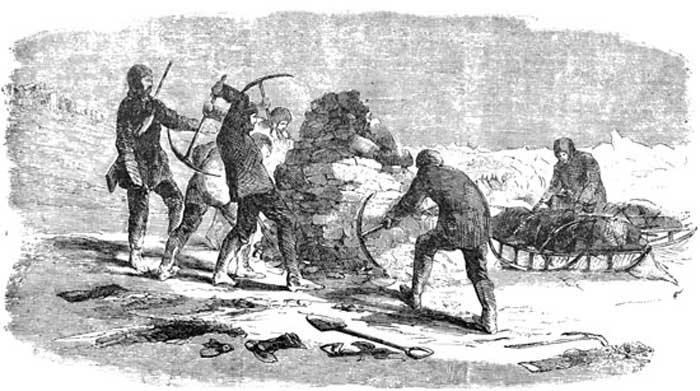
Discovery of cairn at Point Victory by a crew in search of the Franklin expedition. (Courtesy illustration)