
We are not alone. Town halls all over New England were designed to have a large meeting space where all the residents of the town could come together to vote, socialize, and discuss vital town issues. These days, annual town meetings are about the only event where large numbers of residents need to gather in one place at the same time, and few towns have a town hall meeting room large enough to accommodate their town meetings. Communities all around us have faced the same question Harvard faces: What to do with a big, open, high-ceilinged town hall room? This week the Press looks at the solutions some of our neighboring towns have come up with.
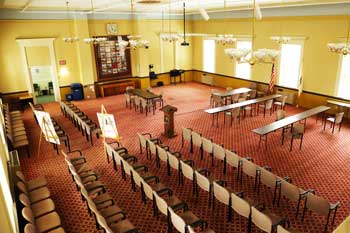
Acton Town Hall as seen from the balcony. The room is almost identical in size to Harvard’s upper Town Hall. Noise is muffled by carpeting, and meetings are held at an appropriately sized table or in the room at large.(Photos by Lisa Aciukewicz)(Photos by Lisa Aciukewicz)

Placement of the projector screen (above) in Acton’s town hall allows
viewing from anywhere in the room. Like Harvard, Acton sacrificed its
stage during renovation in the 1980s.

A movable divider sets off meeting space in Ayer’s large meeting room.

Lancaster’s Town Hall meeting space is the least altered with its stage intact; however, the Board of Selectmen no longer meet in this space, but instead meet in a more modern space in the community center, which is wired for cable TV.
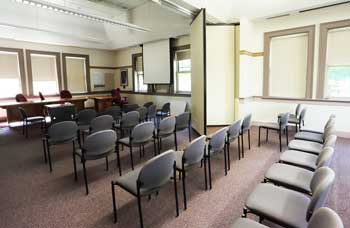
Shirley boasts the newest, most modern meeting space in its 16-year-old Town Hall. A divider (in center of photo above) can be pulled if two meeting spaces are needed at the same time; however, noise can be a problem according to the town clerk.
Acton: Harvard’s
Town Hall twin
Although additions have been made to the back and sides of the building, the original Acton Town Hall could be a twin of Harvard’s in terms of size, shape, and age. The second-floor meeting room is practically identical to Harvard’s: about 2,400 square feet of meeting space with a 20-foot-high flat ceiling and a balcony used for storage. Acton’s meeting room is configured to hold a 100-person meeting on one side and smaller meetings or working groups at long tables on the other side, with no divider between the two spaces. A remote-controlled drop-down screen in one corner is viewable from almost anywhere in the room. According to municipal properties employee Chris West, there are no problems with acoustics, thanks largely to the carpeted floor. The room is available for any town board, committee, or department meeting, and West said the room is used on average five times a week, including for the twice-monthly Board of Selectmen meetings.
Cavernous rooms
in Ayer and Lancaster
In Ayer and Lancaster, the town hall meeting rooms have 30- to 40-foot-high ceilings with angles or curves as well as hardwood floors. Ayer’s meeting room, dubbed the Great Hall, is nearly twice the size of Harvard’s, and echoes in that room prevent it from being used for board and committee meetings, according to Town Clerk Assistant Laurie Fritz. On the town’s Facebook site, announcements of meetings held in Great Hall have prompted comments such as this one: “I love going to meetings at the Great Hall; I only wish it was easier to understand what is being said.” The room is available to rent, which happens about five times a year, according to the assistant to the town administrator, Carly Antonellis. “It’s not a big moneymaker for us,” she added.
In Lancaster, Town Administrator Ryan McNutt said that he holds meetings in the large town hall room, but, he added, “I have a loud voice.” His assistant, Kathy Rocco, acknowledged that the acoustics in the room are bad, mostly due to echoes; and most town boards and committees, including the selectmen, meet either in the school behind the Community Center or in the library. The Community Center itself is undergoing renovation, and McNutt said the fate of a large meeting room planned for that space is now uncertain.
Mixed use in Groton …
Upstairs in the Groton Town Hall, the large meeting room was split into land-use board offices and a meeting room that holds about 60 people. Walls around the offices and meeting room don’t go all the way to the ceiling, so some of the open feel of the room has been preserved, according to Housing Coordinator Fran Stanley, who works in one of the offices on the floor. Although sound does carry over the walls, Stanley said, most meetings are held at night, so noise from the daytime offices is not an issue. But, she added, if a meeting is held in the daytime, employees have been asked to be quiet. Echoes are not a problem in either the office space or the meeting room, but there are no large expanses of open space.
… and in Lunenburg
Lunenburg’s upper Town Hall is split into a meeting room and a few offices. The offices are contained in modules much like Harvard Town Administrator Tim Bragan’s former office in Town Hall, with false ceilings for privacy. The original tin ceiling is still in place, and, according to employees in the building, there are no problems with acoustics, but the office modules take up one-third of the space.
Shirley: A modern space with a divider
Many of Shirley’s boards and committees meet in a large meeting room in the Municipal Building, which was built in 1999. The room holds about 70 people, and a room divider that folds away into the wall can be pulled out to divide the room in half for simultaneous meetings. Town Clerk Amy McDougall said the divider is rarely used. “If there were two relatively quiet meetings going on, it would be fine,” she said, “but if one of the meetings was contentious, it wouldn’t work.”

CLICK IMAGE TO ENLARGE