As a historian of 19th-century American art and culture, Hina Hirayama has spent her career studying both the individuals and the institutions that helped shape New England into the educational, artistic, and cultural center we know today. Her work reveals her own abiding curiosity about the region’s fascination with Japan during the last two decades of the 19th century. This Friday, Hirayama will visit Harvard’s Volunteers Hall to open the 2015–2016 Warner Free Lecture series. There she will speak about one influential New Englander in particular: Edward Sylvester Morse, the very first Warner series lecturer 125 years ago.
Morse, who was born in Maine, was an established zoologist and curator who specialized in marine shells. However, it was his travels to Japan and his extensive collection of Japanese household artifacts now displayed at the Museum of Fine Arts and the Peabody Essex Museum that earned him his invitation to speak in the Warner series. “Though he was still working as a scientist, [after his travels, Morse] gave a lot of lectures about Japan and became this widely known, beloved Japan expert,” Hirayama said in an interview last week. “He told people about this distant and mysterious country that not many had been to.”
A fascination with Japan
At the time of Morse’s 1891 Warner lecture, New England was caught up in a fascination with Japan, an intrigue that coincided with Japan’s fairly new posture of openness with the West. Morse had first traveled to Japan in 1877 to study shells, but he quickly became well known for his contributions beyond marine zoology. While traveling on a train outside Tokyo at the very beginning of his visit, Morse noticed a layer of shells next to the tracks and correctly identified it as a shell mound, otherwise known as a kitchen midden: a prehistoric refuse heap containing shells, bones, and cultural materials that offered valuable insights into the lives of ancient people. Morse returned to the site with an excavation team and discovered what is now known as the Omori shell mound, unlocking thousands of years of forgotten history and, according to Hirayama, establishing himself as the father of Japanese archaeology.

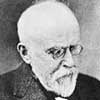
Edward Sylvester Morse. (Courtesy photo)
“He was a very likeable fellow who happened to be at the right place at the right time,” laughed Hirayama. His “luck” soon led to his appointment as the founding professor of the science department of the university in Tokyo. “This was when Japan was just opening to the West, and the government was eager to catch up,” she explained. “They were importing western scientists to teach science and technology to the Japanese students. He became a very popular professor. He was one of the first people who introduced Darwin’s theory of evolution to Japan. He helped raise the first generation of Japanese scientists.”
Though Hirayama studied Morse’s writings and lectures in depth during her dissertation research, her interest in his work goes beyond scholarly interest to a “particular personal affection.”
A life lived like a movie
Hirayama, who has lived and worked in New England for 27 years, was born in Tokyo. “I have known his name ever since I was in grade school. Everyone [in Japan] learns about him in history class,” she said. “It was really kind of moving to visit all the places Morse had something to do with [in Boston] when I came here for the first time. I do feel a particular closeness to him, having come from a different culture myself, and liking living here so much. Morse did kind of the same thing in reverse in Japan 130 years ago.”
While she feels a personal affinity for Morse, in many ways it is the differences between the kind of life he lived as a scientist in the late 19th century and the kind of life scholars live now that has captured Hirayama’s curiosity.
“His life feels like a movie. He was at the right place at the right time so many times,” she said. “He was an exceptional man, exceptionally lucky. He lived in a time before there was too much specialization of knowledge. He was able to comment on shells and beaches, as well as prehistoric shell mounds, and Japanese art, and Mars, and arrow relief. That kind of public intellectual figure is not that common now. Fields are so divided and knowledge is so vast. Nobody can talk about such wide-ranging things.”
Hirayama sounded almost wistful as she spoke about the “great affinity” between academic knowledge and popular culture that was possible during Morse’s lifetime. One indication of that affinity, she said, was the Warner Free Lecture series. “Their idea was that anybody could come and talk to specialists and learn and have a conversation. That kind of tradition was very strong in 19th-century New England. Maybe it still is,” she mused.
Time for an updated biography
As one of the specialists in the conversation, Hirayama is excited about giving the season-opening lecture on Friday, a talk she has titled “Edward Sylvester Morse: A Man of Many Worlds.” The lecture offers Hirayama an opportunity to speak as an expert at an important transition point in her career. Just last month she left her position as associate curator of paintings and sculpture at the Boston Athenaeum to take on a visiting fellow role at Harvard University and a new project.
“For me it’s very lucky because it comes at the early stages of my own new project, which is to write an updated biography of Morse. The only biography published about him was published in 1940, a long time ago. I’m hoping to publish an updated research biography about the man.”
When asked what she’s looking forward to about her new role as biographer, Hirayama’s voice had a hint of a smile. “[Morse] was part of my initial intellectual interest, but I haven’t been able to focus on that for a long time. There will be a lot of archival research and writing opportunities, which I really do enjoy so much. And,” she added, revealing once again that particular personal affection, “it is a topic that is close to my heart.”