Summer is a great time to observe birds. Most of them have settled into their nesting territories and are busy either building nests or feeding their young.
If you observe birds that have food in their beaks (rather than just eating), chances are they are feeding young. When you watch these birds for a few minutes, you should be able to follow the bird to its nesting area.
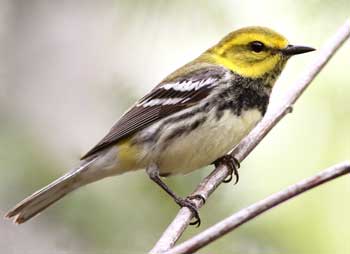
Black-throated green warbler. (Courtesy photo)
The early nesters around the farm are phoebes, bluebirds, and red-winged blackbirds. The bluebirds nesting close to our vegetable garden actively hawk for bugs around the vegetables. The ones nesting in the fields use their nest box as a perch and dive down into the long grass after bugs to feed their young. Occasionally we will see one of the parents exiting the nest box with a white mass in its mouth. This is a fecal sack, which is removed from the nest to keep it clean.
Most of our barn swallows have fledged. We had six or seven active nests. The other day I had 15 young perched on the dead ash tree just outside my barn office window. The swallows do a great job of keeping our farm relatively free of mosquitoes. Most evenings we dine on our terrace bug-free, with the swallows swooping around us and actively hunting over the pond and fields.

Bicknell’s thrush. (Courtesy photo)
Other nesting birds around the farm are the great crested flycatcher, cardinal, cedar waxwing, American robin, red-winged blackbird, Baltimore oriole, and mourning dove. The feeder has been very active and noisy lately, with young nuthatches, chickadees, and titmice all screaming for their parents to feed them.
Woodpeckers, sparrows, goldfinches
The woodpeckers are bringing their young to the tree where we hang suet. They take mouthfuls and feed them to their young.They are joined by the nuthatches and titmice.
A pair of song sparrows made a nest not 3 feet off the ground in a Calycanthus shrub in one of Pam’s perennial gardens. It was easy to see the eggs and then the young darting around the perennial bed. I enjoy their musical songs every day.
Several goldfinches, one of the last nesting birds of the season, have been gleaning seedpods from a variety of flowers in Pam’s garden, seeming to particularly relish the lavender seeds.
We had a pair of pine siskins around in late May, when they have usually returned north to nest. I was hoping they would stick around and nest, which would have been unusual for the area, according to Wayne Petersen of Mass. Audubon, but I have not seen them through the summer.
Although great blue herons do not nest on our property, we have one that is an almost daily visitor to our pond. One morning I looked out and saw one struggling to eat something dangling from its bill. I thought maybe it was a large bullfrog, but upon looking through my binoculars, I discovered it was trying to eat a chipmunk. It took several minutes for the heron to kill it and position it to be swallowed. I hoped he would hang around, as we have several other chipmunks that play havoc around here and would provide good food for him.

Mississippi kite. (Courtesy photo)
In July Pam and I took a day trip to Cannon Mountain in New Hampshire with Dave Larson from Joppa Flats Audubon in Newburyport. The quest was to find the rare Bicknell’s thrush, which has one of the most restricted breeding and wintering ranges of any North American bird. At least one active nest on Cannon was reported. Bicknell’s thrush breeds in montane fir and spruce forests at 3,500 feet or more and is usually associated with recently disturbed areas. It has an unusual mating system. Both males and females mate with different partners. Each nest has young from different males, and males may have young in several nests. More than one male feeds most nests. Males do not hold strict territories, and several different males may sing from the same area within one hour.
Heard but not seen
Unfortunately, when we got to the top of Cannon, the cloud cover limited the distance we could see. There was little chance of seeing the bird, but it was possible to hear the call or song if it was around. After walking a couple hundred feet up one trail, we paused to listen. We repeated this several times, and finally Dave heard the song. It came from down low on a very steep slope beside the trail. There was absolutely no chance of seeing it, so we retreated to the lodge and ate our lunch.
After lunch it had cleared a little, so we backtracked and after a few hundred feet, there was our bird right on the trail about 80 feet away. Luckily I was toward the front of the group and got a good look at it before it hopped off into the brush on the side of the trail. We did hear several more calls, and a lot of the group did see one flying. I was happy to have made this rare sighting—a new bird for me!
As we walked back down the trail, there was the usual mix of bird sounds, but one attracted Pam. It was a chickadee, and Pam realized it was not the chickadee we were used to seeing. This one turned out to be a boreal chickadee, similar to the Carolina chickadee we see around here but with a brown head and flanks. This is another bird that breeds and lives year-round in the northern forests of New England and Canada.
A walk in Waldoboro
On the drive back to Newburyport, Dave took a detour to Newmarket, New Hampshire, where he wanted to show us another unusual bird for this area. Parking on a small dead-end street, Dave pointed up to a nest in a tall tree. After a few minutes of looking through our binoculars, it became clear that we were looking at a nesting Mississippi kite. This bird winters in central South America and flies north to breed on the Great Plains and areas along the Gulf Coast. It is rare for it to nest this far north, but maybe they are part of the trend of birds migrating farther north as the climate changes.
In mid-July while visiting our friend Bonnie in Maine, I read in her local paper about a bird walk sponsored by the Medomak Valley Land Trust. Knowing that we would see nesting birds that we might not see in Harvard, we thought it would be fun to join them. We met early one morning at the Beau Chemin Preservation Farm in Waldoboro (www.beaucheminfarm.com/BeauCheminPreservationFarm.com/Welcome.html).
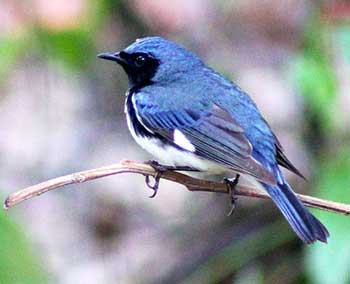
Black-throated blue warbler. (Courtesy photo)
The farm includes pastures, berry and vegetable fields, woods, wetlands, and a pond, and it is home to many nesting birds. One of the fields, although hayed, is managed for bobolinks. This bird is declining because of habitat loss. They nest exclusively in the long grass of open fields, and if the hay is cut too early, the nest and nestlings are destroyed. Aware of this, some farmers either leave their cutting to later or leave some of the grass in large enough patches that the birds can still nest. Wayne, the farmer at Beau Chemin, takes great pains to manage his farm to encourage nesting birds of all sorts, and because of that we saw five or so bobolinks in his hayfield.
A small trail leads from his pastures down through the woods to Havener Pond. Taking this trail, we heard several species of birds. We got good looks at both black-throated blue and black-throated green warblers. Luckily we saw them within several feet of each other, enabling us to see the distinctive plumage of each one. The blue is a small blue-gray warbler with a distinctive white patch (handkerchief) on its wings. The green has a distinctive black breast with greenish cap and back, yellow face, and two white wing bars.
A song at the edge of the woods
John, the leader, immediately knew their calls, but even after listening to them for several minutes, I am not sure I would recall the song. In the woods we also heard ovenbirds and hermit thrushes.
Walking back along the edge of the woods, John heard an indigo bunting; although there were several other species of birds flitting around in the edge, we did not immediately see the bunting. We followed the song out to the road and finally found him sitting on a bare branch about 20 feet up, singing his heart out—a fitting end to a good morning of birding.
David Durrant lives with his wife, Pamela, on East Bare Hill Road at Micheldever Farm, where they watch birds—their own peacocks, their own chickens, and visiting wild birds.