We were booked into a sleeper train compartment for the trip back to Delhi as an alternative to a tortuous six- to eight-hour road trip. A sleeper car promised more space than the packed-to-the-roof general rail car. This was an experience in itself and provided us an opportunity to meet several Indian families with young children traveling up to 18 hours by train to join their families for Diwali, the Indian festival of lights.
The most avid birder in the group spotted a few birds from the train for our daily checklist. It was dark when we got to Delhi, so no new birds that day; however, we were greeted by a city celebrating with fireworks going off and oil lamps lighting the walkways.
We were up early the next day for the long drive to Bhimtal in the Kumaon district of the western Himalayas.
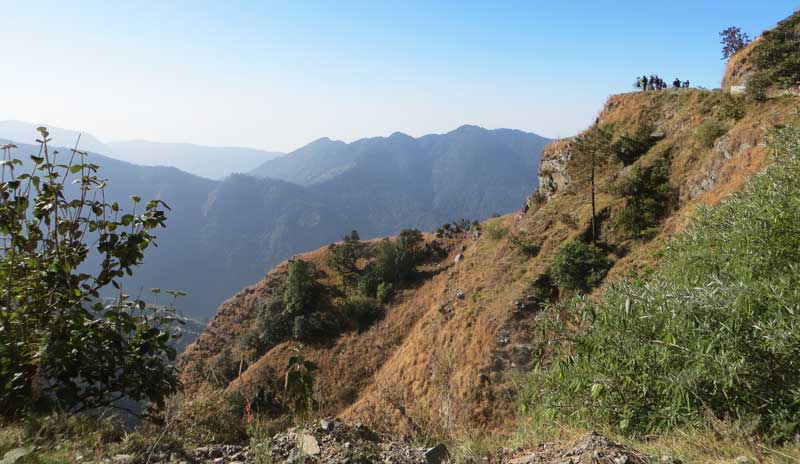
View of Cheer Point, home to the elusive cheer pheasant. (Photos by David Durrant)
The change in elevation and vegetation promised us a range of new species. Our first outing was a mountain stream where we saw white-capped water redstart, plumbeous water redstart, and four species of forktails jumping among the rocks and rushing water. While watching the stream, we heard a large bird flying in and recognized it as a red-billed blue magpie, a large, long-tailed bird. Upon reflection we realized that this was the same bird in an 1897 watercolor David’s grandmother gave him, which is hanging in our dining room. It had always been a mystery as he knew it wasn’t an English bird. We continued along the road and through small farming villages where we saw flycatchers, niltava, minias, and a variety of tits, a species David was familiar with from his youth in England. Hitting a different area the next day gave us a look at some of the most colorful birds of the trip, including ruby throats, bush-robins, minla, barbets, and lots of bulbuls and babblers.
Ancestor of domestic chicken
Farther down the road we spotted our first junglefowl, clucking nearby under a bush. This was one species we were keen to see, as they are thought to be the ancestor of the domestic chicken. We were surprised to see how similar the male was to our Rhode Island red rooster. Another species that was fun to see was the peafowl (peacock and peahen) in their native habitat, having raised them on the farm for years.
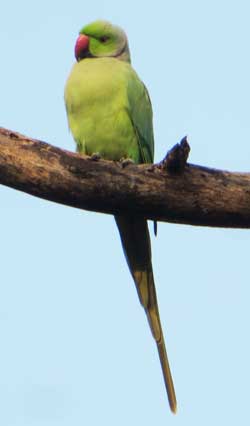
A rose-ringed parakeet watches from its perch.
Then it was off to Pangot farther up the foothills. There we would look for two birds that are hard to find: the kalij pheasant and the globally threatened cheer pheasant. These two birds were “target” birds, along with the ibisbill and the wallcreeper, for the three English birders in our group. Driving through the forest, we were lucky to have a couple of kalij pheasants cross in front of us, but the cheer pheasant proved to be a lot harder to find. There is only one area where this pheasant is reliably found, so off we drove for two hours of continuous hairpin bends through the mountains to Cheer Point. This spot was a pull-off on the road with a near vertical drop off one side. Lockesh, our guide, warned us to stay away from the edge, informing us that last year two birders fell to their death at that same spot. Needless to say, we did most of the viewing from across the road with the cliff to our backs! The bird was indeed as elusive as we had been told, so after about an hour of scanning the rocky hillside we wound our way back down the mountain to look for other birds.
The wide-open skies with mountains providing many updrafts gave us excellent viewing for a variety of raptors. Among the notable birds were a steppe eagle and a mountain hawk-eagle, two of the seven species of eagles we would see. In total we saw more than 20 raptor species throughout the trip.
Like a cotton ball on its head
It was fun to see several rose-ringed parakeets as we were walking on a mountain path down to a stream. Later on, our guide heard the raucous call of the white-crested laughing-thrush. We had keyed in on this bird while reviewing the field guide prior to the trip because of its dramatic plumage—it looks as though it has a large cotton ball on its head. After a minute or two, a flock of six of these birds appeared flitting through the dense woodlands. They were indeed as dramatic as the field guide showed.
From various points of the winding road, we had great views of the Himalayas stretching through India, Tibet, and China beyond, one of the reasons Pam had so much wanted to make this trip.
Part 3 next: Jim Corbett Park and the end of our incredible journey.
Pamela and David Durrant live on East Bare Hill Road at Micheldever Farm, where they watch birds, enjoy their own chickens, Rascal (their guard donkey), & Miss Piggy (their old ewe) both of whom love neighborhood kids to bring them carrots.