
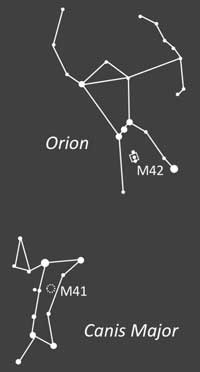
Orion and Canis Major. (Illustration by Marc Vilain)
Last month, I left you fellow sky walkers with a promissory note. While offering advice on how to spend your astronomy-related budget (surely all households have an astronomy-related budget), I had promised to start the new year by discussing where to point all those new telescopes and binoculars. This week, we direct our optics to one of the great sights of the winter skies, and one that practically does not require a star chart.
Early in the new year, by the time the dinner dishes are done, Orion has already climbed well into the evening sky, where he is readily identified by the three stars making up his belt. Perhaps you have noticed that below this stellar threesome is a smaller, angled line of stars that can be seen as a sword dangling from Orion’s belt. I could stop this column right here and just tell you: Go look at the middle one of these three stars.
A nebula beckons
Even binoculars of modest achievement will reveal this middle star to be in fact a nebulous shape floating in space. The visual transformation from dot to nebula is stunning. The Orion Nebula—for that is what you are seeing—is also known more grandly as the Great Nebula in Orion, or more prosaically as M42, an appellation acknowledging that words do not do this sight justice. Case in point: the photo below, captured by an instrument of not-so-modest achievement (the Hubble Space Telescope).
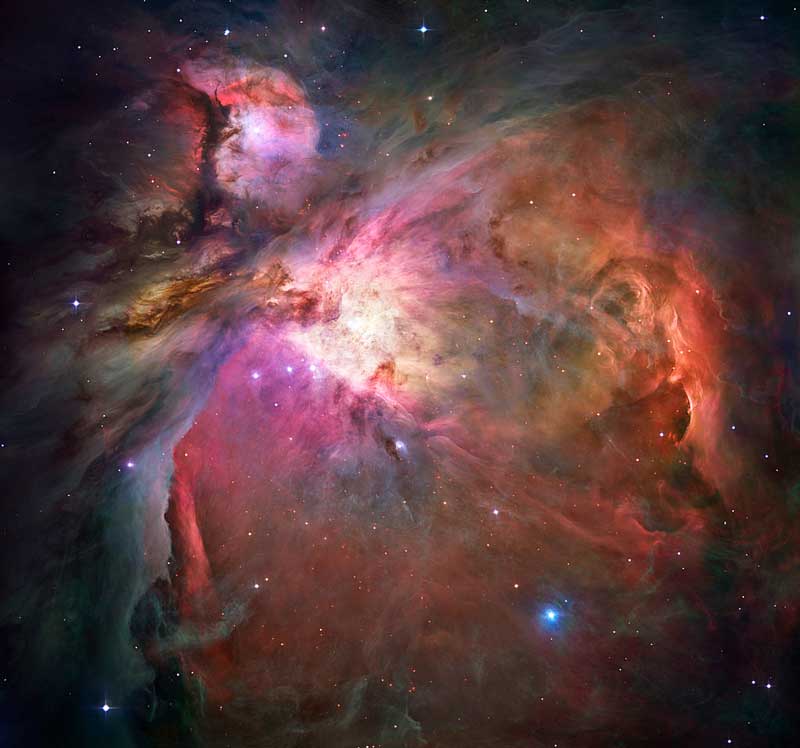
The full glory of the Orion Nebula. (Photo credit: NASA, ESA, M. Robberto, Space Telescope Science Institute/ESA, and the Hubble Space Telescope Orion Treasury Project Team)
The good news for households whose astronomy budget does not encompass a Hubble or two is that the view of the Great Nebula from earthbound binoculars and small telescopes is thrilling in its own right.
My 10×50 binoculars hold the entire sword in the middle of the field of view. An obvious nebulosity surrounds what appears as a pair of bright stars, and looks for all the world like a diminutive owl face. Binoculars will unmask the other two elements of the sword as pairs of neighboring stars as well.
This is one sky walk, however, for which you will want the company of a telescope. If you have not yet availed yourself of the library’s StarBlast lend-a-scope, this would be the time to do so. With greater light capture and magnification, even small telescopes like the StarBlast bring forth much more of the nebula’s fine detail. The brightest part of the nebula comes across to me as shaped like a bird with wings stretched wide. Surrounding the bird is a fainter wispy veil that shows up well in my household’s 8-inch reflector (this may be harder to see with the StarBlast).
A stellar nursery
Telescopic magnification also reveals one of the eyes in the owl face to be four bright stars arranged as a sloppy trapezoid rectangle, the Trapezium. Here the scientific story starts to get interesting. A nebula such as the one in Orion is essentially a large thin cloud of hydrogen gas and dust, adrift in space. In the case of M42, large means 24 light years across, with the nebula itself some 1,200 light years away. The nebula glows as a result of being bombarded by high-energy radiation emitted by highly active young stars, including those in the Trapezium. When the gas is excited by this radiation, it in turn emits light in the visible spectrum, producing the glow we see from Earth.
Another effect of all this radiation is to cause shock waves within the nebula. If you’ve ever seen windblown waves pile into each other as they near shore, a similar kind of piling up takes place within the nebula. Regions of gas compress into clumps, and, one thing leading to another, these clumps collapse over time under the effect of their mutual gravitational attraction. The physics of it all is that these hydrogen clumps heat up as they become denser, and once a certain heat and density threshold is crossed, the clumped hydrogen begins to fuse. Fusion is the nuclear engine that powers a star: When these clumps start to fuse, a star is born.
How many stars have been born this way in the Orion Nebula? To see beyond all that glowing gas and dust requires looking in the infrared part of the spectrum. The following pair of Hubble images show the Trapezium region as imaged in visible light (first photo below) and infrared light (second photo). The infrared image parts the curtains onto an open cluster of many young stars; the current astronomical census counts 700 or so.


The Trapezium, as imaged with visible (left) and infrared (right) light, shown here in false color. (Photo credit: NASA, Harvard-Smithsonian Center for Astrophysics, Steward Observatory, Rice University)
For all this star-birth activity, nebulas such as M42 can be transient artifacts—transient on an astronomical scale, that is. Eventually, all that radiation acts as a stellar wind and effectively blows the nebula into farther and more diffuse space. What’s left behind is a cluster of stars that were all born around the same time. One such cluster lies near Orion and is marked in the star chart as M41, in Canis Major. It is easily seen in binoculars by first locating the star pair slightly to its west. A telescope will provide a much brighter view; try finding M41 with the StarBlast.
Fellow sky walkers, if you have read this far without rushing out with your binoculars or telescope, you have stronger will than I. Do take the time to go out on some moonless night this month, and make or renew acquaintance with this stellar nursery and its neighbor M41. Linger on Orion’s sword; the whole length of it is filled with tantalizing detail. And if the night is dark enough, take your eyes off the eyepiece: You may even see the beckoning faint glow of the Great Nebula with your own naked eyes.
Marc Vilain lives in the center of town. As an amateur stargazer, he has been walking the night sky for more than 20 years.