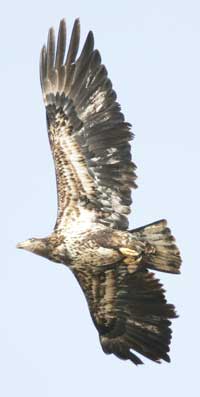
A juvenile bald eagle. (Courtesy photo)
As I began to write this column April 10, we still had ice on our pond. By this time last year we already had mergansers and wood ducks, but with no large amount of open water yet present, I suppose we will have to wait a few more days. As expected, this wonderfully snowy winter seems to have delayed the return of most summer migrants. We did have a single red-winged blackbird return last week, a full week later than last year.
I received reports from several people of activity at Oxbow and Bolton Flats. We went to Oxbow April 8 and found swamp sparrows and song sparrows in their usual spots but no wood ducks on what open water there was, although we did see a pair flying over. A lonely pair of tree swallows flew over the swamp beside the turnpike, and we saw a group of hooded and common mergansers cruising around on the far side. We walked down to the beaver lodge on the turnpike but did not see or hear much more—a fairly quiet morning.
A day for wellies
We then drove over to Bolton Flats. The entrance to the parking lots was flooded so we did not enter. I did not want to risk driving Pam’s Subaru through the deep water; besides, we were not wearing our wellies.
The next day we returned to Bolton Flats in my truck, which has higher ground (water) clearance than Pam’s car, and we were able to park in the lot. We still needed our wellies; water continued to rush over the trail, and the cornfield was partially flooded.
The first bird we heard—and then saw—was a flicker, and we have since had one on our suet feeder at the farm. Scanning the cornfields before proceeding down the trail, we saw the inevitable flock of Canada geese and farther out toward the hoop houses spotted hundreds of green-winged teal. In front of the geese we could see several killdeer. Killdeer like to nest in stony fields. Ten years ago killdeer nested in our area, but a reworking of adjacent pastures eliminated the habitat. This is one species that is on the decline, probably because the open fields they prefer have been gobbled up by development, although some do take advantage of the flat gravel roofs of large commercial buildings.
_300w.jpg)
A juvenile bald eagle. (Courtesy photo)
Walking down the trail, we encountered a fellow birder who spotted an osprey hovering overhead. I am not sure there were any fish in the flooded field, though I suppose some could have come in with the floodwaters from the river. Anyway, he probably decided it was slim pickings and so drifted over to the Still River between the trail and Still River Road.
While we were watching the osprey, a red-tailed hawk flew into view, and then way over the Nashua River we saw a large raptor in flight. It had the distinctive flat wings of a bald eagle, but it lacked the white head and tail we are familiar with. After consulting our field guides, we determined that it was probably a first-year juvenile, identified by the white pattern on its underwing coverts on a body almost totally brown.
Almost impossible to see
While looking for sparrows in the hedgerow farther down the trail, we flushed several snipe. Being ground feeders, these birds are almost impossible to see because their beautifully camouflaged feathers blend so well with the ground and corn stubble. It is only when they take flight that you realize you were probably looking right at them!
Well, this had been a much more productive outing. And to top it off, as we were returning to the truck, I saw my first warbler of the season: a pine warbler.
Back here on the farm I have now cleaned out all my nest boxes for the nesting season. The bluebirds were already exploring the different houses, the cardinals were singing to defend their territory, and our resident Carolina wren was checking out his nesting places. The phoebe was back and the red-tailed hawk was actively hunting our fields. I am awaiting the return of our barn swallows as, to me, that heralds spring. The tree swallows returned to our farm on April 19, which was a week later than last year.
With ice gone, ducks arrive
A few days after I started writing this article, the ice finally left the pond. The next day we had mallards, wood ducks, and hooded merganser on the pond, and, to our surprise, a river otter appeared. I initially thought it was a beaver that we had spotted a day earlier, but its length, distinctive tail, and movement in the water caught my eye. I sat down by the pond and watched it for more than an hour.
David Durrant lives with his wife, Pamela, on East Bare Hill Road at Micheldever Farm, where they watch birds—their own peacocks, chickens, and visiting wild birds.