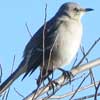

A red-tailed hawk scans the Ryan Land for prey. (Photos by David Durrant)
As in years past, Pam and I participated in the Christmas bird count (the 115th) sponsored by the National Audubon Society. My section is bounded roughly by Mill Road, Prospect Hill Road, and Bare Hill Pond between Willow Road and Willard Lane. Other people in town have different sections making up a Groton-Oxbow circle.
Conservation lands
provide habitat
The count is an excellent opportunity to get out birding and to enjoy our conservation lands. We are lucky our town has great conservation areas thanks to the Harvard Conservation Commission, Harvard Conservation Trust, and the many private landowners who over the years have conserved their land rather than selling it for house lots. During our three-hour walk on a sunny Sunday morning, we had all the trails to ourselves and the birds, not meeting one other person.
The day started with bright sun and temperatures in the high 30s—a pleasant change from last year, when it was cold, wet, and miserable. We started at the Ryan Land to pick up the trail for Prospect Hill. As is usually the case, watching from the parking lot produced a good number of bird sightings. Scanning the tree line above Lisa and Tom Aciukewicz’s house, we immediately saw a large red-tailed hawk with its white breast illuminated by the early morning sun. In the tree line between the field and the dump, we saw chickadees, tufted titmice, a single robin, numerous blue jays, and a pair of cardinals.
Bluebirds, goldfinches, woodpeckers, and more
Edges of woods and fields are good places to find a variety of birds, and that day was no exception. Walking down to the swampy area below the field, we saw nine eastern bluebirds. They were warming themselves high up in a tree, catching the first sun rays and making occasional forays down to the scrub along the edge to feast on bittersweet berries. This prolific, invasive plant is destructive in its habit of taking over woodlands, but the birds sure do like it, no doubt spreading the seeds all over and perpetuating the problem. Along this edge we also saw goldfinches, juncos, downy woodpeckers, and a pair of cardinals, the male’s bright red plumage fairly glowing in the bright sun.
The woods were very quiet. We did hear and find a white-breasted nuthatch, which disappeared into a hole in a snag while we were watching it. I made a mental note to come back in the spring and check for nesting activity. As the woods were fairly quiet, we decided not to go up to Deans Hill but took the trail off to the right that eventually brought us to the corner of Old Shirley and Depot roads. We saw more woodpeckers, including a red-bellied one, the ever-present chickadees, and a couple more nuthatches. We were hoping to see a brown creeper that we had seen in that area before, but no luck.
Walking down Mill Road toward the ball field, we saw three birds high up in an oak tree. We discussed what they might be, as they were quite high up and we did not have a spotting scope. After several minutes of checking field marks and field guides, we agreed they were a male purple finch and two females. In a tangle of Rosa rugosa at the foot of this tree, a song sparrow was flitting around.
No ducks, but many geese
Next we drove along Under Pin Hill Road hoping to see some ducks in the open water of Bowers Brook. Finding none, we continued to Willow Road to check out the pond, but it was frozen and drawn down, so no ducks. The quiet solitude was broken by the hum of equipment near the dam pumping water out of the pond in what I consider an assault on its environmental integrity.
To wrap up our morning we decided to check out the fields on Still River Depot Road. Walking down the hill we counted 20 Canada geese flying over Devens. We then saw what is probably the resident red-tailed hawk hunting over the fields, several goldfinches flying around, downy woodpeckers, and—perched up nicely—a northern mockingbird.
We called it quits after logging 17 species of birds, a big improvement over last year’s count when we saw only two—a robin and a crow.
Even more species at the feeder
A feeder count is also taken at this time of year. Although our farm is just outside the official circle, I decided to make a list anyway to prove my hypothesis that the best birding is usually at home.
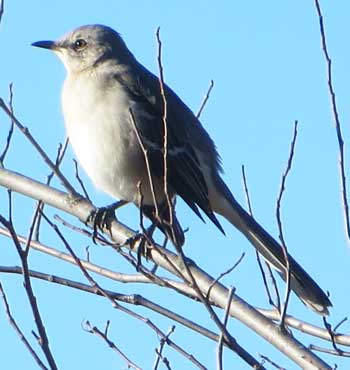
A northern mockingbird.
The most exciting sighting was a visit by approximately 30 pine siskins. We have an old stone water trough that I keep free of ice with a small pump and heater. The trough was lined with siskins quenching their thirst. They were here for a few hours and then all took off. Pine siskins are one of the species that occasionally irrupts from Canada. This is apparently one of those years as flocks of siskins have periodically reappeared at our feeder and trough.
Other finches we have had at our house were the house finch, purple finch, goldfinch, and English sparrow. The usual downy, hairy, and red-bellied woodpeckers were enjoying our suet.
Although it is not a feeder bird, I count the red-tailed hawk because he feeds in our pastures.
Ground birds around the feeder included mourning doves, cardinals, white-throated sparrows, song sparrows, a tree sparrow, blue jays, and lots of dark-eyed juncos, prompting Pam to call the feeder Junco Junction.
The Carolina wren has been a consistent presence with its melodious call that reminds me of the tropics. Chickadees, tufted titmice, and white-breasted nuthatches rounded out the count along with the bluebirds that are here daily.
I counted 20 species. It’s too bad our farm is not within the count circle because next year I would have been tempted to sit at my window and count—but then I would not have the invigorating walk through some of our beautiful, preserved land in the company of friends who share my passion.
David Durrant lives with his wife, Pamela, on East Bare Hill Road at Micheldever Farm, where they watch birds—their own peacocks, chickens, and visiting wild birds.