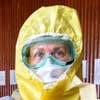
Dr. Patty Ruze was almost home, ready to hug her family and sleep in her own bed. As a volunteer with Partners In Health, a Boston-based organization responding to the Ebola outbreak, Ruze had just spent six weeks caring for patients in the Port Loko Government Hospital and Maforki Ebola Treatment Unit in Sierra Leone. But when she landed at Newark, Ruze’s body temperature was elevated. She waited for assessment while her flight to Boston took off without her.
Diverted
“They have a list of names from the flight who are coming from West Africa, and they divert you,” Ruze explained over coffee at the General Store last weekend. Over and over, different officials wearing personal protective equipment asked her the same series of questions: Have you taken care of anyone with Ebola? Have you worked in a hospital? Have you touched any dead bodies? Ruze repeatedly answered their questions: “Yes,” “Yes,” and “Yes.” Steadily her temperature rose, from 99.9 to 100.5. “It took hours. They were trying to decide what to do with me. I didn’t have a high fever and I didn’t have any significant symptoms for Ebola.” And yet because she was considered borderline, with a low-grade fever and mild intestinal upset, officials were not willing to risk letting Ruze complete her trip home.
“In America we talk about rights, we talk about what we deserve and what we are entitled to. It’s very difficult to talk about this without sounding self-righteous or judgmental … our entitlement is problematic.”
—Patty Ruze
Eventually, they decided that her symptoms required her to enter quarantine at the nearby university hospital. That decision did not sit well with Ruze, who was certain she did not have Ebola. “I was jet-lagged, I was a little sick, and I was desperately ready to get home. I was doing pushups and jumping jacks, trying to show them how strong I was.” Even so, she had to submit to the protocols for quarantine. The feeling of powerlessness was a challenge. “You pace yourself. You land in the airport after being on the flight forever, and then find out that what you promised yourself is not going to happen. Physically and emotionally that was a difficult experience.”
The quarantine cell
Ruze was transported by ambulance to the isolation unit at the nearby hospital, an experience she found surreal. “They closed off the highway. We were escorted by eight police cars, like there was some incredible crisis. I was sitting up in the ambulance looking out the back, and I felt like waving because it was so ridiculous,” she said.
Once she arrived at the hospital, she was set up in an isolation tent, which she called her “quarantine cell.” None of her personal items could go in with her, and even written materials were against protocol. The only diversion she had was a TV showing episodes from “The Jerry Springer Show.”
“It was so extreme to go from Port Loko Government Hospital to this tent where I had three staff members taking care of me at all times.” In Port Loko, Ruze had just spent the last six weeks “scrounging” for essentials like bedsheets for her patients, many of whom would die from curable diseases because the hospital lacked diagnostic equipment and proper medications. In quarantine, however, she “had a beautiful hospital bed. People were always asking what they could do to help me. At the end of my quarantine, they had spent $27,000 on just me. It was an excessive contrast. I felt guilty. I felt so undeserving of all that care, and I also didn’t want it.
“I felt like people were telling me I was in quarantine because I could be sick. People were saying, ‘We’re going to take good care of you.’ But I didn’t have any exposures. The chances of having anything were negligible. The reality of it wasn’t about providing care or needing care, it was about the perception of protection for the public. Nobody wanted to have a breach at the airport, not after they’ve spent so much money on this.”
Reverse culture shock
Sitting in her isolation tent, Ruze experienced what she described as “reverse culture shock.” A seasoned Peace Corps volunteer who has traveled extensively, she expected some difficulty adjusting on her return home, but this was much worse than she expected. “I was really surprised. I was not equipped to handle being locked in a tent to watch Jerry Springer.” The personal injury commercials were especially jarring. “‘Get the compensation you deserve,’ they said. It was disgusting, so out of place. I couldn’t stop thinking about the children who couldn’t get the compensation they deserved.”
A particular child stayed on her mind. Four days before she left Port Loko, Ruze had lost a 12-year-old patient named Alimamy, who died of complications from malnutrition and abdominal tuberculosis. He had no family nearby to care for him or bring him meals when the hospital decided it no longer needed to provide food for patients. So Ruze had cared for him for weeks, stealing hard-boiled eggs for him from the Port Loko tent city. The day before he died, Ruze had told him that she still thought he could get better. “I told him he was going to get up and play like other little kids,” she said, her eyes still full of grief. When she was settled in quarantine, Ruze was given a snack package of hard-boiled eggs to eat, the equivalent of three days worth of smuggled food for Alimamy. Looking at the eggs nestled in their disposable plastic packaging, Ruze ached with injustice. She couldn’t eat the eggs. Instead, she broke down and wept.
“In America, we talk about rights, we talk about what we deserve and what we are entitled to,” she said. “It’s very difficult to talk about this without sounding self-righteous or judgmental, but from a cultural perspective, compared to the rest of the world, our entitlement is problematic.” She shook her head and continued, “If only we could shift just a little bit over there.”
Shifting balance
Shifting resources can get tricky. On the one hand, American volunteers like Ruze offer lifesaving resources to communities that have been ravaged by disaster. However, losing access to volunteer resources before the community becomes self-sufficient can be incredibly challenging. Just after Ruze returned to Harvard, one of her colleagues in Sierra Leone started showing signs of real illness. When her colleague was diagnosed with Ebola, Partners In Health became concerned for staff safety and started pulling volunteers. The impact on the Port Loko Government Hospital was immediate. “We had worked so hard to upgrade patient care, to get more supplies, to have adequate staffing, to mentor the local staff and partner with them. And then everybody left. That may be the saddest thing for me in the whole story. After all we put into upgrading the hospital, I think the level of care really plummeted,” said Ruze.
‘A newer understanding of my vulnerabilities’
As for Ruze, after a few days in quarantine, she tested negative for Ebola and was released. She completed a three-week voluntary self-surveillance at home in Harvard, and she is now back to her regular activities. Self-monitoring for three weeks gave her time to reflect, go for walks with friends, and do some light home repairs. Her experiences in Sierra Leone made her “more grateful and appreciative of the opportunities my family and I have. I have a newer understanding of my vulnerabilities. I’m reminded how fortunate we are. I go in to work at the [Concord MCI] prison, and I say, ‘Wow, this place is lovely.’”
Ruze finished her volunteer experience in Sierra Leone—and even her quarantine—with her values of service and compassion still intact. “I do feel like this experience has empowered me to respond to whatever the next Ebola is, whatever natural disaster. My family did great; my work was fine. It wasn’t that difficult or disruptive for everyone else.” She paused, sipped her coffee, smiled, and said, “I’m ready to go again, someplace else, to the next crisis.”