Jon Schoenberg crosses the finish line in a previous marathon.
(Courtesy photos)

Deana Boucher and Joyce Maiore pose before a training run.
On Patriots Day, eight runners from Harvard will join the 30,000 athletes competing in the 2015 Boston Marathon. Deana Boucher, Sue George, Paul Kavanagh, Ted MacMahon, Joyce Maiore, Terry Reagan, Jon Schoenberg, and Scott Sloan will compete in the 119th running of the world’s oldest annually contested marathon.
Crossing it off the bucket list
For George, Maiore, and Sloan, 2015 represents their first experience running the Boston Marathon, and for George, it is her first marathon, period. A lifelong athlete, George said in an email that she’s been thinking about running the Boston Marathon for many years. “Every year when the marathon season would roll back around, I would regret not running. Last April, I decided my time had come,” George said. George has a passion for running, but before she began her training for Boston, “I don’t think I had ever run more than 10 miles,” she said. Now she has run two half
marathons and is excited about her upcoming 26.2-mile effort.
Three of the remaining runners have quite a bit of experience competing in Boston. Reagan has raced for multiple consecutive years; the Boston Athletic Association (BAA) archive records show this to be his 11th time running Boston since 2001. For Schoenberg, this year will mark his 23rd Boston Marathon. Schoenberg ran it 12 years in a row, from 1989 through 2000, then had to skip a few years due to military and family duties. He has run Boston every year since 2006.
MacMahon ran his first Boston Marathon in 1991 and “never looked back. I have only missed a few Bostons since then,” he said in an email. This year he is running Boston just for fun. “It is not very often that you can soak up the energy of a few million people cajoling you to accomplish something. That is part of the magic of the Boston Marathon and what puts it on the bucket list of so many runners from around the world.”
Qualifying to run
Like more than 80 percent of the runners in the 2015 marathon, MacMahon and Schoenberg qualified to run Boston based on their finish times in previous marathon races. Both completed last year’s marathon in less than 3 hours, which is significantly faster than their qualifying standards of 3 hours, 25 minutes and 3 hours, 30 minutes, respectively. Meeting the qualifying standard allowed them the privilege of submitting their registration application but did not guarantee either of these speedsters a spot on the starting line. All qualifying applications are reviewed against each other, with only the quickest runners selected to participate. The qualifying field is extremely competitive. The BAA reports this year that nearly 2,000 applicants whose times qualified them for the race were not accepted because of limitations on the size of the field.
Supporting worthy causes
More than 6,000 runners, including six of Harvard’s racers, gained entry to the 2015 race through the BAA’s Official Charity Program and John Hancock’s Marathon Non-Profit Program. These programs allow runners to join fundraising teams for approved nonprofits, earning them the chance to wear one of the organizations’ official bib numbers in the race. This year Boucher is running for the Charlestown Boys and Girls Club; Maiore is running for the Joe Andruzzi Foundation; George is running for the Boston Children’s Hospital; and Sloan is running for the Francis Ouimet Scholarship Fund (see sidebar above). The BAA reports that 27 charities are expected to raise more than $13 million this year.
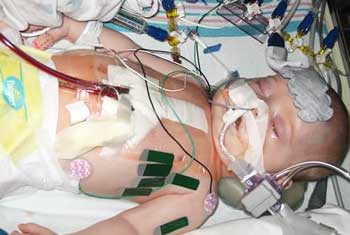
Keelan Peterson’s heart defect was initially considered untreatable. (Courtesy photo)
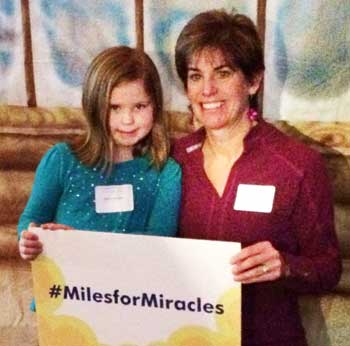
Now 7-year-old Keelan poses with Sue George, who will run the marathon on her behalf.
Maiore applied to just one team, the Joe Andruzzi Foundation team. “I wanted it to have personal meaning,” she said in an interview. After losing her mother to ovarian cancer, Maiore was moved by the Andruzzi Foundation’s mission to provide financial and emotional support to patients and families living with cancer. “My biggest question was how much of the money raised goes to patients. The standard is 75 percent, and they give 80 percent. They have beaten the standard for how much money goes back to patients.”
Maiore’s experience training with her team has been exceptionally positive. She has attended many team events and has appreciated the personal interest the Andruzzi family has taken in supporting the runners. “Every Saturday they are along the training course providing aid. For [a team of] only 20 runners, they are doing all this.”
George’s fundraising experience has also been profoundly personal. As part of her experience on the Boston Children’s Hospital team, she was assigned a patient partner, a 7-year-old girl named Keelan Peterson, who is living with a complex heart defect that was originally thought to be untreatable. Meeting Keelan and her family has meant a lot to George. “It makes fundraising much more personal, to hear her story. Children’s Hospital saved her life.”
Finding the motivation to run
For some runners, the way they selected which charity to run for is related to why they are running the marathon at all. Sloan wanted to run Boston to honor his late father-in-law, longtime Harvard resident Bob Mitchell of Pinnacle Road, who passed away last September. Sloan is running for the Francis Ouimet Scholarship Fund, which provides need-based college scholarships to students working at golf courses in Massachusetts. “My father-in-law was a big golfer and a caddy back in his day. I chose this organization because I wanted to honor him,” Sloan said in a phone interview.

Ted MacMahon. (Courtesy photo)
When a runner brings this kind of personal motivation to the race, “it’s emotional,” said Sloan. “There’s my father-in-law—I’m running for him. I’m running for my two young boys, who I’d like to show that goals can actually be met if you work for them. Fathers and sons is a strong theme for me.” Sloan has enjoyed sharing his training with his family, which provides important support for him as he prepares to run Boston for the first time. “They’ve seen me come home late at night and grind out an hour on the treadmill from 12 to 1 a.m. or get up in the early morning and do it. The kids are quietly rooting for me, helping nudge me along and get up for training sessions. My wife has been a real sport about managing some of the aftermath. Handling the laundry has been really challenging,” he said, laughing.
Feeling the local love
Support from friends and family has been a consistent key to training success for each of this year’s runners. Maiore, who has raised more than $8,000 for the Joe Andruzzi Foundation, said, “The support of my husband and friends in Harvard has been overwhelming, really. Not just in donating money. Everyone I see is really supportive.”
Boucher also has felt the local love: “I’ve had a lot of support from people in town. I was really nervous about having to raise money for a charity. This year 75 percent of my money raised was from friends and neighbors in Harvard, which is crazy to me. They want to support me and cheer me on. It is a great feeling.”
(Read “Taking back the race: Deana Boucher’s journey“)
Runners have also supported each other as they prepare for the race. Maiore has enjoyed doing some training runs with Boucher. “[Deana] gets me out there; she pushes me.”
Weathering challenges
This winter, severe weather and more than 100 inches of snow made “getting out there” even more challenging. “I was one of the crazy people running on the snowy streets of Harvard,” said George. Boucher agreed, noting, “It is unsafe when the snow is too high to see around the corner. Though I did many of my runs outside, this winter my treadmill and I became BFFs.”
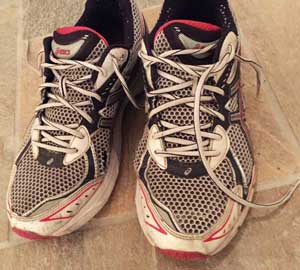
Scott Sloan’s soon-to-be retired sneakers. (Courtesy photo)
The relentless cold temperatures added another layer of difficulty. Maiore said, “Two weeks in a row, my long runs were 10 degrees. I had to talk to people on Facebook to find out what they were wearing: hats, gloves, thick insulated pants!”
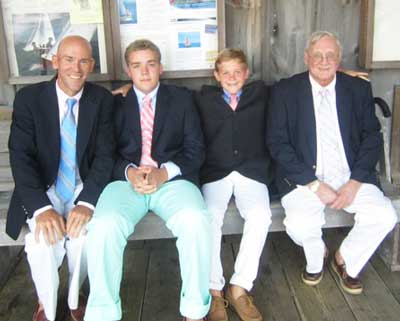
From left: Scott Sloan, Connor Sloan, Liam Sloan, and Bob Mitchell. (Courtesy photo)
MacMahon agreed that proper gear is a key to success. “Especially coming from a ski-racing background, I have the mind-set that there’s no such thing as bad weather, but rather there are poor choices in clothing. My mantra has been to bundle up, stop whining, and be grateful to have an able body and the luxury of exercising outdoors in a very peaceful part of the world.”
The extreme winter weather made the possibility of injury very real. Finding time to run when the roads were clear of snow was no easy task for Schoenberg. “There was one weekend where the snow was unavoidable. That 20-miler was like running in sand, and I ended up injured,” he said. He turned to Wellesley Therapeutic Services for help, where “Sean Crockett had me fixed up in one appointment, so I was able to get back to training.”
Local professionals help runners get ready
Training success often meant using local professionals to help prepare for the race. MacMahon “head[ed] to Swymfit at least once a week, [to] do some low-impact, deep-water running and exercises, using some techniques and routines that founder and owner Steve Victorson taught me.” Maiore received energy-restoring Reiki treatments by Harvard practitioner and friend Sue Ginouves, and Boucher visited Dr. Terry Anelons at Harvard Chiropractic for active release therapy, a soft tissue treatment designed for athletic injuries. Like many of the other runners, George used a running coach to help her prepare for the race. Her coach, Rick Muir, “not only helped me with my running, he’s inspired me. He’s the most inspirational person I’ve ever met,” she said.
Making an old-school effort
Not everyone preparing for the marathon seeks the guidance of the experts. “I went on the Internet, got the Beginners Marathon Plan. I have no idea if it’s even a credible marathon training plan, but it’s the one I found,” said Sloan. A self-described “purist,” Sloan is making what he calls an old-school effort to prepare for the race without a cadre of professionals supporting him. “No coaches, no chiropractors, no masseuses, nobody. Just a little fish oil. That’s my secret weapon. I am choosing to believe it is helping me manage my joint pain.”
A week before the race, Sloan admitted, “I’ve never run on the course, period. I’m going in cold turkey. I’m going old school. I’ve got shoes with holes in them. I’m gonna retire them at the end, maybe give them their own tombstone.” Like all the runners, Sloan is spending his last week before the race thinking a lot about how it might go. “All of us beginners wonder, are we going to make it, are we going to get our hearts broken? I’ve already trained to a place where I’m in a position to run. Whether I make it or not, it’s just gonna be me. It’s a retro approach. I like that.”
|
How to track Harvard’s runners on race day |
|||
|
Name |
Bib # |
Wave/Corral |
Wave Start Time |
|
Deana Boucher |
30052 |
4/7 |
11:15 a.m. |
|
Sue George |
25705 |
4/2 |
11:15 a.m. |
|
Paul T. Kavanaugh |
29454 |
4/6 |
11:15 a.m. |
|
Ted MacMahon |
2318 |
1/3 |
10:00 a.m. |
|
Joyce Maiore |
29977 |
4/6 |
11:15 a.m. |
|
Terry Reagan |
27443 |
4/4 |
11:15 a.m. |
|
Jon S. Schoenberg |
3660 |
1/4 |
10:00 a.m. |
|
Scott Sloan |
29805 |
4/6 |
11:15 a.m. |