

The Shakers marketed their spring water as having medicinal qualities, as this ad attests. (Courtesy photo) CLICK IMAGE TO ENLARGE
Filmmakers from the PBS series “New England Legends” came to Harvard last Sunday, April 18, to visit and film Shaker sites and ponder the connection between the Shakers’ longevity and their exceptionally pure water. Executive producer and series host Jeff Belanger and his crew toured the Shaker Village Historic District, the Shaker springhouse, and the Shaker cemetery, accompanied by Joe Theriault, chairman of the Harvard Historical Commission, Moe Dancause of the Harvard Historcal Commission and historian Roben Campbell.
Belanger’s interest was piqued several years ago by an 1880 advertisement he saw at Fruitlands Museum. The ad promoted the health-giving powers of Shaker Medicinal Spring Water, which supposedly cured everything from kidney stones to indigestion and “general debility.”
It was Shaker Elder Elijah Myrick, for whom Myrick Lane is named, who saw the spring water as a marketable commodity in an era that had few effective medicines. Harvard’s Shaker community had relied on that water supply since 1855, when the group built a mile-long aqueduct from the spring to a reservoir near the main Shaker settlement. The project cost $5,000, or about $1 million in unskilled labor costs today. (See www.boudillion.com/spring/shakerspringtwo.htm for information on the spring and the aqueduct by Daniel V. Boudillion.)
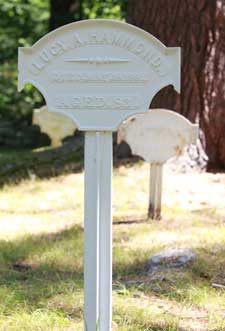
Many Shakers, like the one buried at this grave marker, lived into their 80s and 90s.
(Photo by LIsa Aciukewicz)
Overall, the Shakers did indeed enjoy better health than most people of the late 1800s. Dates on the Shaker cemetery markers indicate that the average lifespan for a Shaker was more than 70, Theriault said, well beyond the average for the general population of the time. And a surprising number of Shakers lived into their 80s and 90s.
In a phone conversation, Campbell noted that Shakers were much less likely to die of waterborne diseases such as typhus and cholera than were other residents of Harvard.
Although pure, uncontaminated water may have helped, it was certainly not the only factor in keeping Shakers alive and well longer than their contemporaries. “The Shakers lived very healthy lives and took good care of their seniors,” Theriault said in a phone interview.
Campbell agreed, saying that elderly Shakers remained active, productive members of the community. “They were well provided for, and they were honored for their long service and what they had given the community,” she said, adding that visitors often remarked on what a “jolly group” the oldest Shakers were.

From left: Moe Dancause of the Harvard HIstorical Commission and executive producer of “New England Legends” Jeff Belanger listen to Shaker historian Roben Campbell discuss the importance of bacteria-free water to longevity. (Photo by Lisa Aciukewicz)
Local legends and hauntings
Belanger also featured the Shaker spring water in his 2008 book, “Weird Massachusetts: Your Travel Guide to Massachusetts’ Local Legends and Best Kept Secrets.” Other places that Belanger describes in the guide include Ventfort Hall in Lenox and Glastenbury Mountain near Bennington, Vermont. Ventfort Hall is a Gilded Age mansion supposedly haunted by the couple who built it, their presence signaled by the scent of her perfume or his cigars. Glastenbury was the site of several unexplained disappearances in the late 1940s and 1950s.
Belanger often emphasizes the unusual and the paranormal in an effort to reach audiences that do not usually take an interest in history. The first episode of the “New England Legends” series, “The Spooky Berkshires,” was nominated for an Emmy in 2014.
“I think in some cases, a ghost is history demanding to be remembered,” Belanger said in that episode, speaking of the ghost of Anna Pease, a 10-year-old girl who died in 1829 and is buried on October Mountain in western Massachusetts.
In filming one scene in Harvard last weekend, Belanger strove for an eerie atmosphere by putting a video camera inside the springhouse, so that an unseen hand could open the door with a ghostly creak. This episode on Harvard’s Shakers and their spring is expected to air sometime next fall on PBS stations in Worcester and Springfield, as well as Providence, Rhode Island.