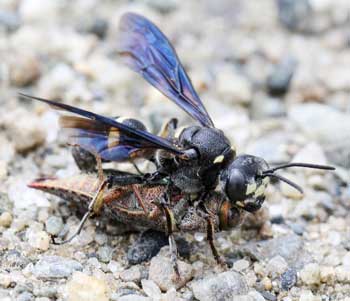
Cerceris fumipennis with buprestid beetle prey. (Photos by Mary Holland)
The wasps we’re most familiar with—paper wasps, yellow jackets, hornets—are all social wasps. They live in a colony with one queen, a few male drones, and hundreds or thousands of female workers, depending on the species. They work as a unit for the benefit of all. Ninety percent of wasp species, however, live solitary lives, with every female not only laying eggs but also constructing the nests in which they are laid and provisioning them with food.
The nests of one species of solitary wasp, Cerceris fumipennis, are built, like that of many other solitary wasps, in hard-packed sandy soil, such as you find on baseball diamonds and unpaved parking lots. Their nests consist of a central tunnel, with anywhere from five to 24 branching cells.
A food source that tells a tale
The entrance to the nest has a mound of sand, similar to an ant mound, but the hole is large—roughly the diameter of a pencil. You rarely see just one nest. While they live independently, these solitary wasps locate their nests close to one another, so as to take advantage of the specific habitat they require. Where you find one, you usually find several or even hundreds.
C. fumipennis, like many solitary wasps, doesn’t actively care for its young. Rather, the female stashes a supply of food in each underground cell she makes and then lays an egg in it, so that when the egg hatches the larva has plenty to eat until it pupates and emerges as an adult. It’s the nature of the food this wasp collects for its offspring that has inadvertently made it a very efficient agent of biosurveillance, the practice of using another species to track a pest species. C. fumipennis generally gathers only members of the Buprestid beetle family to feed her larvae, and it so happens that the emerald ash borer beetle is a member of this family.
Tracking a destroyer of trees
A clever biologist recognized the potential of this wasp to help detect the presence of the emerald ash borer in any area where C. fumipennis lives. Biologists and citizen scientist volunteers now track the prey that C. fumipennis collects and brings back to its nest, keeping an eye out for metallic green beetles (there are several emerald ash borer look-alikes, so specimens are sent to a specialist for analysis).

Cerceris fumipennis, in hand.
The effects of the emerald ash borer, a native of Asia, were first observed in North America in 2002. It has since been found in much of the eastern half of the United States, including all of New England except for Maine and Vermont. Massachusetts detected it in 2012, and Connecticut (through biosurveillance) and New Hampshire in 2013. Although the adult emerald ash borer does some damage to ash foliage, it is the larvae feeding on the inner bark of all species of ashes that do the most damage, as they destroy the trees’ ability to transport water and nutrients.
Tens of millions of ash trees have been killed, with much more devastation predicted. One-third to one-half of an infested tree’s branches may die in one year, and most of the canopy will be dead within two years of when symptoms are first observed.
Detection, then quarantines
Once the presence of the emerald ash borer has been determined, quarantines are put into place, preventing the transportation of trees, logs, and firewood outside of the quarantined areas. Thus, the early detection of this beetle in any given area is key to stopping its spread. C. fumipennis has proven to be more efficient at finding emerald ash borers than any man-made device, making detection possible sooner in areas within the wasp’s range.
Crucial to this method of biosurveillance is the manpower to carry it out. If spending a few hours in July in a sunny, sandy spot watching for shiny beetles in the clutches of wasps (that rarely, if ever, sting humans) is appealing to you, consider contacting Michael Bohne at mbohne@fs.fed.us. Participation is guaranteed to make you feel better every time you see an ash tree.
Mary Holland is the author of “Naturally Curious: A Photographic Field Guide and Month-by-Month Journey Through the Fields, Woods, and Marshes of New England,” “Milkweed Visitors,” “Ferdinand Fox’s First Summer” and “The Beavers’ Busy Year.” She has a natural history blog which can be found at www.naturallycuriouswithmaryholland.wordpress.com.