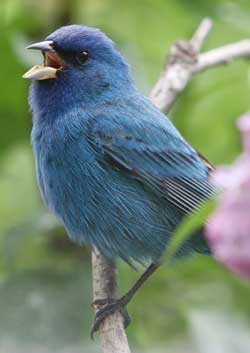
A male indigo bunting(Photos by Mary Holland)

A male red-winged blackbird.

A male yellow warbler.
This is the time of year when the relative silence of winter is broken by the melodic singing of courting birds. With the growing popularity of birding (learning to recognize the different species of birds), most people are aware of bird song basics.
Birds are most vociferous in the spring and early summer. Each species has a unique song that distinguishes it from other species. Usually it’s the males who do the singing as a way of staking out territory, attracting a mate, or maintaining a pair bond during the breeding season. One of the more subtle aspects of bird songs is the timing of their occurrence each day. The timing of bird songs is not random; most birds stick to a particular song cycle each day.
The dawn chorus
If you rise before the sun, you already know that birds sing most energetically in the hour or two before dawn. As Wilson Flagg, a 19th-century ornithologist said, “[W]e are overwhelmed by the vocal and multitudinous chorus of the feathered tribe … there is first an occasional twittering, then a single performance from some early waker, then a gradual joining in of new voices, until at length there is a full chorus of song. Every few minutes some new voice joins the concert, as if aroused by the beginners and excited by emulations, until thousands of melodious voices seem to be calling us out from sleep.”
As Flagg intimated, there is a sequence, or general order, in which different birds begin singing each morning, which is determined in large part by the light level. Different species respond to different amounts of light, and, as the sun rises, their songs build to a crescendo known as the “dawn chorus.”
Why do birds vocalize at such an early hour? Several theories exist. First, sound carries well at that time of day, when the air is usually calmest. Second, dawn is not the best time for feeding, at least for most insect-eating birds, because most insects aren’t active until the temperature rises and because it’s too dark for a bird to easily find them. For many birds, it makes a great deal of sense to sing early in the day and forage for food later.
If you get up with the sun, or slightly before, not only are you privy to the dawn chorus of a majority of songbirds, but you may also hear songs that sleepier heads will not. Some species, such as the eastern wood-pewee, have a special song heard only at dawn. Even if none of these birds happens to be singing, though, the intensity of the dawn choral performance is unmatched at any other time of day or night.
Midday quiet time
After this early morning chorus, many songbirds remain relatively quiet during the middle of the day, often stopping entirely in the early afternoon, when many birds seem to rest. Late afternoon and dusk are periods of renewed song activity, although it is rarely as intense as that of early morning. As the sun sets and most birds cease singing, there are a select number of songbirds whose singing appears to be activated by the low light. Members of the thrush family, including American robins, wood thrushes, hermit thrushes, and veeries come into their own at this time of day. While their plumage may not be as flashy as other species, thrushes are known for their melodic prowess. The songs sung by these birds on a spring evening are considered to be among the most beautiful on earth. The hermit thrush’s flute-like jumble of notes has struck humans over the centuries as uniquely ethereal. The Iroquois believed the hermit thrush flew high into the heavens to receive its voice from the spirit world. Poets and naturalists from John Burroughs and Walt Whitman to Henry David Thoreau have sung the praises of this chorister.
As darkness descends, these songs diminish and eventually silence reigns. Occasionally, however, the silence is broken by a bird song sung in the middle of the night. Ovenbirds, small woodland warblers, have a flight song they sing on the wing at night that differs greatly from their daytime song. Other nocturnal singers include the northern mockingbird, gray catbird, and white-throated sparrow. The frequency of their night songs seems to increase on moonlit nights.
A unique vitality
Around the clock, but especially in the early hours of a spring day, bird songs signal a vitality unique to this time of year. An avian concert fills the air every morning—it’s free and you can attend without ever leaving your bed. Treat yourself in the next month to one of the most magnificent choruses on earth, right outside your bedroom window.
Mary Holland is the author of “Naturally Curious: A Photographic Field Guide and Month-by-Month Journey Through the Fields, Woods, and Marshes of New England,” “Milkweed Visitors,” “Ferdinand Fox’s First Summer,” and her most recent children’s book, “The Beavers’ Busy Year.” She has a natural history blog which can be found at www.naturallycuriouswithmaryholland.wordpress.com.