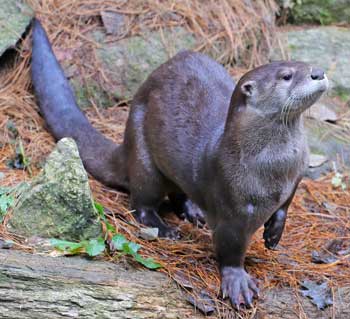
All four feet of a river otter are webbed, greatly enhancing their swimming ability. (Photographs taken at Squam Lake Science Center, Holderness, N.H. by Mary Holland)
River otters, the most aquatic members of the weasel family other than sea otters, are found across America wherever there is enough water to support them. They are active year round and during both day and night. Even so, it is much more common to come across signs of an otter than to see one.
During the winter, the river otter’s overland journeys are well documented by their tracks and slides (leaving belly grooves) in the snow. In the summer, signs of an otter’s presence are more subtle and often are related to its scent marking. Each hind foot has multiple scent glands, which are constantly leaving information for other animals. Being a member of the weasel family, the river otter has highly developed anal glands and is an active and frequent scent marker. It is these markings that one looks for at this time of year.
When otters are on the move, they often travel along well-worn paths or along streams. A typical otter covers 2 to 3 miles of shoreline a day. They tend to mark their route frequently, often on elevated surfaces or where they enter and exit the water. The most common and obvious markings are their latrines and their scrapes and rolls.
Otter spraint
Otter spraint, or scat, can assume many forms, from tubular to patty-like. Regardless of its initial shape, it disintegrates rapidly into a pile of fish scales, bones, and perhaps some broken bits of crayfish shells. The river otter leaves the water when it defecates. Multiple otters tend to use the same spot on land over and over for this purpose, creating a “latrine.”
An otter latrine is also referred to as a “brown out,” as the acid tends to build up and kill the vegetation. Various other otter sign can be present at these spots, including circular scent mounds of earth and vegetation that the otters make and then mark with their gland secretions and/or spraint or urine. River otters also tend to roll in these areas (which are also called “rolls,” “haulouts,” “landings,” and “scrapes,” spreading oil throughout their coat to make it waterproof while simultaneously scent marking.
” />
River otters can swim up to 7.5 miles per hour, dive to 60 feet, and spend up to four minutes underwater on a single breath. (Source: “Behavior of North American Mammals,” Elbroch and Rinehart)
If you would like to see one of these areas, there are certain locations where you are more apt to find them than others. If there are two bodies of water, look at the narrowest strip of land between them. This is a preferred spot for otters to mark. Another frequently used site is a narrow peninsula that juts out into a river, lake, or pond. If you’re aware of an otter run, look along it and near holes in a bank where otters enter and exit the water.
An aquatic life
Like beavers, otters are well equipped for their aquatic surroundings. They are excellent swimmers and divers (they can dive to a depth of 60 feet) thanks to their webbed feet, streamlined body, and powerful tail. Valves in their ears and nose automatically close when they go under water, and sensitive whiskers compensate for their compromised vision, hearing, and ability to smell when submerged. Their thick, water-repellent fur equips them for the coldest water.
Look for river otters in saltwater marshes, open beaches, and tidal pools as well as in streams, lakes and ponds. A very adaptable animal, the river otter can inhabit both lowlands and mountains and is found in both warm and cold climates. The river otter’s adaptability does not, however, extend as far as tolerating polluted water. It is generally true that where you find otters, you find relatively clean water.
If you are lucky enough to spot an actual otter, make the most of your sighting, as there is no guarantee that it will linger. River otters are usually on the move, traveling a circuit through their home range, visiting ponds and streams along the way. Rarely are they in one place for an extended amount of time—just long enough to leave sign and perhaps catch a fish or two (non-game, usually).
Mary Holland is the author of “Naturally Curious: A Photographic Field Guide and Month-by-Month Journey Through the Fields, Woods, and Marshes of New England,” “Milkweed Visitors,” “Ferdinand Fox’s First Summer,” and “The Beavers’ Busy Year.” She has a natural history blog which can be found at www.naturallycuriouswithmaryholland.wordpress.com.