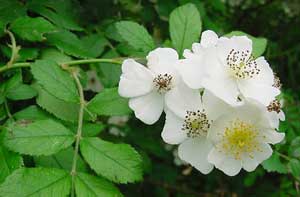
Multiflora rose is beautiful, but invasive. (Courtesy photo)
Each spring, Fruitlands Museum chief curator Michael Volmar visits the 12-acre nesting bird habitat on the museum grounds, and each spring, he said, he notices a patch of multiflora roses that turns green before all the other plants. Multiflora rose is one of several invasive species competing with the natural plants on the museum’s 210-acre property along Prospect Hill Road in Harvard, Volmar said.
“Once you start to recognize these particular plants, and you see how ubiquitous they are, it starts to get concerning, because they’re really taking over,” he said.
Invasive plants are non-indigenous species that compete with, and often choke out, the naturally occurring species in a given environment. Many invasive plants originated on other continents and were introduced to North America by humans for decorative purposes.
Massachusetts has 66 plants on its invasive list, Volmar said, and Fruitlands hosts about 16, including glossy buckthorn, Japanese barberry, multiflora rose, Asian bittersweet, and autumn olive. This according to an “ecological inventory” the museum did of its property in 1999 and then again in 2010.
“All the reports kept coming back in that we really needed to take a look at all the invasive plants on the property,” Volmar said.
So, with funding from a Department of Agriculture grant, Fruitlands is now in the second year of a three-year plan to purge invasive plants from its grounds—or at least as much as possible, considering birds and other animals unwittingly transport invasive plant seeds onto the property from outside, Volmar said. He expects keeping the invasive plants at bay will be an ongoing effort, he said.

Japanese barberry is one of about 16 invasive plants found at Fruitlands according to museum curator Mike Volmar. (Courtesy photo)
“You just have to keep monitoring,” Volmar said. “…What we’re going to do is develop a group of volunteers who can seasonally walk our property and help us to hand pull these things, for the foreseeable future.”
Fruitlands started last year by treating 10 acres of forest. The treatment involves chemical spraying and cutting, Volmar said. This year, it’s treating 61 of its 150 forested acres. Already, Volmar said, he can see the difference the treatment has made.
Though the museum, which stands on the site of a former Utopian commune, is known for its historic, artistic, and cultural collection, its natural assets are just as important to its mission, Volmar said.
“The land is really our first collection,” he said. “It’s the thing that kind of links together all the other museums that we have, and there’s a lot of history on our land.”
For residents of Harvard and other area towns who are also facing the scourge of invasive plants on their properties, Fruitlands is hosting an invasive plant control workshop on Saturday, July 14, at 10 a.m. Workshop leader Joan Deely, of Polatin Ecological Services, Inc., will show participants how to identify and eradicate different species of invasive plants. The day-long workshop will include a walk on the museum property to see invasive plants in their non-natural habitats.
The cost for the workshop is $85 for museum members and $115 for non-members. Registration information is available at www.fruitlands.org.