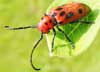

Milkweed Longhorn Beetle. (Photos by Mary Holland)

Tiger Beetle.

Locust Borer.
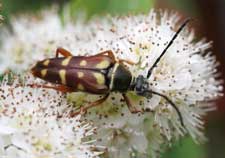
Flower Longhorn Beetle.
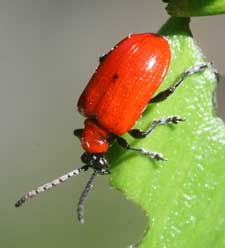
Lily Leak Beetle.
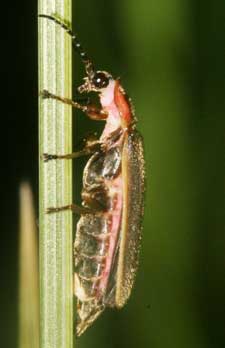
Firefly.
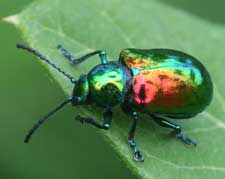
Dogbane Beetle.

June Bug.
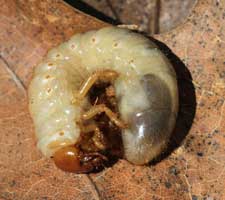
June bug larva or grub.
Beetles, beetles, everywhere—ladybugs, June bugs, weevils, fireflies, potato bugs. No other animal group has such a range of color, shape, and size. Some beetle species are larger than your fist; others are so small they can fit through the eye of a needle. Many species are brilliantly colored, like jewels, while others cleverly blend in to their environment. Current estimates of the total number of animal species on Earth range from 5 to 30 million, of which approximately two million have been formally described.
Half a million, or a quarter of all described species, are beetles; they make up about 40 percent of all described insects and are the largest group of animals on the planet. Not only are there a large number of beetle species, but they have been very successful, having adapted to nearly every environment, including air, water and land. They have also been around about 225 million years—much longer than other insects—and they may well outlast humans.
Most beetles have two pairs of wings: forewings, or elytra, and hind wings. Over millions of years of adaptation their forewings have become highly specialized, giving them their scientific name, Coleoptera, which comes from the Greek word “koleon,” meaning sheath. It is these hard, shiny forewings that give beetles their recognizable armor-sheathed bodies. Scientists believe that over the years the wing veins in the forewings became thickened and grew harder until they developed into tough, protective covers for the more delicate hind wings as well as the rear part of the beetle’s body.
When at rest, beetles do not usually display their hind wings, which remain folded under their forewings except when they are flying. The hind wings actually do the flapping, while the outer forewings act as stabilizers during flight.
Beetles range in size from .25 millimeters up to 20 centimeter, equivalent to that between the tiniest shrew and the largest whale. This diversity in size is equaled by the diversity of their diet. There are beetles that feed on plants, decaying organic plant matter, carrion, fungi and scat–different species have different preferences. In addition, some are parasites and some are predators.
Beetles are in the 88 percent of insects that undergo complete metamorphosis. There are four separate stages: egg, larva, pupa and adult. Beetle eggs are usually soft and smooth. They can be laid in the soil, in wood, under tree bark, on leaves, or in carcasses. Depending on the species, a female may lay a single egg or several thousand. Most female beetles do not take care of the eggs once they are laid. Looking a bit like worms or caterpillars, beetle larvae hatch from eggs. They are sometimes called grubs at this stage.
Most beetle larvae have from one to six simple eyes on each side of the head and mouth parts for eating. They eat and grow, molting as they get bigger and bigger. At the end of the larval stage, the grubs either create a pupal cell or find a safe place to go to protect themselves while their bodies change. When the adult beetle emerges from the pupal stage, its body is soft and pale. Soon the body covering becomes hard, and the beetle’s true colors appear.
We rarely see beetles’ first three stages, as a majority of the time they are underground, in crevices or under logs.
As far as their body structure, beetles, being insects, have three body parts (head, thorax, abdomen), two antennae and six legs. Their eyes are compound, and sometimes quite sophisticated, as in the whirligig beetle, which has split eyes to allow a view both above and below the waterline. Beetles’ antennae are used primarily to detect scents, but also enable the beetle to physically explore its environment. The mouthparts of beetles are very similar to those of grasshoppers. They possess mandibles, which look like large pincers on the front of some beetles. The mandibles move horizontally to grasp, crush ,or cut a variety of foods. In addition, there are two pairs of appendages called palpi near the mandibles, which help move food into the beetle’s mouth. Nectar-feeding beetles are an execption, they have tube-like mouthparts.)
The legs of beetles are sometimes specialized–widened for diggers, hairy for swimmers, or enlarged for jumpers. In addition to their “armor,” beetle defenses include spikes and horns, chemicals secretions, mimicry, and camouflage.
Given the large number of species, their mastery of land, air, and water, the diversity of their diets, and their comparatively long history on earth, beetles are considered the most successful life form of all time. While some in the logging and agricultural fields consider them pests, beetles also contribute greatly to recycling and the creation of soil, predation of pests such as aphids and potato beetles, and the pollination of many fruit and vegetable flowers.
Mary Holland is the author of “Naturally Curious: A Photographic Field Guide and Month-by-Month Journey Through the Fields, Woods, and Marshes of New England” and “Milkweed Visitors.” She has a natural history blog which can be found at www.naturallycuriouswithmaryholland.wordpress.com.