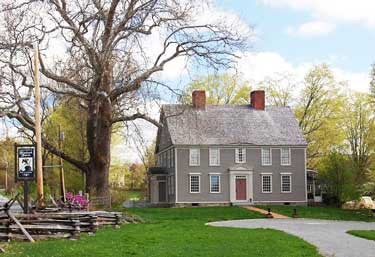
Flintlock Farm on Still River Road may best be identified by its immense sycamore tree, reported to be one of the largest in the state. It is also the scene of the whipping of a Shaker in 1782. (Courtesy photo)
There are many reasons to notice Flintlock Farm in Still River when driving by: the striking Revolutionary-era house, the ancient sycamore tree, the long snake rail fence and border of lavender, the extensive nursery of boxwoods plants. Early American Life certainly noticed the farm, which the magazine features in a 10-page cover story in its August issue.
The article portrays the farm that owners Phil and Beth Wilson have caringly restored and enhanced since they bought the 178 house and its surrounding 16 acres in 1994. The couple, who had experience restoring two other Colonial era homes in Sudbury and Wayland and a 1950 Colonial reproduction in Harvard, was attracted to the period house and its many original features, as well as the opportunity for farmland.
A significant house in its day, the Georgian style house reflected the prominence of its original owner, Captain Thaddeus Pollard, a prosperous blacksmith from Bolton. Although over the years the roof design was modified and some Federal and Greek revival elements added, few modernizations were made to the interior of the house, which stayed in the Pollard family for almost 100 years.
Unlike many center-front Colonials, the house has dual stack chimneys in the interior of the house that service 11 fireplaces. Large mullioned windows, some with interior shutters that slide into the wall, bring light to the rooms in the symmetrically balanced floor plan.
Another unusual feature is a still-functioning, 40-foot well in an ell of the house. The Wilsons suspect that a hand-forged chain on a well bucket that came with the house, as well as other pieces of hand-forged hardware throughout the house, may have been made by Pollard.
Refinished floors, carefully chosen paint, and antique and reproduction furnishings contribute to the illusion of a time-arrested environment.
Yet preserving, restoring, and beautifying the house and grounds are not all the Wilsons have been doing. They are researching and keeping alive the history of the house. Their budding nursery business serves modern-day customers. And they are combining a passion for past tradition with a vision for the future.
Capt. Pollard’s life crossed many aspects of Colonial history. As a Minuteman, he was sent to Cambridge on April 19, 1775, during the first days of skirmishes in the Revolutionary War. Two years later, he went to Bennington with the local militia to help counter British General Burgoyne’s army advancing from the north. Pollard had ties to the commerce of his day and is also an example of leadership of Harvard, where he was four times elected a selectman. The Pollard house and family history reflect the social and cultural norms and activities of late eighteenth-century Massachusetts.
The ancient sycamore, reported to be one of the largest in the state, is also linked to Harvard’s past, but in a more infamous way. According to an account in “The History of the Town of Harvard” by Henry S. Nourse, in 1782, the same year the Pollard house was built, a “Harvard mob” surrounded several Shakers that they were trying to run out of town, just as the Believers reached the Harvard/Bolton town line.
Shaker follower Abijah Worster was tied to the sycamore and given 10 lashes for “the crime of going about and breaking up families and churches.” He was rescued from 10 more by James Haskell, a prominent Harvard resident who happened by and shamed the mob into disbanding.
Later, in the 1880s, Isaac Marshall, a scientific farmer connected to the use of rock phosphates and other soil amendments, lived on the farm.
Today, Flintlock Farm produces and sells hardy boxwoods, lavender, herbs, and other nursery items.
Rescuing lost arts as a bridge to the future
In the 1960s, Phil Wilson was influenced by Foxfire magazine, a student-created publication that sought to preserve the vanishing culture of southern Appalachia. Later, an exhibit at Colonial Williamsburg gave him the inspiration to create Lost Arts Collaborative, an effort to protect, preserve, and pass on lost or endangered arts—traditions, cultural practices, methods, and skills that are in danger of dying out.
This fall, the Lost Arts Collaborative will host Introduction to Holistic Farm Management workshop and a SPIN (Small Plot Intensive) workshop on small-plot, intensive farming.
Wilson told the Press the house is in line to become perhaps the fourth Harvard site listed in the National Register of Historic Places. The Wilsons invite researchers and scholars to add to the knowledge about the farm, its inhabitants, and their contributions to Harvard history.