The Finance Committee voted Tuesday to recommend taxpayers dig a bit deeper into their pockets to maintain town and school operations at their current levels in the coming fiscal year.
But, with little opposition, the committee also recommended that taxpayers be offered a second option, one that would include requests that department heads and the school district say would improve operations and the efficiency with which they are delivered.
If accepted by the Select Board, voters would be given a choice: approve the collection of an additional $504,582 in property taxes to maintain town services at fiscal 2024 levels, or increase the levy by more than twice that amount, approximately $1.3 million, to pay for the additional staff and services the town and schools have requested in addition to level service.
Either of these options would require a Proposition 2½ override, allowing the town to increase the tax levy on real estate and personal property above the limit set by state law—a 2.5% increase over the previous year’s levy—plus the assessed value of new construction. A majority of voters must approve an override at Town Meeting and then again at the ballot box. Once enacted, an override becomes permanent, the increase embedded in the base amount the town may increase each year.
In discussing their recommendation, committee members agreed that an override of $504,582 was the absolute minimum departments need to maintain their current levels of service in fiscal 2025, an amount that includes one additional police officer. Without those additional dollars, departments and the schools would be forced to make the drastic “level 2” cuts described in last week’s edition of the Press. (See “Officials wrestle with options, including an override, to preserve town services in FY25,” Harvard Press, Jan. 26)
Tier 2, however, includes the level service amount of $504,582 and also restores
departments’ requests for additional personnel and dollars they say are needed to meet a growing demand for staff and services.
If approved by the Select Board, the alternatives would be presented to voters as a two-tiered tax override, first as separate articles on the 2024 Annual Town Meeting warrant April 6, and then as two questions on the Town Election ballot April 9, the graveyard of override requests in 2011 and 2020. A voter could endorse the tier 1 increase, but reject tier 2 of the two-layer fiscal cake. A vote for the second layer is an implicit vote for the amount contained in tier 1.
According to a calculator provided by the state’s Division of Local Services, adding $504,582 to this year’s levy would have increased the tax bill of an average home in Harvard—one valued at $875,968—by approximately $245.47. The tax rate for residential owners would have been $15.18 per $1,000 rather than the current $14.90.
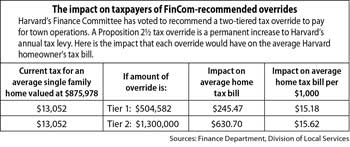
If this year’s levy had been increased by $1.3 million, however, the tax on an average home would have increased by $630.70 and the tax rate increased to $15.62 per $1,000. (See table.)
At its Tuesday meeting, the six members present for the vote were unanimous in their support of a $504,582 override. “I think that is the minimum amount that we can ask here for an override,” said Jennifer Finch. But she thought the number was “not great. We’re a growing town and we have growing needs and we are always looking to improve and sometimes improvements cost money.” The committee had to trust, but verify, that departments and the schools were putting forward reasonable requests to better serve the taxpayers, she said.
Associate member Bob Thurston agreed, saying the town should give voters a chance to weigh in on the additional requests of town departments and the schools. “There’s some pretty valuable and important stuff in there,” he said. Those requests would return in fiscal 2026 on top of further increases to wages and benefits and other costs beyond the town’s control. If denied, those requests would just be kicked down the road, Thurston said.
The vote to recommend a second-tier override of approximately $1.3 million was 4-1, with member Noyan Kinayman voting against. Chair Eric Ward was a reluctant “aye,” saying he would like to see a third layer, an amount somewhere between the “bare minimum” of $504,582, and the enhanced level-service amount. But he said, with support from other members, that discussion of a middle layer should be left to the Select Board.
There was a bit of good news at the start of the meeting. Town Administrator Tim Bragan reported that an increase in net state aid and a decrease in the anticipated cost of insurance had reduced the budget deficit reported last week from approximately $1.5 million to the tier 2 $1.3 million number.
Next steps are in the hands of the Select Board, which is scheduled to hear the recommendation of FinCom Feb. 6. The board must decide by Feb. 23 whether to add an override to the April 6 Town Meeting warrant.
Other business
In other business, the committee voted unanimously to create two new enterprise funds, one for water and the other for sewer. The move, which must be approved by Town Meeting, creates two self-funded budgets that can collect the fees paid by users and be drawn upon for system expenses.