The other day I stopped by Fivesparks to check out the Artists-in-Residence project and left feeling like I had experienced in-depth studio visits to three of the 10 participating local artists.
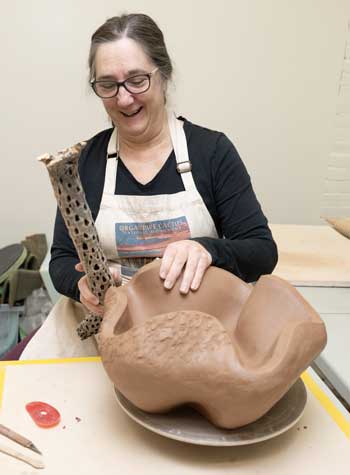
Artist Anne Swinton uses a dried limb from a cholla cactus to texture the outside of a sculpture. A finished sculpture, which resembles a cut geode, can be seen to the right. (Photos by Lisa Aciukewicz)
Kimberly Stoney, from Littleton, had set up her tables to create a demonstration and practice area in a corner of the main gallery. She was surrounded by exhibition space on the wall, where her meticulously mounted collages can be viewed up close. Her art drew me in, and her ability to communicate and demonstrate the “element of serious play” that she said is important in art kept me hanging around her tables.
I watched and listened as she applied and rolled paint onto the gelli plate and added bits of paper, stencils, and plants. She pressed a blank sheet of paper over the plate. All the colors and shapes and objects were now hidden under that sheet of paper. After pressing the back of the blank paper with her hands, she pulled it off the plate, revealing the print. From there she could add another layer of paint, materials, or drawing and do another pressing. She has a practice of making three additions of some sort to each print, that bit of extra effort making each one unique.
She showed me some of the papers she uses, such as deli and freezer papers, explaining how their different properties were useful to her. Her trays of little squeeze bottles of inks and paints begged to be picked up. After talking to Stoney I was inspired to make prints.
The next day I talked with oil painter Gina Kalenderian from Bolton, as she stood before her easel in the passageway with the arched windows. We talked about the abundance of light in that space, her introduction to art as a child, and her studio studies as an adult. I observed her paintings of various subjects—animals, landscapes, still life, portraits—but I was most drawn to a pencil drawing from an old photo of her mother with a friend. Kalenderian described her plans for a large project using more photos of her mother and extended family.
Then we began to talk about a difficult subject: the relationship between the artist and the art market. It is a challenge for most artists to be able to afford the materials, entry fees to shows and exhibits, guild memberships, studio rent, and shipping. Because of these expenses, artists must be aware of the market for their work. Intensely personal projects, for instance, may have a smaller market value until the artist becomes well known in the art world. “But,” Kalendrian said, “the audience is important,” and she said that it’s necessary to understand what your audience may expect. She finds it “fascinating to see what catches people’s eyes.”
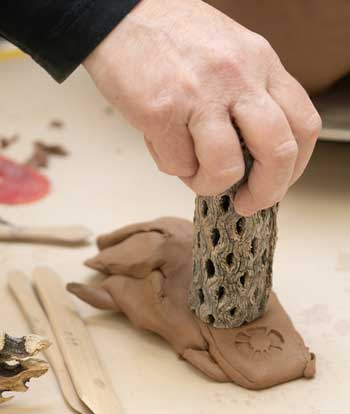
Anne Swinton shows how she marks the bottom of some of her clay pieces with a stamp made from a piece of dried cholla cactus.
Natural ceramic forms, some the size and finish of large stones with shiny hollows, were displayed on the shelves in the main gallery, which is where I found Northborough artist Anne Swinton. Her ceramics career started at the Worcester Center for Crafts when she and her future husband attended a ceramics class for a date night. During the next 30 years, she mastered creating wheel-thrown objects, and had them fired in the electric kiln at the center.
We left the gallery and descended the stairs to her basement studio to continue our discussion. I wanted to fathom her transformation from a skilled and dedicated craftsperson creating beautiful utilitarian objects into an artist venturing into the unknown reaches of imagination, responding to her love of nature. She began thinking about natural forms.The shapes were hollow on one side and solid-looking on the other. “Like a geode,” one gallery volunteer had suggested.
In the studio, I saw clay at various stages of completion: as a block of clay, a rolled-out slab like a pie crust, various slabs draped and rounded over soft materials. As we talked, she would occasionally run her fingers along the edges, gently testing and communicating with the clay. In the following days, the clay will dry and then undergo a bisque firing in an electric kiln at home. Swinton will apply glazes to the surface, and eventually she will take them to a wood-fire kiln in Connecticut, taking her turn at tending to the two-day firing while awaiting their final emergence into the world, and for many pieces, into her garden.
I asked the artists why they had signed up to participate in the Artist-in-Residence project, paid the fee, lugged in armloads of materials, negotiated and arranged a work space. Without missing a beat, Harvard pastel artist Terri Knoettner said that having a chance to interact with other artists was her motivation. Getting exposure and interacting with the public was another answer. Swinton was glad to get out of her cold basement. They all said they appreciated working in such a beautiful building.
As for me, I got tips about materials, classes, and processes. In meeting artists as they worked, I felt a rapport with their community.
The Artists-in-Residence project ends Feb. 10, with live demonstrations on Saturdays. Check the website for hours or look for the flag outside the building, which means the building is open.
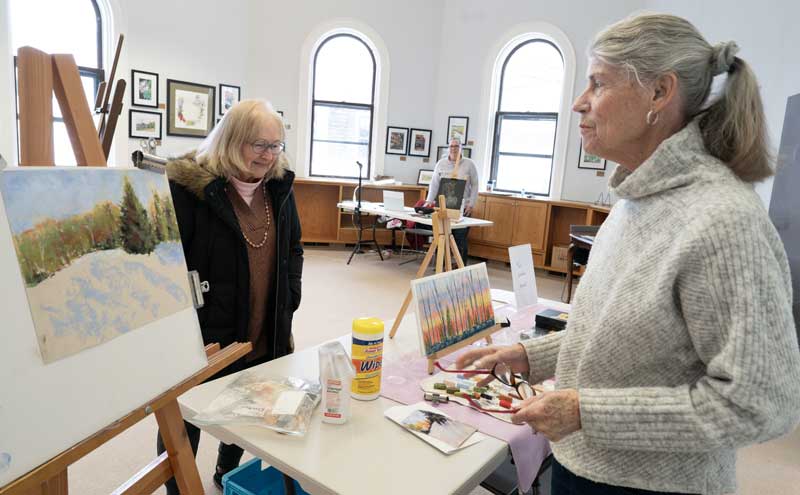
Suzan Osborn speaks with Terri Knoettner at an artist-in-residence demonstration at Fivesparks, Jan. 20.