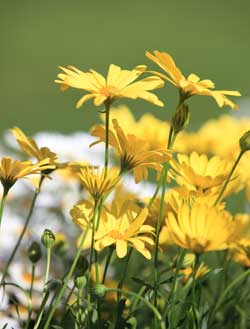
Coreopsis bask in the sun at last year’s plant sale. (Photos by Lisa Aciukewicz)
My first piece of shopping advice is one I personally never follow: Plan.
Before you head out to the Garden Club of Harvard’s annual plant sale on May 18, look around your gardens and see where you have room for some new plants. Check out whether those areas have shade or sun; think about what you might like to replace; consider what would go with the plants you already have.
The consequences of failing to plan—to which I can personally attest—are varied, but all are disastrous. The first scenario has you wandering around your yard, new, irresistible plants in hand—or tow—looking for empty spots. Maybe you will be lucky and find them perfect new homes. Otherwise, you will stuff them in places where they won’t flourish. Worse yet, you will give up in despair and leave them to plant later. “Later,” you will find them expired. Worst of all, you may create a new garden for your purchases. You’ll fill that up, and next year . . . So, figure things out ahead of time.
From perennials to vegetables
When you get to the Common—people line up before 9 a.m—you will be delighted to find that the sale itself is highly organized to make things easy for you. You will see tables arranged in a large U shape. Starting on the right as you enter are tables for perennials that like shade, such as hosta, astibile, and bleeding heart. Next, perennials that like sun—daylilies, iris, daisies, hens and chicks. Each perennial has its own colored stick; strategically placed charts will show you the color-coded prices. The perennial tables are followed by annuals, herbs and vegetables, and a nice selection of shrubs.
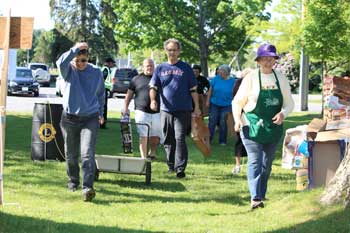
Eager to get the best deals, shoppers enter last year’s plant sale promptly at 9 a.m. after Garden Club member Marty Green (far right) opens the gate.
A second bit of advice: Don’t expect instant gratification. Not every perennial grown in Harvard will be in glorious bloom on May 18. Some, such as primroses, may already have flowered, but will delight you with their pinks and whites in your garden next spring. Others, such as chrysanthemums (pink-flowering) and asters (probably purple) will make you be patient until early fall. (Meantime, pinch them back until early July to make them less leggy.) Small, Harvard-raised English delphinium will be dazzlingly tall in your early summer garden.
Bring help, or at least a wagon
Third tip: Bring help. Despite your best intentions, you may find yourself unable to resist the call of the plants and end up with more than you planned. That’s okay. There will be cardboard boxes to help you carry, but a spouse, kid, or wagon would come in handy.
When you go to check out, you will once again be delighted at the Garden Club’s organization. You bring your plants to talliers, who will be standing near the “exit.” These talliers will take out the colored sticks, add up the total cost, and give you a slip of paper with the amount you owe. You then proceed to the cashiers.
You already know that money spent on plants doesn’t count. For you. But it counts for the Garden Club, because it allows us to beautify the public spaces in town, such as plantings on the Common, window boxes at Town Hall, and a hillside of flowers at the library. Proceeds from the sale allow us to give an annual education grant, make an award at the Bromfield Science Fair, and invite educational speakers throughout the year, to which the community is always welcome.
A final bit of advice: “The earth laughs in flowers;” you should, too.