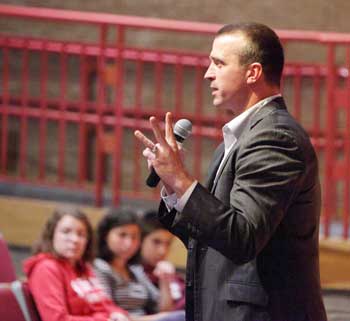
Former Boston Celtic basketball player Chris Herren details his climb to fame and his fall into drug addiction to a rapt audience in a talk at Bromfield, May 13. (Photos by Lisa Aciukewicz)
Neither Bromfield’s high academic ranking nor Harvard’s relative affluence impressed Chris Herren. Those factors provide no protection against drug and alcohol abuse, he emphasized repeatedly.
“There are kids in this room taking Adderall to stay up and study, I guarantee it,” Herren said, referring to a prescription drug that contains amphetamines and is commonly prescribed for attention deficit hyperactivity disorder. He explained that both Harvard University and Notre Dame had called him in to talk about drug abuse. “They have kids turning to cocaine, because Adderall doesn’t work for them any more like it did in high school,” he said.
Herren spoke at the Bromfield School last Monday evening in a presentation arranged by the Bromfield School Council and sponsored by the Harvard Schools Trust, the PTO, SADD, Emerson Hospital, the Lions Club, the Harvard Athletic Association, the Harvard Road Race Association, and Bromfield wellness teacher Elaine Beckett.
Discounting the warnings
For much of Herren’s gripping talk in Cronin Auditorium, you could have heard a pin drop, even though about 400 people were in the seats. The majority of the audience were students, but many parents and community members attended as well.
Looking back on his own high school years, Herren said he had discounted all the warnings about addiction: “I remember saying to myself, ‘Not another drug talk. This doesn’t apply to me.”’

Jacqueline Lee (center) reacts to Herren’s recounting of being revived after overdosing on heroin.
Yet by the time he was 18, drugs had cost him his basketball scholarship to Boston College, and he had been expelled. It was the beginning of what he called “a 14-year nightmare.”
Herren warned that high school students today face a wider range of drug perils than he did 20 years ago in Fall River. “For me, it was just Pabst Blue Ribbon or weed,” he said. But now there is a vast array of potentially addictive prescription drugs in home medicine cabinets. Moreover, he said, growers are spraying crystal meth on marijuana crops to create a more addictive product.
Herren got a second chance at college basketball at Fresno State, and–despite another bout with drugs–won a place in the NBA with the Denver Nuggets. He said his Denver teammates helped him stay clean during his rookie year. But then he got the opportunity he had always dreamed of—he was traded to the Boston Celtics.
Back in his home town of Fall River, Herren invited old friends to a barbecue. During the party, one of his high school buddies sold him an Oxycontin pill.
“I had no idea,” Herren said. “That decision changed my life forever. From that 40-milligram pill for $20, I ended up taking 1,600 milligrams a day, for $25,000 a month. I had no idea.”
From the ages of 28 to 32, Herren described himself as “a stone-cold street junkie.” His basketball career gone, he described selling his wife’s jewelry and his children’s video games to get drug money. Not until he had suffered a couple of near-fatal overdoses and been rejected by his family did he finally face his problem and stick with a rehabilitation program.
Looking at his audience of high school students, Herren told them to ask themselves, “How come on Friday and Saturday nights, I can’t just be me? Why do I need to put something else in my body?”
Drugs are not the only risk
“The image of a drug addict has changed,” Herren said. It is not the junkie on the street corner anymore, but the kid in the fashionable jeans and trendy boots. “Every drug addict has a first day. That street corner, that’s the last day.”
Herren noted that drug abuse is not the only form of self-harm that takes place among young people. He described a young woman at one of his talks who was cutting herself in response to bullying at school. Then he looked out across the seats in Cronin and addressed the audience directly.
“To the kids who ducked their heads when I said ‘cutting,’ I saw it,” he said. “Pull someone aside and say you need some help.”
The attentive audience broke into applause at the end of Herren’s talk and applauded spontaneously again during the question period, when he said he was reunited with his wife and children.
On the way out the door, tenth-grader Jennifer Specht undoubtedly spoke for many when she said, “It’s not something we’ll forget.”