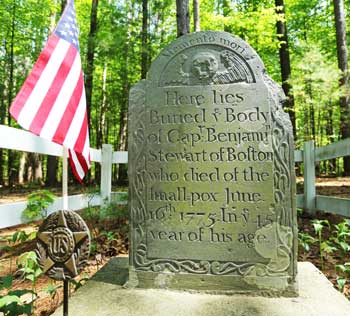
The grave of smallpox victim Captain Benjamin Stewart on Poor Farm Road. (Photo by Lisa Aciukewicz)
Thanks to a small band of volunteer veterans in town, nearly 400 graves of the Harvard men and women who served in the military since the days of the Revolutionary War received American flags last Saturday, May 16. The tradition of placing flags on veterans’ graves for Memorial Day grew out of the post-Civil War tradition of decorating the graves of fallen soldiers from that war (see “How Memorial Day began” below). It takes place across the United States and now includes the graves of all veterans, not just those who died in action.
In Harvard, volunteers place flags in the Town Center Cemetery, where many Revolutionary War and Civil War soldiers are buried, and at Bellevue Cemetery, where most of the service members who died after the Civil War are buried. Veterans’ graves are marked with metal flag holders, some of which identify which war the veteran fought in. Flags are also placed at the center monument of the Shaker Cemetery, where graveside flags are not allowed. An estimated seven veterans are buried there.
In addition, a flag is placed at the grave of Captain Benjamin Stewart, a Revolutionary War soldier, on Poor Farm Road and at the Still River Village memorial for Corporal Roger Skillings, who died in action in the Korean War. Eight or nine veterans are also buried at the St. Benedict Center on Still River Road, and flags are placed on those graves by the sisters who reside there.
Geraniums for all
This year, the gravesite flag contingent consisted of army veterans Steve and Nancy Cronin, navy veteran Don Green, interim Veterans’ Agent and army veteran Mike Detillion, and Robb Ricker, a neighbor of the Cronins. In addition to flags, Green and the Cronins plant geraniums at the grave of every veteran in the Town Center and Bellevue cemeteries. The geraniums are delivered to the cemeteries before the parade, and the flowers are distributed to the individual graves by young parade-watchers. “We encourage the kids who are attending the parade to pick up a geranium and place it on a flagged grave,” said Nancy Cronin. At Bellevue Cemetery, where a smaller crowd attends the parade, volunteer firefighters and their families help distribute the flowers. The volunteer vets return a few days after the parade to plant the flowers.

Note: Information is from a count of the Town Center and Bellevue cemetery flags and grave markers. Those buried at the Shaker cemetery and at St. Benedict’s are not included.
The Cronins began helping to place flags about 20 years ago when Korean War veteran Paul “P.J.” Johnston, who decorated the graves for many years, asked for help. About ten years ago, the Cronins and ex-Veterans’ Agent Dennis Lyddy enlisted the help of Don Green. A few years later, Green also took over veteran Warren Harrod’s geranium-planting job, and with the help of family and the Cronins, the task of planting almost 400 flowers at gravesites is completed in just a few days after Memorial Day.
Reading the names
This year I accompanied Nancy Cronin as she placed her flags, and while the other volunteers moved quickly through the cemeteries, Cronin took the time to read the grave marker of each veteran. “If we don’t read them, who will?” she said. Grass growing over the flat stones made some difficult to read. “We’re losing these plates,” Cronin remarked, as she used her hands to pull the grass away from the names. These flat markers, supplied by the U.S. government free of charge to veterans who die on active duty or are honorably discharged, mark the graves of many veterans who served in World War I and after.
Who supplies the flags and holders?
The flags themselves are purchased by the town’s veterans’ agent, and the state pays 75 percent of the cost, while the town picks up the remaining 25 percent. The metal flag holders that mark the graves of veterans used to be provided by Johnston, and Nancy Cronin told the Press that she didn’t know where he got them, but when he didn’t have enough, he’d borrow some from his brother Peter, also a Korean War veteran, who lives in Ayer. Johnston died in 2009, and in recent years, his old supply of flag holders has run out. A few local veterans have stepped up to purchase more, but Green said that they have asked the Cemetery Commission to purchase them in the future. Interim Veterans’ agent Mike Detillion confirmed that he is currently working on a request to the commission for flag holders.