Looking down the hill from outside the tent at Fruitlands Museum, one sees long bunches of yellow-green orbs, suspended from the lower branches of a tall pine. As though on an old-fashioned clothespole, lines of iridescent color rotate lazily near the Shaker office building, and giant white “birds” flap across the field in front of the Alcott farmhouse. These are three of the 20 outdoor sculptures that have transformed the museum landscape.
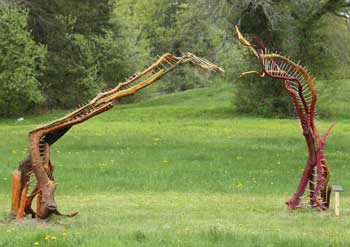
Sculptor Nicholas Kantarelis gives dead trees new life. (Photo by Lisa Aciukewicz)
Fourteen New England artists, including some repeats from 2013, are represented in the third biannual Art in Nature exhibit at Fruitlands. Most of the artists attended an opening reception on Saturday, May 9, and spoke about their pieces as Curator Mike Volmar led a group of more than 40 people around the grounds. The exhibit will remain until November, and, as Volmar explained, visitors to the museum may pick up a map of the sculptures, with artists’ statements on the back, and are invited to vote for their three favorite pieces. While this is a juried sculpture show, there will be cash prizes for the winners of the popular vote, as well as for the artists chosen by Volmar and other jury panel members.
Art enhances the landscape
Many of the sculptures seem to integrate naturally into the landscape. The first sculpture is called “Tree 7” and is part of a series by Nicholas Kantarelis in which dead trees are stripped down and reassembled to create new life. In this piece, located in the field to the left as one drives into the museum, two groups of glossy, colored branches arch toward each other, anchored by underground footings. Appropriately, “Tree 7” occupies the same spot as one of the “Tree People” in Joseph Wheelwright’s 2010 exhibit at Fruitlands, the exhibit that inspired future Art in Nature at the museum.

“Rython” by Evan Morse. (Photo by Lisa Aciukewicz)

“Soaring” by Eric Lintala. (Courtesy photo)
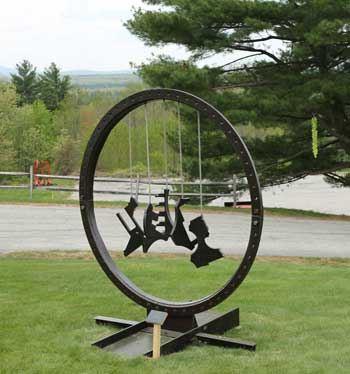
“Oshkosh” by Brendan Stecchini. (Photo by Lisa Aciukewicz)
Artist Evan Morse knew he wanted to work with a group of trees, and he found them in a clump of spruce near the administration building. Heavy rope lashes the three trunks together and suspends a triangular stone object in their center. One feels the connectedness of the trees and the pull of gravity. Morse said he wants the viewer to “wonder at the object,” but his explanation that the title of the work, “Rython,” means an ancient ceremonial drinking vessel adds another dimension for the viewer: the image of water going through the stone into the ground and nourishing the group of trees.
“Soaring,” outside the Art Gallery, is made of curved fiberglass pieces topped by a vertical “wing.” Of their being painted white, Eric Lintala said there is a ”spirituality behind that.” The piece was triggered by an experience of watching hawks, “their movement in space … they swirl and dive.” The red-tailed hawks at Fruitlands will echo that original inspiration. When one looks closely at “Flight” by Bernie Zubrowski, one sees that each pair of wings is anchored by a “foot” of green steel and turns in the wind, each according to its own choreography.
At first the heavy steel structures of Brendan Stecchini may seem intrusive. But they have both movement and balance that mirror the forces in nature. And, as Stecchini pointed out, iron is at the very core of the earth itself. “Oshkosh” is a series of shapes suspended on springs across the diameter of a large open circle. They move in the wind or when touched, and when they hit each other, they create a pleasant, somewhat somber tone. In front of the farmhouse is another Stecchini piece, made from the boom of a crane manufactured in 1948. Now, its utilitarian purpose gone, it looks like a giant seesaw. Stecchini’s art recycles machine parts used in factories of a bygone era and pays tribute to those workers (of which he himself was one) who earned their livelihoods in manufacturing.
Landscape changes the art
Just as the art transforms the landscape, the natural setting also has its impact on the art. Gianna Stewart created “Ladder to Fruitlands.” Installed at the edge of the slope down to the farmhouse, the steel ladder seems to rise over the roof and into the sky. Stewart writes, “The idea behind it stems from the transcendentalists there who viewed the land as a means to a higher place.” Looking back at her sculpture from below, Stewart remarked, “Amazing how the landscape can scale things down.”
Walking all around “Orange Bath” by Phil Marshall allows one to see the various curves and connections between the two pieces, which are actually the top and bottom slices of an iron bathtub, mounted vertically and painted bright orange. Asked why orange, Marshall explained, “Cast iron loves to rust and go orange, so [I thought] why don’t I start orange?” The pieces took days to cut with a circular saw and diamond blade. Marshall said he did not bend the pieces: “That’s just the way it is.” Marshall’s wife, Brenda, remarked at Saturday’s opening that she hadn’t really liked the piece until she saw it at Fruitlands. Being in such an open space emphasizes how the curves of the sculpture enclose space within them.
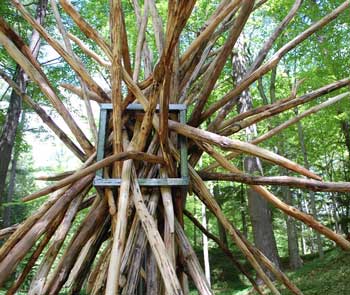
“Colletta Caotico” by Taylor Apostol. (Courtesy photo)
Finding perfect setting
Curator Mike Volmar, sometimes in conjunction with the artist, has done a masterful job of placing the sculptures in the landscape. The open field beyond the hillside down from the restaurant tent is the perfect setting for “Colletta Caoctico” by Taylor Apostol. Rising in the middle of the open expanse is a large bundle of hand-carved sticks bound together by steel. It looks like a giant’s version of the child’s game pick-up sticks, the sticks about to be strewn out over the playing field.
Placed near the permanent bronze of an American Indian with his bow arched high in his arms is “Helen of Troy” by Mara Sfara. In a stance echoing the larger piece, Helen’s arms are raised in what Sfara calls a welcoming gesture. “I like the innocence of her. She represents people going to war over love,” said Sfara, who finds deep meaning in mythology.
“Fantail”—not a clothespole at all but what Zubrowski calls a “polyrhythmic composition”—is set in front of an apple tree, and the living and nonliving complement each other. The whimsical “Dream Pod,” also by Marshall, finds a perfect home high in the gnarled pine tree on the road by the Shaker building. Made of green aluminum mesh and red racquetballs, it is Marshall’s version of the bizarre and unbelievable plants he has seen in his travels around the world.
At the very bottom of the hill is Madeleine Lord’s “Ostrich.” With a junkyard for her “palette,” Lord lets her creatures evolve organically. A single piece becomes the body, or the head (as is the case with the ostrich), and then she searches for other body parts. She exclaimed on Saturday, “I love this spot.” The slope down to a split-rail fence and stands of white pines make a perfect setting for her art in nature.
Artist Nicholas Kantarelis cut short a discussion of his tree sculpture on Saturday, saying, “I make art to not talk, not think.” But the pieces in Fruitlands’ Art in Nature will definitely have visitors thinking and talking.