The tree swallows and barn swallows returned this spring within three or four days of their return in years past. The tree swallows are exploring the nest boxes in our pasture, and the barn swallows are continually winging in and out of the barn, deciding where to nest. While tree swallows will build new nests, the barn swallows often take advantage of old nests and refurbish them.
Several pairs of robins have nested.
The bluebirds in one of the boxes in our vegetable garden are already feeding young.
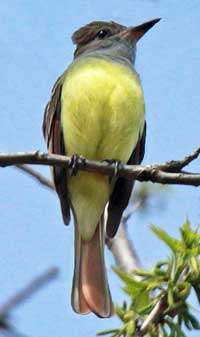
Great crested flycatcher. (Courtesy photo)
I heard the distinctive trill of a great crested flycatcher when I was working in the vegetable garden one afternoon. I spotted him on a favorite perch at the top of a maple. According to my field notes, he arrived one day later than last year. It always amazes me that a bird can travel thousands of miles and come back to the same area and even the same tree perch. I always assume that it is the same bird; otherwise, why else would he end up there?
Getting ready
My field notes are a great help in predicting when various birds return. I like to get a little ahead of them and get their food out and waiting for them. This was true of both the ruby-throated hummingbird and the Baltimore oriole. I made sugar water for the hummingbird feeder (⅓ cup sugar, 1 cup water, no food coloring) and put out two orange halves just one day before they both returned. The males usually arrive ahead of the females. On one day, I had three male Baltimore orioles feeding and checking out the trees for nesting sites. A good time to check for old oriole nests is before leaf-out, which will give you some indication of where they are likely to nest this year.
Another way of predicting when migrants may return is to study the wind map at hint.fm/wind/ or check the bird radar at www.wunderground.com/weather-radar/united-states/ma/boston/box/?region=hfd. The wind map is actually a piece of art and is displayed at MoMA in New York. The site gives you real-time wind direction. If there is a southerly wind, chances are it is bringing migrants north. The radar can give you an idea of the quantities of birds migrating and where they are stopping.
On a recent trip to Wompatuck State Park in Hingham, we saw several migrants and a Louisiana water thrush, which was a new bird for me. Wayne Peterson from Mass Audubon was leading the trip and heard the call. After several minutes of searching we found a pair of the birds beside a small stream in the woods. The Louisiana water thrush is, in fact, not a thrush but a warbler, as are the northern water thrush and the ovenbird.

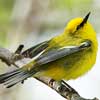
Blue-winged warbler. (Courtesy photo)
Oxbow’s bounty
On several early-morning trips to the Oxbow National Wildlife Refuge, we had a good selection of birds, including both orchard and Baltimore orioles, red-breasted grosbeak, and a pair of kingbirds, which we watched for several minutes gathering nesting material from a stand of sumac and flying to a large sycamore nearby where they were constructing their nest. The warblers we saw included yellow, pine, common yellowthroat, redstarts, and a new bird for Pam and me, a blue-winged warbler.
At first we were unable to identify the warbler, but after several minutes it hopped up to a bare branch illuminated by the low morning sun, giving us a great view and allowing us to confirm its field marks: bright yellow, thin dark eye-line, and two white wing bars on grayish wings.
Other migrants I have seen on the farm this spring are the eastern towhee, white-throated sparrow, chipping sparrow, pine warbler, yellow warbler, common yellowthroat, ovenbird, and lots of red-winged blackbirds.
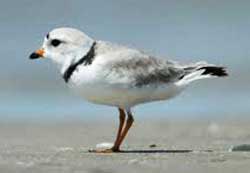
Piping plover. (Courtesy photo)
One evening we went up to Parker River N.W.R. for Wednesday-night birding with Bill Getty from Joppa Flats Audubon Center. We went to the north end of Plum Island first to check out the nesting piping plovers. The nesting area is roped off to protect the birds and their nests from human disturbance. Through our binoculars, we were able to see a pair of plovers with the female sitting on a nest, which is just a scrape in the sand. They are so well camouflaged that one only notices them when they move; it is no wonder that beaches are closed to vehicles and foot traffic during the breeding season, as they are almost impossible to see if you are not aware of them. While on the beach, which is at the mouth of the Merrimack River, we saw hundreds of long-tailed ducks flying down the river to the open sea where they would spend the night. These ducks are known as passage migrants; they stop briefly to rest up and then continue their journey to Northern Canada and the Arctic where they breed.
Another passage migrant
On the whole it was pretty quiet, but we did see a pair of purple martins on the gourd nests at parking lot number one. While we were driving on the refuge road, another birder stopped us and reported seeing a bay-breasted warbler around the Hellcat parking lot. We drove to the lot and after several minutes found the bird in some shrubs close to the path. This pretty little warbler with chestnut flanks and two distinctive wing bars is another passage migrant. It spends the winter in South America and breeds in the northern spruce forests of Canada.
Not a bad couple of weeks of birding, having seen three new birds: the blue-winged warbler, the Louisiana water thrush, and the bay-breasted warbler.
David Durrant lives with his wife, Pamela, on East Bare Hill Road at Micheldever Farm, where they watch birds—their own peacocks, chickens, and visiting wild birds.