On Jan. 21, people from across the country joined together in what has been reported as the country’s largest single-day protest, according to The Atlantic magazine. The movement, known as the Women’s March on America, drew hundreds of thousands of protesters in Washington, D.C., and at least 3 million more at 673 “sister marches” across the country and around the world, according to womensmarch.com.
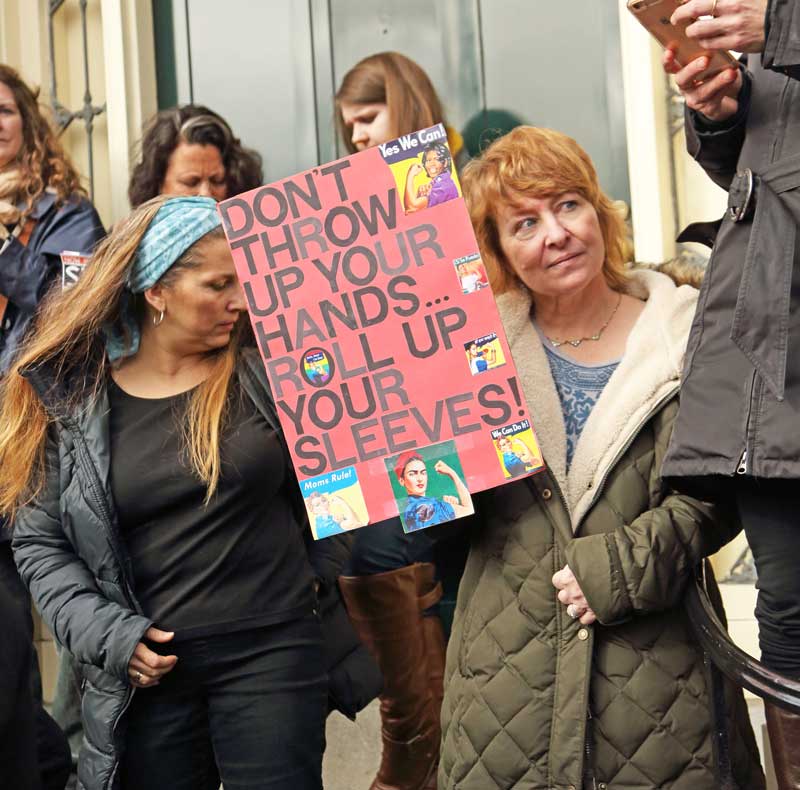
A protester in Boston on Jan. 21 holds a sign harkening back to Rosie the Riveter. (Photo by Lisa Aciukewicz) MORE PHOTOS
The cumulative number of protesters at all American marches on Saturday is estimated between 3.1 million and 4.6 million, according to a spreadsheet compiled by Erica Chenoweth at the University of Denver and Jeremy Pressman at the University of Connecticut, who have tracked down figures from newspapers, social media, and other sources, and published them along with links and cross-checked sources when available. The researchers, who state they were not collecting the information as part of a research project, made their data available “in the public interest,” according to a statement on the spreadsheet.
One of the larger sister marches took place in Boston, where organizers estimate more than 200,000 people participated, according to bostonwomensmarchforamerica.org. Marchers crammed shoulder to shoulder on the Boston Common to hear speeches by Senators Elizabeth Warren and Ed Markey, Massachusetts Attorney General Maura Healey, Boston Mayor Marty Walsh, and representatives of the NAACP, ACLU, Planned Parenthood, unions, and the tribal council of the Fresh Water People of the Nipmuc Nation and the Mashpee Wampanoag Tribe. The crowd shuffled along the mile-long route through Back Bay, singing protest songs such as Woody Guthrie’s “This Land Is Your Land” and chanting phrases such as “This is what democracy looks like.” Many carried signs and wore the iconic pink “pussy hats” that have become associated with women’s marches across the country.
Though the crowd size was much larger than organizers had anticipated, the march in Boston was peaceful, with no reported police incidents, according to the event organizers. In a tweet following the event, the Boston Parks and Recreation Department called the protesters “courteous.”
Among the Boston and Washington, D.C. protestors were some familiar faces from Harvard. Last week the Press invited local residents who attended either the Inauguration or the Women’s March to send in photos or personal reflections of their experience. While we did not receive responses from anyone who attended the Inauguration, many people wrote about their experiences marching in Boston and Washington, D.C. Here are a few of their reflections. The views expressed herein are not those of the Harvard Press and belong solely to the individuals who wrote them.
Metro Magic
by Jan Daley, Brown Road
On Saturday morning our party of 11, ranging in age from 3 to 74, caught a bus from Alexandria, Virginia, to the Metro. As the bus approached the train station, our local host, Lindsay, gasped at the sight of a giant anaconda line stretching around the block. “I’ve never seen this in all the years I’ve lived here,” she pronounced. We took our place at the anaconda’s tail and began to brainstorm possible alternative routes to the march. The line hardly moved while we pulled out phones, calculating the feasibility of driving into town (roads were jammed and there would be no place to park), hiring Ubers (even if they were available, how many would we need to transport 11 of us?), or riding bikes (not with our age diversity). We struck down each of our identified options. We began to wonder if we’d driven from New England to the capital only to miss the main event and spend the day instead sharing in the solidarity of the legions of pink hat-clad new friends in the line. A woman, perhaps East Indian, and her son stood by the line with a sign offering “Free Hugs to Marchers.” We happily accepted and thanked her for brightening our spirits.
Just as our hopes flagged, though, the snake slithered forward. We moved slowly at first, then very quickly into the concrete station. Word began to pass across the crowds that due to the sheer magnitude of our presence all around the city, the Metro had simply given up on charging riders. Workers propped open every gate and shouted their welcome to us as we gratefully spilled through onto the escalators and train platforms. The mass of humanity was tight but calm, exuberant and peaceful. And as it became clear that all of us (as we began to grasp the sense of unity that would define the day) would make it into the city for the march, a whoop of sonic exhilaration and joy swept across the crowd in waves and made us shiver with its volume and energy. We’d overpowered the transportation system. We were powerful. We were together.
A Unifying Event
by Suzie Allen, Littleton Road
I drove to D.C. with my daughter, Tegan Allen (age 8), as well as Jan Daley, Becca Mickey Allen, and Madison Mickey (age 16). We were there to stand up for the rights of many groups that our new president has threatened. We had an unbelievable experience at this uplifting, inspiring, and unifying event filled with smiles, chants, hugs, music, family, friends, and strangers with whom we became instantly bonded. We sang with Madonna and Alicia Keys, were inspired by Gloria Steinem, motivated to keep moving forward by Van Jones, and brought to tears by Ashley Judd. We chanted a call and response as we marched past the White House: Some called “Welcome to your first day” and others answered “We’re never going away.” We bring our experience and passion from the event back to Harvard and are dedicated to keeping our eyes open and staying active throughout the transition and presidency.
A Day of Generosity and Camaraderie
by Lucinda Bowen, Littleton County Road
The Boston march was an experience of enormous generosity and camaraderie, and gave me a palpable sense of being part of a larger community, a feeling that was a welcome relief from the sense of isolation and confusion that followed me after the election. The generosity started as soon as my son and I got on the train at Alewife, surrounded by a crowd of people in pink hats, carrying posters. I felt self-consciously aware of my own bare head—I had not had time to make myself one of the iconic square hats whose corners poked out from the wearer’s head like ears. As a knitter, I felt I had shirked some moral obligation to use my skills in what would undoubtedly be one of the most powerful public displays of fiber arts I would see in my lifetime. Just then, a woman touched my shoulder. “You don’t have a hat,” she said, as if reading my thoughts. “No,” I answered, guilty.
“That’s OK,” she said. “My mom, Nancy, made you one. She’s 86 and couldn’t come, so she made hats for us to give away.” She opened a plastic bag containing a few dozen hats and offered me my choice. I imagined Nancy surrounded by skeins of pink yarn, her aged fingers working the needles, doing her part quietly in her house, without the thrill of a crowd surrounding her or the palpable sense of solidarity I had already noticed that morning on the train. I grabbed the pinkest one. “I will wear it in her honor,” I said, and I put it on.
At the Common, my son and I walked around, scouting out the best vantage points, getting swept up in the energy as people arrived in droves. A young man walked up to us, polite and a little baffled. “Excuse me,” he said, “is there some meaning to the pink hats?” He gestured “everywhere” with his hands. Though the rally had not started yet, we were indeed surrounded. “Yes. They’re called ‘pussy hats’,” I answered, pointing to the cat-like “ears” the hat made on my head. “Oh,” he said, and then a second later, “Ohhhhh!” with a new level of comprehension. His eyes widened as he looked around.
We were standing near the Common parking garage entrance when I started to feel nervous. The garage felt dangerous to me—what if there was some kind of violent attack? I explained to my son that I wanted to shuffle away from the garage, a journey of about 100 yards that took nearly 30 minutes. As we arrived at the large tree that I had decided would be our safe zone, cheers erupted behind us and we turned to investigate. A large group of Muslim women carrying self-identifying signs and wearing bright pink headscarves was walking by, down an aisle of space that hadn’t existed a few minutes ago as we struggled to pass through. The people around these women were cheering and clapping as they stepped back to make room for their passage, calling out encouraging words of solidarity. The women’s faces beamed as they walked past with purpose, and I imagined the courage it might take to don such an attention-grabbing item as a bright pink hijab, before I stepped forward to lend my voice to the din.
A Historic Show of Love and Tolerance
by Natalie O’Leary, Old Meadow Lane
Hundreds of thousands of people—women, men, children, adults, elders—dressed in pink hats and holding colorful signs gathered in the very heart of Washington, D.C., this past Saturday, in a show of unity and support at the Women’s March on Washington. The three main avenues to the White House (Constitution Avenue, Pennsylvania Avenue, and Independence Avenue) were absolutely filled with people, jammed so close together that I found it difficult to lift an arm in the middle of the crowd. The sheer number of people more than doubled the predicted crowd, not just in D.C., but in almost every one of hundreds of marches that took place around the world on Saturday.
Yet in spite of the vastness of the crowd and the justified scrambling that was necessary to organize such a large crowd, the event was far from chaotic, simply due to the attitudes of those present. Nearly everyone marching with me was incredibly accommodating, generous, and supportive. If someone was separated from their family or needed to get across a certain area, there was no shortage of people there to direct them, to hold their arm so they would not fall, and to lift them up, both physically and mentally, over the barriers that separated them from where they needed to go. In a packed street where it seemed as though a person could not move even one step, we allowed an entire ambulance to pass through, simply because someone needed help, and all of us there were willing to do whatever was necessary to aid them.
More than just a march for female rights, this was an event of love among people, and a time to give voice to countless issues of civil rights that plague our country today. While the primary focus of the march was on women and how our new president will affect the lives of the female sex, as Scarlett Johansson put it, “If you want to talk about women’s issues, ask me about the economy.” Women preached and advocated for abortion rights, for equal pay, and for respect, but they also raised their voices for black lives, for immigrants, for the injustice of a Muslim registry, for an end to the plans to build a wall separating us from Mexico. The event was a historic show of love and tolerance for all, and a statement that the women of America will not stand idly by if the rights of any American citizens are questioned or slandered. It was an uplifting experience unlike any I have ever encountered, and I am proud to have been a part of this moment in history.
A Great River of Spirit
by Judith Schutzman, Littleton County Road
After Harvard’s small yet committed demonstration on the town Common during the Inauguration, every step of the march proved amazing in its camaraderie and strength in numbers. Early Saturday morning the platform in Littleton was already full of demonstrators with signs and high spirits; we boarded the commuter train to stand jubilantly shoulder to shoulder in the aisles. By the time we arrived, the Boston Common was packed, yet people held on to their good humor and patience as we waited for others (I thought of the crowds left standing on platforms, the train sweeping by with no room left). We sang “America the Beautiful” with full hearts, thinking about the words—in the second round “crown thy good with sisterhood” instead of “brotherhood.” Speakers were numerous; I was glad to hear the thoughts of union presidents as well as the great Elizabeth Warren. People around me included a couple with a toddler who amused herself with veggie chips, sitting on her father’s shoulders, a woman in a wheelchair, and members of the Dirty River Brass Marching Band. Still we itched to move along Beacon Street.
Sweet release to find ourselves in the street, marching, sometimes chanting or dancing in time to the music of the bands, carrying our signs overhead, and church bells ringing out song. People leaned out of apartment windows overhead, and police and sanitary workers were friendly and supportive. At the end people stacked their signs against the fence of the Common, enclosing the space in true populist sentiments.
It was an oceanic experience, joyful and pure in its belief in the future. For the first time since the election, I felt the mantle of depression drop from my shoulders. The earth depends on our actions—and I have witnessed the sea of humanity that moves with us in a great river of spirit and responsibility.
It’s About the Journey, Not the Destination
by Marty Green, Old Littleton Road
For people who been in cramped seats on a bus that seemed to have no springs from 1 a.m. and 8 a.m., we were surprisingly cheerful. With about 40 other women (and one guy), I had joined my sister-in-law and several friends going from Waterbury, Connecticut, to Washington, D.C., for the Women’s March on Jan 21.
When we disembarked at RFK Stadium among scores of other buses and saw the long, motionless line of people at the Metro station, we decided to walk to Capitol Hill. An 80-year-old grandmother rolled up her protest sign, tucked it under her arm, and set out on the 2-mile walk with us. Her teenaged granddaughters wore pink hats that matched hers.
The closer we got to the Capitol, the more walkers flowed in from side streets, like streams joining a river. When we reached the official march route, the crowd made it impossible to do more than shuffle inch by inch in what we hoped was the right direction.
At some points, especially intersections, we were jammed together so tightly that I could only admire the courage of the people with canes and walkers, the people in wheelchairs, the parents with baby strollers, in the midst of the crush. But no one seemed frightened or angry or even much annoyed. I must have heard hundreds people say “Oh, sorry” or “Excuse me” as we edged past one another.
Hand-crafted signs were everywhere, ranging from respectable to profane, heartfelt to hilarious. Some of the printable ones: “Keep Your Tiny Hands Off Obamacare,” “The Future Is Female,” “Respect My Existence, Or Expect My Resistance,” and “We Shall Overcomb.”
After about four hours (and eight zigzag miles on my Fitbit), we were nowhere near the White House. But we had almost made it to the Washington Monument. So, in a final act of civil disobedience, two of us climbed over some concrete barriers, cut across the Mall, and headed off for tacos and margaritas. All in all, a heartening and happy day.