CLICK IMAGE TO ENLARGE
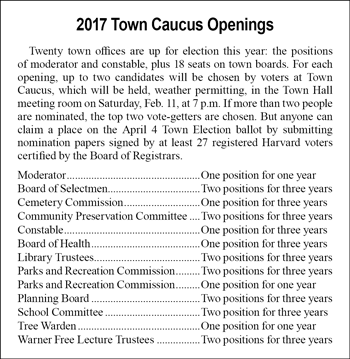
As a newly energized citizen, perhaps you’ve decided to run for the position of moderator, constable, or one of the 18 seats on town boards whose occupants are up for re-election this spring. Now what?
The mechanics of gaining a place on the ballot are straightforward; deciding where your skills would be of greatest use requires more thought (see our “Checklist for Candidates,” below).
Any registered Harvard voter can run for a seat on a town board. There are three ways to get onto the ballot: First, you can be nominated by the voters who attend Town Caucus, scheduled this year for Saturday, Feb. 11; second, you can collect signatures and file nomination papers; or third, you can offer yourself to voters as a write-in candidate on election day.
Nomination by Town Caucus is the simplest option. You don’t even have to be present. Simply arrange for two of your supporters—friends or neighbors—to attend the Feb. 11 meeting, one to place your name in nomination and the other to second it. Although there is no limit to the number of candidates who can be nominated for any given position, Town Caucus can choose only two for the ballot. If more than two are nominated, a vote is taken and the two with the highest number of votes are chosen. What’s the caucus advantage? Candidates selected by Town Caucus have “Caucus Nominee” printed with their names on the ballot. Caucus-nominated candidates must sign nomination papers, either before leaving the meeting or at the town clerk’s office, by 5 p.m., Tuesday, Feb. 14.
If you skip the caucus or fail to win a slot there, you can still collect signatures and file nomination papers with the town clerk. The number of signatures needed on a nomination form varies from year to year because of a state law that uses town turnout at the most recent gubernatorial election as its basis. This year the required number is 27. Town Clerk Amy McDougall has the necessary forms at her desk in Town Hall. The deadline for submitting the forms is 5 p.m., Tuesday, Feb. 14. McDougall could not be reached for comment, but last year former Town Clerk Janet Vellante told us firmly, “There can be no exceptions.”
Write-in candidates have no such deadline, but with no name on the ballot, their task requires lining up voters ahead of time. “I don’t recommend this approach,” Vellante told us last year. It’s rare for a write-in candidate to win an election when there are other names on the ballot, she said. “Think of it as a last resort,” she said, to be used only if you are not nominated or unable to submit signed nomination papers in time.
Write-in candidates sometimes create stickers to affix to the ballot, but Vellante recommended checking with the town clerk to make sure they will fit within the available space and can be read by voting-machine scanners. Handing out stickers or otherwise soliciting votes on election day is not permitted within 150 feet of the polling place. “If you’re planning a write-in campaign,” Vellante warned last year, “please let [the clerk’s office] know ahead of time. It helps us plan our vote counting on election day.”
But getting yourself on the ballot should be one of the last considerations of anyone seeking office, say the authors of “The Lexicon of Harvard Politics,” a guide first published by the League of Women Voters of Harvard in 1992, updated in 2014, and available at no charge at the League’s website. Before taking that life-altering step, they write, it’s time for some self-assessment.
First, do you understand the mission and responsibilities of the board you seek to join? What kind of expertise do you need to become an effective member, and what major tasks will the board undertake during your term of office? Membership on an elected board requires time and attention. Will you be able to attend regular meetings? Are you able to take on committee work outside of those regular times? Do you have the time and the drive to delve into topics that might come before your board but with which you are unfamiliar?
In addition to contributing your time and attention to the work of a board, as an elected official you will also be expected to be accessible. “Most voluntary town positions do not have secretarial assistance or other usual office support,” the guide observes, though in recent years that has begun to change.
While experience and skills can be important, the guide adds, it’s not necessary to be an expert to be a good contributor. What counts, the guide states, is the ability to work in teams and to collaborate with peers with whom you will not always agree, as well as a willingness to learn and master the details of the job. The several resignations from town boards this past year testify to the difficulties volunteers face.
In an email to the Press this week, Sharon Briggs, voter services coordinator for the Harvard League of Women Voters, said her organization hopes the charged political environment will encourage more Harvard citizens to run for office this year. “For the past few years, because of the lack of candidates, the League, which encourages informed and active participation in government, did not have a candidates forum,” she wrote in the email. “Seeing all the local and national engagement this year, we are expecting an increase in the number of candidates and are looking forward to a lively debate prior to the Town Election on April 4.”
A Checklist for Candidates
Thinking of running for office? Here’s a checklist of recommended actions:
- Read “How to Run for Office” in “The Lexicon of Harvard Politics” by the League of Women Voters of Harvard (available at the League’s website). Also read the free “Campaign Finance Guide for Local Election Officials,” available at the website of the state Office of Campaign and Political Finance.
- Familiarize yourself with the duties and scope of activities of the board you wish to join. Attend a few meetings and speak with current and former members to assess the level of commitment the job entails. Go to the board or committee website and read its mission statement as well as its recent minutes and agendas (links to the pages of all elected offices can be found at the Harvard town website). You might also consult the 2016 Master Plan (available on the Planning Board page of the town website) to see what actions the document has recommended town committees take over the next few years.
- Assess your own readiness to perform the duties of the office, including experience, interests, drive, and available time. Talk to a member of the board, friends, and especially family for advice and feedback. What unique qualities would you be able to bring to the work? How do you see yourself working with existing members? What would be your message to voters?
- Get advice on potential financial and other conflicts of interest. Is there anything that would prevent you from dealing with town matters in an un-self-interested way?
-
Place your name on the ballot by:
- Arranging to be nominated at Town Caucus on Feb. 11. Don’t forget to sign your nomination papers that night or no later than 5 p.m., Tuesday, Feb. 14, at the town clerk’s office at Town Hall.
- Submitting signed nomination papers containing at least 27 certifiable signatures to the town clerk no later than 5 p.m., Tuesday, Feb. 14. Signatures must be legible and must match exactly the names on the town’s list of registered voters. It’s wise, said Janet Vellante last year, to include more than the required number of signatures in case some are disqualified. Signatures are certified by Harvard’s four-member Board of Registrars.
- Asking voters to add your name to the ballot in the space reserved for write-in candidates. This is not recommended, said Vellante, and should be done only if you miss the Feb. 14 deadline.
- Form a campaign committee. It’s not required, but a small team of friends and supporters can help you keep your campaign on track. Having a treasurer is especially useful. File Massachusetts Form CPF M 101 (Statement of Organization) with the town clerk (forms are available at the town clerk’s office in Town Hall and online).
- Set up a means to record campaign contributions and expenditures. Get a copy of Massachusetts Form CPF M 102 (Campaign Finance Report), which you’ll have to file eight days before election day and again 30 days later.
- Start your campaign. Get out there and talk with voters. And have fun.