Year after year after year, winds, rain, and snow take down power lines here in town. Our schools shut down and town government services are limited to emergencies. Businesses, whether storefronts or at home, are often crippled. When the electricity goes out, so does broadband internet, and our mobile phone coverage vanishes. We are isolated, an especially difficult situation for our elderly population, which often needs regular help to get by.
Yet the two outages this year show that National Grid has done little to upgrade its delivery of electricity here. Effective tree-trimming, robust electrical wire structures, and improved government oversight can all boost the reliability of the power grid.
Tree-trimming
To be fair, both National Grid and tree wardens across the state need to live within state laws governing the relationship among trees, tree wardens, and public utilities. Trees within the defined right of way of a street and intruding onto wires can be cut or trimmed by the utility with consent of the tree warden, but if the base of a dead tree is outside the right of way, the property owner is legally responsible for removing the tree. Based on observation by Harvard’s tree warden, JC Ferguson, trees trimmed by the utility often die, causing further problems.
But, wait! It’s not just Harvard, so it’s not just our trees.
How can National Grid explain why more than 95,000 of its customers statewide needed to have their power restored after the March 15 storm, according to NBC Boston? And why was National Grid’s estimate for restoration of power during the storm off by more than a day? A National Grid program manager responded by email that the company invested $306 million in its Massachusetts electrical grid in 2021.
But that investment does not seem to make the power grid more robust—perhaps because the physical design of our local power lines is simply not sturdy enough to stand up to the elements.
Power line hardware
In Harvard and elsewhere, three electrical wires run from utility pole to utility pole. The wires highest on a utility pole are the electrical wires. The other wires and cables belong to the telephone company, Spectrum, and maybe others. Each wire stands all by itself between utility poles, with nothing to reinforce it against wind, rain, snow, or falling branches.
The design used by our neighboring municipal power companies in Hudson and Littleton is quite different. Municipal electric transmission has four wires, three live electrical wires and one nontransmitting so-called messenger wire for support. The wires are held together at the pole by a four-sided Hendrix cable spreader.
Similar cable spreaders between the poles keep the wires together, but at a safe distance from one another. Clearly, four wires kept close to one another will withstand wind, rain, snow, and falling branches far better than the spread out, three-wire setup here in Harvard. And it is no surprise that local municipal power companies did not have widespread power outages.
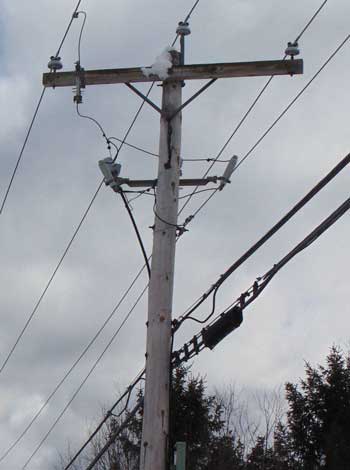
Electrical wires in Harvard. (Courtesy photos)
How did customers of nearby local municipal utilities fare? Groton had as much snow as Harvard, and a spokesman for the Groton Electric Light Department said the worst outage lasted three hours for 414 customers due to a tree falling on wires. Littleton Electric Light Department, also serving Boxborough, had one short outage for 50 customers, caused by a car colliding with a utility pole during the storm. Sterling Municipal Light Department reported that 398 of its customers lost power for 50 minutes, with a few other shorter outages. The town of Princeton had 2 to 3 feet of snow in the recent storm. Its municipal light department dealt with a half-hour outage for the whole town when the National Grid transmission feed went out, and about 500 customers lost service for eight to 10 hours. In the first large snowstorm of the year, Princeton was without electrical service for two days while the transmission feed from National Grid was broken.

Hendrix cable spreaders do their job in the town of Stow.
According to a National Grid spokesperson, the utility uses spacer cable where applicable. Construction that uses Hendrix spacers may be more resistant to tree branches leaning against the lines, the spokesperson said, but when a large branch or tree falls on Hendrix cable it can cause pole damage.
The experience of customers of municipal electric companies during the recent storm, however, seems to contradict National Grid’s statement.
Weak oversight for private electric power utilities
According to its website, the mission of the Department of Public Utilities’ electric power division is to ensure that electric distribution companies in Massachusetts provide their customers with reliable service at the lowest possible cost. The division, however, provides insufficient influence and oversight of National Grid. The electric power division’s mission does not call for oversight of municipal power companies, which seem to do very well on their own.
Governor Healey has appointed two commissioners with appropriate and independent credentials to lead the DPU. The most recent chair of the DPU, Matthew Nelson, was previously employed by Eversource Energy, part of the revolving door as people go back and forth between regulatory government positions and regulated industries.
For years, Harvard residents have all lost time and money during power outages, but National Grid CEO John Pettigrew took home £6.5 million ($7.87 million) in 2022, according to the Daily Mail. National Grid PLC in the United Kingdom has continual serious issues delivering power through its grid there. We are paying National Grid two to three times more per kilowatt hour than customers of the municipal power companies.
New state legislation
The current session of the Massachusetts Legislature has several bills under consideration. For instance, House bill H3128 would establish a commission on infrastructure resilience, and Senate bill S2181 would create a three-year process to manage improvements to the grid.
So our legislators clearly see that there is a need to improve the delivery of electricity, but the bills lack teeth. If we are to build a reliable electrical grid, what’s required are plans with measurable goals—yearly, instead of the proposed every three years, and with penalties for failing to meet milestones.
The Legislature should hold public hearings about the current bills under consideration, with focus on the cost and reliability of service. The DPU can also conduct its own hearings. National Grid, Unitil, and Eversource all need to be held accountable for their failure to improve the reliability of the electrical grid while at the same time gouging their customers. It’s high time to fix the delivery of electricity. Our state suffers along with the rest of the country from a mediocre power grid. The necessary push for greener electric vehicles and heat pumps can only worsen an already dire situation.
Ben Myers is a 38-year resident of Harvard and a local business owner, long involved in community activities.