Winter is a good time to get to know the species of birds common in Harvard. A bird feeder brings birds closer to home, so get a comfortable chair, a field guide, a pair of binoculars, a cup of tea— and study them. Knowing our common birds will help you identify an unusual or less common visitor. Climate change seems to be varying the winter range of some birds and that in conjunction with irruptions of more northerly birds can present some exciting opportunities for birders.
Sparrows are one species that may confound you. There are about 16 species of sparrows that can be seen in Massachusetts. Many people pass them off as “little brown jobs” or “LBJs” to birders. In winter there are usually two or three species that consistently hang around here.
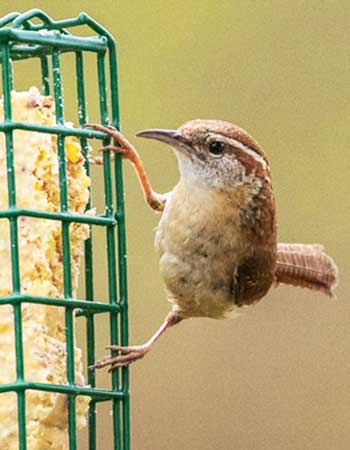
A Carolina wren feeds on suet, a high-fat food that builds up reserves to survive cold days. (Courtesy photo)
Most people are familiar with the English house sparrow, an introduced species, but have you really studied its features? The females are drab gray-brown overall with a plain crown and face. Their stout yellowish-gray bill is typical of many seedeaters. The males are a different story. They have whitish cheeks and a black throat patch. The rufous nape extends to the wings, which have a broad white wing bar. If you have chickens, house sparrows are invariably around feeding on spilled grain and invading the chicken coop. We are vigilant in tossing sparrows out of our bluebird nest boxes in the spring, as they will commandeer the box with their mass of messy nesting materials.
A bird that we are seeing more often in the winter is the white-throated sparrow. We usually hear this bird before we are aware that it is around, as its distinctive “Old Sam Peabody, Peabody, Peabody” is hard to miss and reminds us of hiking in the north woods of Maine, where the birds typically nest. Always found scratching around at the base of feeders or in leaf litter scratching for food, it sports a heavily streaked cap, an obvious white throat, a bright white eyebrow, and, if you look carefully, a bright-yellow patch by the eyes (which is much brighter in the spring). Listen and look for this beautiful bird, which is one of our favorites.
The song sparrow is another one easily missed, although if you know its song, you will remember it forever. A quick identification is its longer than usual tail and the bold streaks on its breast converging into a central spot. On closer identification, you will see russet stripes on the crown and through the eye, with a darker broad malar or mustache stripe.
Taking time to study the common birds at your feeders will make it easier to spot the unusual birds. Several people have reported seeing red-breasted nuthatches at their feeders this winter. Most people are probably familiar with the common white-breasted nuthatch. For the red-breasted, look for a reddish chest and a prominent black eye stripe. You will usually see them climbing up tree trunks or branches, or hanging on your suet feeder, not perched.
Winters are not the easiest time for birds. Most species that rely on insects and fruits have migrated to warmer places in Central and South America. For the species that remain around here, most are attracted to our feeders. Birds enjoy high-fat seeds like black-oil sunflower seeds and suet that build up their fat reserves for cold days. We feed “Zick Dough”* to our bluebirds and other smaller birds like chickadees and titmice that are small enough to get into our size-restricted feeder. Although warm-blooded, with temperatures slightly higher than ours, birds rely on these fat reserves and their feathered bodies to help them through the cold. The birds fluff up their feathers (much like we fluff up our down comforters) for trapping their body heat and deflecting the wind.
For roosting, birds search out dense natural cover, especially conifers, or find a sheltered spot on the leeward side of trees and huddle together. Some birds take advantage of tree cavities to provide shelter, and if you have nest boxes on your property, groups of bluebirds are known to huddle in these boxes. The Carolina wren that last year built a nest on a shelf at our back porch uses that nest throughout the winter to roost. She seems to put up with our going in and out, our back door only a few feet away. Many early mornings she is the first one to greet us with her song, which reminds us of our travels in the tropics.
Providing an open source of water is beneficial when most natural sources are frozen. We have a birdbath with a thermostatically controlled heater that keeps the water accessible all year. A heated dog bowl will do the same thing. Always put some rocks in the bath so the birds can stand on these exposed rocks and sip away. The rocks will deter the birds from fully bathing in the winter as extreme cold could freeze their feathers, making them unable to fly. You may want to challenge yourself and see how many species of birds you can see in your garden—we have counted up to 23.
David and Pam Durrant live and work at Micheldever Farm on East Bare Hill Road.
* http://juliezickefoose.blogspot.com/2010/03/zick-dough-improved.html
.