Imagine being alone on the ridgeline of some of the highest peaks of the Presidential Range in New Hampshire’s White Mountains in midwinter. Sensing the beginning of frostbite, with a wind chill of as much as minus 50, you are trying to turn around but are forced back by wind gusts of more than 100 mph that knock you over. You manage to send a signal from your emergency locator beacon to initiate a search effort.
This is a situation from New Hampshire native Ty Gagne’s book “Where You’ll Find Me,” which traces the route of 32-year-old Kate Matrosova who died mountaineering in the White Mountains Feb. 15, 2015. Gagne will tell that story and answer questions at the Warner Free Lecture over Zoom Friday, Jan. 14, at 7 p.m.
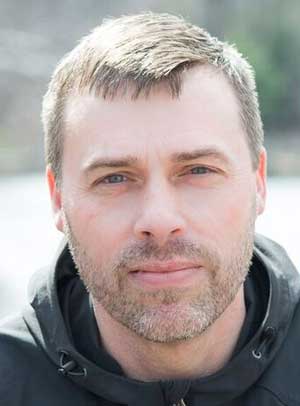
Author Ty Gagne. (Courtesy photo)
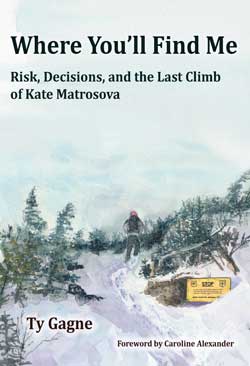
Gagne, CEO of Primex, New Hampshire Public Risk Management Exchange, and a certified wilderness first responder, said in a phone conversation that he began including Matrosova’s story as part of his educational and training presentations on risk management and the lessons to be learned from mountaineering accidents. His purpose was to explore how these things happen—the physical, environmental, and human factors that come into play—and what one can do to prevent them. Over a period of time, his talks became increasingly focused on Matrosova’s story, and he became committed to writing a book. “Where You’ll Find Me: Risk, Decisions, and the Last Climb of Kate Matrosova” came out in 2017. Gagne said he hopes the story will help people in assessing risk and in decision-making—whether in mountaineering or in everyday living.
Using information from Matrosova’s hand-held GPS, Gagne was able to reconstruct the route she took on her last day. He used software to work with information from the New Hampshire Fish and Game Department, the Mount Washington Observatory, and eyewitnesses to recreate the weather conditions and the terrain where she died. From her family he learned more about Matrosova’s personality, goals, and intentions. He said her husband told him that he admired her accomplishments and goals, and he respected the choices she made.
An accomplished climber, Matrosova’s goal was to summit the highest mountains on each continent. In 2015 she was living with her husband in New York City and had a highly successful career as a financial analyst. She had been climbing stairways in the city to keep in shape and had come to the White Mountains that February weekend to train. She had asked friends to join her but couldn’t find anyone interested.
A featureless winter landscape
She had a plan to take a northern Presidential traverse, a 15-mile route with an 8,700-foot cumulative elevation gain over the five tallest mountains in the Presidential Range.The ridge is completely exposed to wind and cold and has been described as a featureless winter moonscape. She had planned the route carefully, but she was not familiar with the trail system.
Matrosova chose to hike the traverse in fast and light alpine style, without any survival gear. She had checked weather forecasts and knew the coldest temperatures of the season were expected and that a storm was threatening. But she intended to race through the route and get below the tree line on Mt. Washington before any adverse conditions arose. Her husband let her off in the parking lot at 5 a.m. He received a notification midafternoon that her emergency locator beacon had been activated.
Gagne learned that she summited Mt. Madison and was above the tree line on Mt. Adams. The weather had worsened; she was behind her timeline; and the challenges were increasingly complex. Her decisions had left her exhausted, frostbitten, and facing an “impenetrable wall of wind” that caused her to turn back at a point too late to save her own life.
“We’ll never know what really happened,” said Gagne. But he said with temperatures reaching minus 50, hypothermia, “the silent killer,” would have affected her brain and disabled her ability to make good decisions in those adverse conditions. She was able to use her emergency locator to send a signal for help.
The risks of attempting rescue
New Hampshire Fish and Game Department sent a small rescue team, but they were unable to find her and turned back in the worsening weather. A larger rescue party, including volunteers, hiked up the next day in equally bad conditions; they found her body that afternoon. The second part of Gagne’s book is about the challenges the rescuers faced, the decisions they had to make, and how the rescue attempt affected them.
Gagne said he looks without judgment at the decisions Matrosova made that day and the risks she chose to take. She had a plan that included ways to opt out if she needed to. He looks at each point where she could have turned back and explains what may have caused her to think it wasn’t yet time to bail. Everyone has something they’re passionate about, he said, and decisions are fueled by emotions. With more understanding of what was influencing her decisions, she might have made different choices that may have led to her survival rather than her death.
He also brings empathy to his analysis. Gagne said in 2008 he made bad decisions that could have resulted in a tragic outcome for himself and two others. He said he ignored the fact he wasn’t in the best condition, and he let his ego and deference to a more experienced climber prevent him from saying he wanted to turn back. He said he learned a lot and that the experience had a profound effect on his future decision-making. In Matrosova’s case, Gagne thinks her high drive and previous accomplishments influenced her decision to stick to her plan. “But things got away from her.”
“Something has gotten away from each of us at some point,” Gagne said. What’s important is to recognize what drove the poor decision and to reflect on how we can make a better choice the next time. We need to be open to new information and to look at ourselves with a wider lens. Whatever our “summit” is, we need to be aware of what emotions and biases in ourselves trigger too much risk and how we can structure our choices to minimize the consequences if we choose poorly.
Gagne’s book is available on his website, but he made a point of saying he hopes people will choose to purchase it from an independent bookseller.
To register for the lecture, go to bit.ly/3pScEUO.