The new elementary school is on schedule for its May 2021 opening despite winter weather fluctuations, and it is on budget despite dwindling contingency funds. At a meeting last week. the School Building Committee considered those issues as well as future plans for solar roof panels and possible opportunities for students to use the project for real-world learning.
Winter weather has created challenges for the elementary school building project, Tom Murphy of the project management firm NV5 told the School Building Committee last Thursday. Since cold weather set in, workers have needed diesel-fueled generators to heat the tarped-off spaces where concrete slabs are being poured. The cost of heating those areas, Murphy said, “has been a challenge to the budget.”
But Murphy also had some good news on that front at the building committee’s Jan. 16 meeting. National Grid at last had the natural gas line and meter ready for use at the site. “They just have to take the lock off,” Murphy said, and neither diesel fuel nor rented generators will be needed any longer. As for electricity, however, National Grid has yet to install the lines to supply the building site with power.
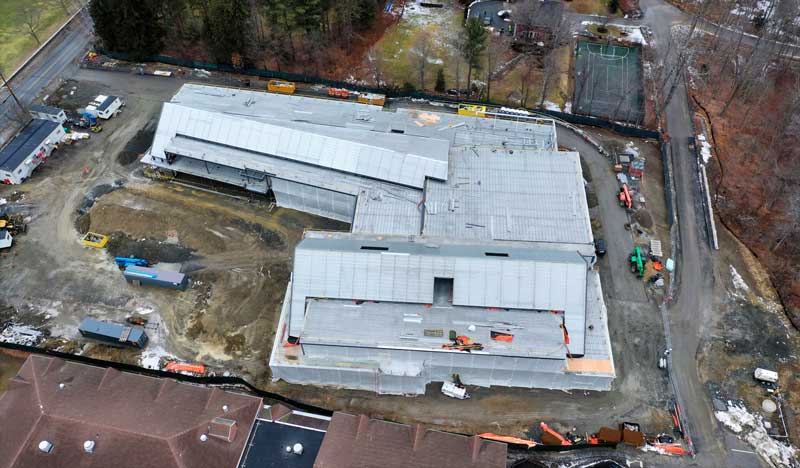
Aerial view of the construction site, Jan. 11, 2020. (Photo courtesy of Will Stevenson)
Ryan Lynch, the project executive for Shawmut Construction, gave the committee an overview of the building’s progress. Structural steel work was 95% complete, he said, and workers were slated to begin framing the exterior walls this week. He expected concrete pours to be finished by Jan. 31, helped along by the two days of unseasonably warm weather earlier this month. Looking farther ahead, Lynch said roofing is scheduled to begin in March, followed by windows and masonry in April and May.
As for the weather’s effect on the project budget, Lynch said, “We are very solid on the GMP”—that is, the guaranteed maximum price set for Shawmut’s construction work on the project. That price includes a contingency fund for winter conditions, most of which is being spent this season. But project manager Murphy said the expense is normal for this stage; he did not expect to need much of this contingency money next winter, when the building will be fully enclosed.
Changes cut into contingency funds
The new school is still within budget, as Lynch and Murphy agree, but some items are slowly eating through the contingencies that were built into the budget to cover “unknowns.”
Earlier this month, the building committee accepted a change order of nearly $150,000 to raise the sewer lift station. The station is the part of the town sewer system that sends sewage to the water treatment plant. The location of the station behind the elementary school isn’t changing, but parts of the system must be raised because the land there has been regraded for the new parking area, building committee Chair SusanMary Redinger explained in an email. Other changes include moving the lift station control panel, electrical work, and adding a shelter and fencing for the station controls. Murphy noted that all these changes had been vetted by the town’s engineering firm for the system and by the company that operates the system. As a change order, this expense will be covered by the owner’s contingency—a percentage built into the budget for changes the town requires.
As the construction manager at risk, Shawmut also carries its own contingency fund to cover bids from subcontractors that come in higher than expected. At last week’s meeting Lynch gave the building committee a list of all such costs from final bids. While some bids had come in lower than estimated, others were higher. In particular, Lynch admitted that Shawmut’s estimating team had mistakenly omitted the cost of final cleanup of the building and site after all construction is complete. That cost, listed at $110,000, will now have to come from the construction manager’s contingency fund.
Planning for solar panels
Committee member Ron Ostberg asked if the new school’s roof would be “absolutely clear” to allow for solar panels to be placed in a regular pattern, not in a haphazard patchwork. The photovoltaic panels are not part of the current construction project but are expected to be added later, with funding from the state or other grant. Katy Lillich of the Arrowstreet architecture and design firm said architects were working to make sure two roof vents did not interfere with the layout of the proposed panels. She also assured committee members that the roof had been designed with the weight of solar panels in mind.
Committee member David Fay said Arrowstreet is sending its drawings for the roof to Solect Energy of Hopkinton, a firm that has worked out power purchase agreements (PPAs) with more than 50 schools in Massachusetts. Under a PPA, a solar provider such as Solect would pay for the panels and their installation. The town would get cheaper electricity for the school building, but it would not get as high a return from the utility company because much of that return would go to the provider.
The one stumbling block, Fay said, is that the state has capped the number of large solar installations it will allow in National Grid territory, and that cap has been reached. However, some legislators and environmental groups are working to raise the cap. Fay suggested, based on advice from Solect, that Harvard begin planning for the PPA because there will likely be a rush to get into the state program if the state does raise the cap.
Involving Bromfield students
Committee member Joe Tardif asked if there was a way that interested Bromfield students—likely in the engineering classes—could see the CAD designs for the new school. Tardif said he would volunteer some time to work with students who wanted to be more involved with the project. Fay suggested that kids who are interested in environmental issues might want to join some of the meetings on solar planning. Ostberg concurred, saying students who take part could gain “the sense of what it means to be a builder today.”