“If there is no struggle, there is no progress. … Power concedes nothing without a demand. It never did and it never will.” These words by Frederick Douglass appear after the dedication page in Tina Cassidy’s new work, “Mr. President, How Long Must We Wait?” The book describes the long struggle of suffragist Alice Paul and others as they demand President Woodrow Wilson’s support in passing the Susan B. Anthony amendment giving all American women the right to vote.
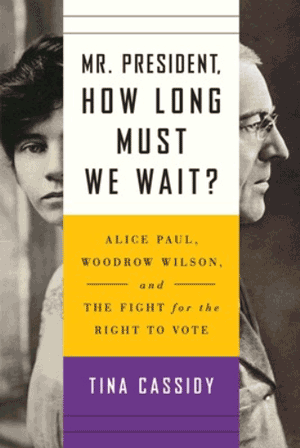
Cassidy is the author of two previous books and, as a journalist, she spent most of her career at the Boston Globe. She will be speaking at Fivesparks, Oct. 20, at 5 p.m. to kick off the Harvard Press Speaker Series. Journalist Charlie Sennott will moderate the program. The series is a fundraiser for Fivesparks and the Press as well as an endeavor to raise awareness in the community of the power of the written word through narrative journalism. A book signing (books from The Silver Unicorn bookstore in Acton) and reception with libations and light bites will follow the talk. For tickets go to eventbrite.com.
In her preface, Cassidy talks about her surprise that, in doing her research, she seemed to be looking not at the past but the present: “The issues at the heart of American democracy remain the same today as they did a century ago.” In making some points of comparison, she concludes that we often fail to remember that “it takes just one person—however imperfect—who is utterly committed to change, to make it happen.”
For the passage of the 19th Amendment a century ago, that one person was Alice Paul, whose incredible persistence in the face of so many defeats is truly inspiring. Cassidy’s account of this remarkable, yet not widely known woman shows how, had it not been for her tireless efforts, the Susan B. Anthony amendment and the work of the early suffragists might have come to naught—or at least been delayed for even longer than it was.
Wilson vs. Paul
With a wealth of primary and secondary source material, Cassidy makes an organizational decision to alternate chapters between the perspectives of Paul and Wilson to show their individual issues and also the oppositional nature of their relationship. In the first two chapters of the book we meet Alice Paul, a 23-year-old Quaker woman from New Jersey taking a specialized graduate course in Birmingham, England. She has always had a love of learning and feels that her purpose in life is to help other people.

The year is 1907, one year after the death of Susan B. Anthony and 49 years after Elizabeth Cady Stanton led a women’s convention in Seneca Falls, New York. Paul attends a Votes for Women rally where she is inspired by the words of Emmeline Pankhurst and her daughter, who have earned the derisive name of “suffragette” for their militant activism. Paul is both shocked and motivated by the chaos surrounding the event—it is unlike meetings she had attended at home.
Paul was inspired to become an activist, standing on a soapbox in a London park for the cause of suffrage, pelted by rotten fruit and rocks, and traveling England making speeches with the Pankhursts. The first of her many arrests, hunger strikes, and forced feedings, which would have a lasting impact on her health, happened in England. In 1910 she returned home and pursued a doctoral program at the University of Pennsylvania.
Attention shifts to Woodrow Wilson, a boy during the Civil War, whose father taught him that the Bible condoned slavery and inequality and whose education at Princeton ingrained in him the idea that universal suffrage is at the foundation of every evil in this country. As president of Princeton University, he decried the snobby eating clubs but refused to admit blacks or women to the school. Later, while he espoused progressive ideas in his presidential bid, his subsequent behavior showed that his early bias against racial and gender equality ran deep.
Protagonists collide
The paths of Paul and Wilson are moving toward one another, and they collide at the latter’s inauguration in March 1913. Paul has organized a suffrage procession timed to coincide with Wilson’s arrival at the Capitol. Thousands of women dressed in white with colorful capes march behind a beautiful woman on horseback, whom Paul has deliberately chosen to counter the stereotype of a feminist as an angry, homely spinster. Paul has insisted, over the protests of some of the women in the group, that black women be part of the march, and she has strategically scattered them in the procession. The march is radical and shocking. Groups of men heckle the women, pushing them into a narrower and narrower space. The police do nothing to protect the women until finally they call out the cavalry. Meanwhile, Wilson is met with a small welcoming party and surprised by the deserted streets.
That next day, Paul had scheduled the first of what would become many meetings between representative suffragists and Wilson. Each of five prominent women spoke in support of universal suffrage. And, as he would do so many times, Wilson refused to bring the proposal to Congress. Tax reform and currency were his priorities, he told them. Later it would be one evasion after another—his remarriage, the war, prohibition—or just a flat “no.”
Paul and her close associates were part of the National Union of Women’s Suffrage Societies, but for Paul the group was moving too slowly and its goal was too broad, so she formed a Congressional Union committee whose sole function was pushing for a constitutional amendment. She organized marches, conventions, letter writing campaigns, and auto brigades to collect signatures across the country and drive petitions to Washington, D.C. She launched a weekly newspaper, “The Suffragist,” to educate and inspire—and to raise money. When a delegation from New Jersey was turned away because they had no appointment with Wilson, Paul urged them to show up outside his office anyway.
Silent sentinels
When these traditionally polite methods made no dent in Wilson’s stance against universal suffrage, Paul organized picket lines around the White House, with women working in shifts to be “silent sentinels” holding signs and banners. Despite being arrested (illegally) and placed in a workhouse where the food was inedible, where toilets could only be flushed from outside, and the cells rat-infested, the women continued to picket for a year. Paul staged hunger strikes in jail, where the women would be fed milk and raw eggs through a tube up their nose, causing them to scream, vomit, and bleed. Wilson instructed his aides to tell the press the women did not object to the treatment.
Cassidy quotes often from Paul’s entreaties to Wilson and from the signs and banners the women carried. One vivid scene takes place when Paul and others are seated in the gallery in the House of Representatives where Wilson will address Congress. As he enters, they lower a huge banner reading, “Mr. President, what will you do for women suffrage?” An effective strategy of Paul was to use Wilson’s own words against him. In a message to Congress he said, “We shall fight for the things we have always held nearest our hearts …for the right of those who submit to authority to have a voice in their own government.” The reader’s frustration mounts with that of the suffragists as Wilson refuses to see the irony of his words in the face of 20 million Americans who had no voice.
While Cassidy does show the more personal side of Wilson and creates some sympathy for the domestic and international difficulties he confronts, she more often juxtaposes his comfort with the hardships of the suffragists. While Wilson and his wife golf, Paul and others are exhausted and ill from their relentless campaigning for equality. Wilson sits by his fire on the first day of his new term while outside on a rainy day 1,000 women circle the White House four times, one for every year they have been petitioning and Wilson has ignored them. He poses for a portrait by John Singer Sargent, while prominent women are freezing and humiliated in jail.
When the Susan B. Anthony amendment finally passes Aug. 26, 1920, it seems almost a Pyrrhic victory. And, as the last sentence of the book says, “There is still so much to be done.”