The first Harvard Open for Business breakfast, jointly hosted by the Nashoba Valley Chamber of Commerce (NVCoC) and Harvard’s Director of Community and Economic Development Christopher Ryan, brought together local businesses with advocacy groups and resources. Five guest speakers representing regional business resources introduced their organizations to more than 60 attendees in the upper Town Hall meeting room May 30. Everyone enjoyed a breakfast catered by the Harvard General Store, and Planning Board Chair Erin McBee later remarked, “The business breakfast was awesome; we even had people from the governor’s office.”
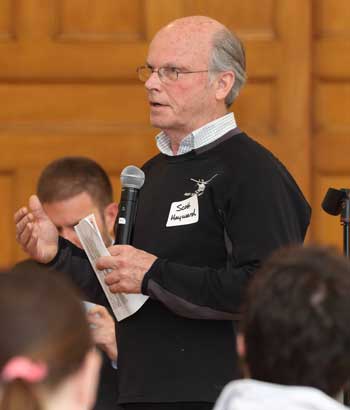
Scott Hayward comments that competition is good for local businesses. (Photos by Lisa Aciukewicz)
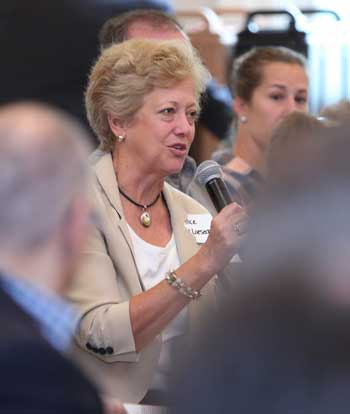
Select Board member Alice von Loesecke takes the mic.
After around 15 minutes of breakfast and networking, Select Board member Kara Minar kicked off the event with a brief overview of Harvard’s business assets, including the fact that more than 13,000 cars travel Ayer Road each day.
Melissa Fetterhoff, president and CEO of the NVCoC, listed the resources her organization offers to businesses, including advocacy, education, and networking. Peter Milano of the Massachusetts Office of Business Development explained how his office uses tax relief programs to partner with businesses and municipalities to encourage growth. Kelley Arvidson, MassDevelopment vice president for business and economic development in central Massachusetts, told attendees how her organization helps finance housing and economic development projects. Paul Matthews, executive director of the 495/MetroWest Corridor Partnership, offered a data-driven analysis of Harvard’s economic progress and assets, highlighting its consistent growth and well-educated populace.
Ryan laid out the projects he is currently working on. These include improving the bylaws’ ease of use with a recodification and usage guide; proposed bylaws offering business and housing incentives for preserving historical features and open space; preserving the town center’s aesthetic with an architecturally prescriptive zoning district; improving Harvard’s housing diversity with bylaws oriented toward addressing the town’s lack of both affordable housing and senior housing; and upgrading the town’s water, sewer, and internet infrastructure.
Harvard’s opportunity area
Describing the Ayer Road commercial district as “Harvard’s opportunity area,” Ryan outlined a three-step project to encourage its economic growth. The steps would be a market analysis study, a study of the road’s traffic and infrastructure, and the creation of a form-based zoning code. Such a code requires buildings in a neighborhood to follow a specific architectural plan, sacrificing design freedom for consistent appearance. Ryan explained that such codes, already adopted in areas of nearby towns such as Ayer and Littleton, are “a melding of architecture and planning.” He said they allow a town to open up development within narrow design parameters, allowing the town to reap the benefits of development without losing its unique character. Milano suggested that Harvard might take advantage of a MassWorks infrastructure grant to improve utilities within the corridor.
Success stories
The breakfast also featured two Harvard success stories presented by local business owners. The first was Scott Hayward speaking about the Harvard General Store. He shared the story of how another small business owner in a different town worked to overcome a regulatory hurdle preventing restaurants with craft breweries from offering their own brews on the premises, and finally succeeded after convincing the governor to relax the regulations. The new regulations, Hayward explained, allowed Harvard’s General Store to expand its own business, demonstrating how small businesses can jointly benefit from advocacy.

Kerri Green asks about bylaw changes.
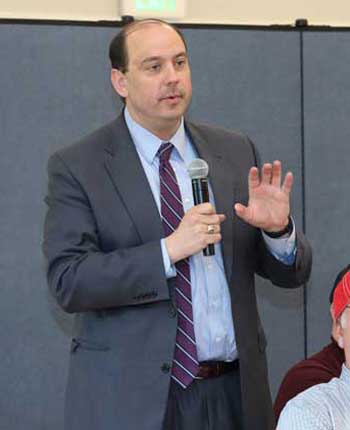
State Senator Jamie Eldridge stopped in to hear about local business owners’ concerns.
During the Q/A period for Hayward, Nicky Schmidt of the Agricultural Advisory Commission cautioned attendees to be aware of the effects economic development could have on existing businesses, saying, “If we are talking about adding businesses to the Ayer corridor that will put the General Store out of business, we have defeated our purpose here.” Hayward responded with support for economic development. “I see all traffic in Harvard as good for the town center,” he said. “I am a competitor; I am not afraid of having competition. We have to look at it that way and not have a zero-sum approach to business.” Hayward’s declaration was greeted with applause from the crowd.
Mark Mikitarian, board president of Fivesparks, the organization formerly known as the Harvard Cultural Collaborative, offered the second success story. He discussed how his organization’s name changed: After realizing that it was being confused with the Harvard Cultural Council, the cultural collaborative held a townwide drive to find a new name. The winner, Fivesparks, is the name of an asteroid discovered at Harvard’s Oak Ridge Observatory. Mikitarian also advertised the organization’s upcoming second annual music festival, and its prospective tagline “Arts, Culture, and Community.”
After the final Q/A period, Ryan invited the guests to stand up and introduce themselves and the businesses they represented. This list, with many names, including Chris Connors of Rollstone Bank & Trust, Kerri Green of Westward Orchards, Kim Casto of Bodylines Pilates, and many more, demonstrated the richness and variety of local business.

Town Planner Chris Ryan leads a discussion with local business owners about encouraging growth on Ayer Road.