The School Building Committee thought it received some good news at its June 20 meeting when NV5 project manager Tom Murphy said that with preliminary bid results for the nontrades in hand, the budget overage had shrunk from $900,000 to $500,000. What he neglected to mention, both verbally and in a spreadsheet handed out at the meeting, was that the remaining design contingency and escalation funds, about $590,000, had been added to the construction budget; it was not that construction costs had gone down.
The preliminary nontrade bid total is just slightly over estimates. That’s good news, because the trade bids exceeded estimates by 6%; but also bad news, because the nontrade bids had no effect on the $900,000 overage, something the committee had hoped for. Of bids for the 20 nontrade categories, which include drywall, demolition, and landscaping, 11 were below estimates and nine were over. Murphy said negotiations with the nontrade contractors are ongoing, but he doesn’t expect the numbers to change much.
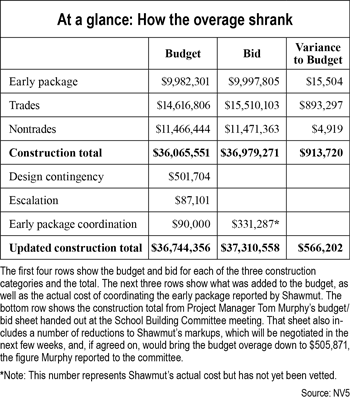
On discovering it was not the nontrade bids that had reduced the overage, the Press postulated that the design contingency and escalation funds had been added to the budget. The Press contacted School Building Committee Chair SusanMary Redinger, but she did not respond to this theory. However, Murphy confirmed that the $502,000 remaining in the design contingency fund and $87,000 remaining in the escalation fund had been added to the construction budget. These funds had been carried in the project soft costs, and are now used up.
In a prior meeting, the committee had spoken about the possibility of using the remaining design contingency funds to negate the bid overage, so it is unclear why at this meeting he did not inform the committee of the accounting transfer, or why Murphy implied the nontrade bids had reduced the overage. The Press reached out to Murphy for comment, but had not heard back in time for this paper. Select Board liaison Alice von Loesecke, who attended the June 20 SBC meeting by phone, told the Select Board at its June 25 meeting this week that the nontrade bids were much better than the trade bids and “by the time we got those worked in, the overage was back down to around $500,000,” implying she did not know the real reason it shrank.
Coordination cost overrun adds to overage
Had the full design contingency and escalation ($590,000) been applied to the overage, it would have shrunk to $310,000, not $500,000. But, as Murphy explained to the Press, there had been an additional cost overrun of $241,000, this one incurred by Shawmut in coordinating the early package work (see “At a glance” table above). This overrun was also not mentioned in the committee meeting, although it was included in Murphy’s final overage number.
The committee is also dealing with two costly change orders that have already taken a large bite out of the construction contingency. (See boulders story.) As a result, it will be looking at the list of five bid alternates as well as possible value engineering items that could be cut from the project. Cuts are still allowable to nontrade items at this stage of the project because the town is using a construction manager at risk instead of a general contractor.
Next: Alternates and value engineering
Murphy said the five alternates, which are currently included in the project, represent about $460,000 of direct costs (before markup). Massachusetts General Law requires cutting the alternates from the project in order, and alternate five, curtainwall sunshades (on the outside of the building), is the highest priced item on the list at $184,000. Committee member Nick Browse said the committee has to cut all five items to get to that one. Chair SusanMary Redinger replied, “We may, we may not,” and Browse replied, “Where else are we going to get $184,000?” Member Rick Maiore agreed with Browse, saying, “We have to get to a balanced budget.”
Murphy also distributed a list of value engineering items for the committee to consider. Some, such as gym bleachers and scoreboard, were identified as possible candidates for fundraising. Others, such as using solid-surface countertops instead of quartz, which would yield a savings of $72,000, were suggested by the nontrade bidders as possible ways to save money.
The committee must negotiate a “guaranteed maximum price” (GMP) for the project with Shawmut by July 18, and Murphy suggested it appoint a negotiation working group for that purpose. The GMP represents the total of all the bids plus Shawmut’s markups. It does not include the cost of change orders; the town is responsible for paying for those, and the budget includes a 5% construction contingency for that purpose.
The committee will likely meet July 11 to discuss the bid alternates and value engineering items and will definitely meet July 18 when the GMP must be finalized.