Most years, Annual Town Meeting (ATM) attendees are quick to pass the largest financial item in the warrant. It is rare for the omnibus budget, which this year comprises 64 line items and totals $27 million, to require more than five minutes for discussion and a favorable vote.
The secret to the speed of its passage is the wrapping of the spending requests of every town department in a single article. Now Town Administrator Tim Bragan, with the approval of town counsel, the Select Board, and the finance and capital committees, wants to apply that approach to the 15 spending and borrowing requests of the Capital Planning and Investment Committee as well as the eight Community Preservation Committee requests. Traditionally, each of these would have been presented as a separate article. But this year they have been collected into three groups, each of which each can be approved in its entirety by a single vote of town meeting.
“It’s an experiment,” commented Select Board member Alice von Loesecke when Bragan presented the plan earlier this spring.
How would it work? Much the same way the omnibus budget is handled currently, said Bragan in an interview earlier this month. When the budget is presented each year, the town moderator leads attendees through the recommended expenditures, one page at a time. If a voter wishes to comment on any item, the moderator pauses to allow discussion and motions to amend before moving on to a final vote on the entire package—as amended, or not.
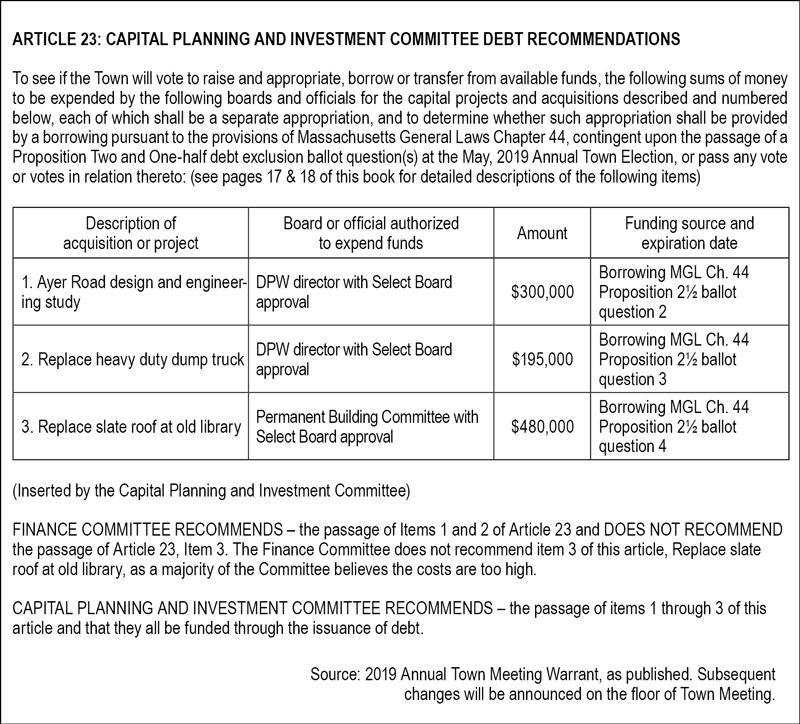
This year Moderator Bill Barton will use a similar approach to present CPIC’s Articles 22 and 23 and CPC’s Article 26, each a bundle of requests with the same source of revenue. Barton will ask for comment on each item, and if there is debate or a desire to offer amendments, he will set it aside and return for debate, amendment, and a separate vote once the rest of the article has been decided. The items in each article are sparsely worded, however, and for details, attendees must flip to the reports of the capital and community preservation committees at the front of the warrant book. (As an example, see Article 23, which appears below.)
Bragan says that he and Barton have rehearsed the procedure and he is confident it will go smoothly and speed up the proceedings. At past town meetings, voters have approved capital and CPC requests quickly with little debate. A search of town meeting minutes from 2014 through 2018 found that only one money article had been rejected, a request for more parking at the beach in 2014. Previously, the biggest ‘no’ vote for a money article in recent memory was the request for additional spending for the Town Hall renovation at 2013 Special Town Meeting (STM).
Discussion of money articles has likewise been rare. Tree maintenance articles at ATM 2015 and ATM 2016 sparked debate on how that maintenance should be done. There was a push to use free cash instead of other funding sources for additional Hildreth House renovation funding at STM 2016 and for fire pond restoration at ATM 2017. There were changes to wording as well as articles dealing with the town planner’s salary at ATM 2017, new servers for Town Hall at ATM 2016, and an emergency generator for the town well pump at ATM 2018.
With additions, deletions, and revisions to this year’s money articles making their way through committees, whether the new procedure will make for a smooth or bumpy ride remains to be seen. Townspeople will receive their own copies of the warrant booklet sometime next week, when Bragan says they will be mailed (or they can visit the town website, where the warrant was recently posted), and can judge its content for themselves. The test drive is Annual Town Meeting, which convenes Saturday, May 4, at 9 a.m. in the Bromfield gym.
Joan Eliyesil contributed to this story.