The documentary film “Paper Lanterns” exists because of three dedicated, compassionate men who refused to let the lives of 12 American pilots killed by the bomb dropped on Hiroshima be forgotten. Two of those men will be at the showing of the film at the Warner Free Lecture Feb. 8 at 7 p.m. in Volunteers Hall and will answer questions and sign books. Barry Frechette, who lives in Billerica, directed the film, and Harvard resident Peter Grilli is the co-producer. At the heart of “Paper Lanterns” is Shigeaki Mori, who lives with his wife outside of Hiroshima.
Mori was 8 years old on Aug. 6, 1945, and it was only by chance that he was not one of the 1,000 students who died in a school close to the hypocenter of the bomb. A few days earlier, Mori had been withdrawn from that school and enrolled in one a bit farther away. The horror of that day and his fascination with discovering the truth of history later sent Mori on a 40-year search to bring to light an unknown fact—12 American prisoners of war had also been killed by the atomic bomb. He felt a deep sense of connection to them and was determined to find the truth about their deaths so their next of kin could have closure.
After the bombing there was great confusion, but in time more facts became known. An American bomber, Lonesome Lady, and smaller fighter planes had been shot down while on a mission to destroy a Japanese cruiser hidden in a bay near Hiroshima. Twelve survivors had been taken to a military police station in the heart of the city. The U.S. had lost track of the men, and their relatives had known only that the pilots were “missing in action.”

President Obama embraces Shigeaki Mori in 2016. (Courtesy photo)
Mori, who worked as a clerk at a security company, devoted decades of his spare time to learn the identities and hometowns of these 12 men. In each town or city, he obtained phone listings and called everyone with that last name, looking for relatives. While very supportive of her husband’s project, Mrs. Mori objected to the long-distance phone calls, saying their family could go bankrupt from them. In answer to her concerns, Mr. Mori took a second job to pay the phone bills. In time he managed to connect with the relatives of all 12 men, giving the family whatever details he had about the death of their sons. Two such families were the Brissettes of Lowell and the Neals of Harrodsburg, Kentucky.
Norman Brissette had enlisted in the Navy at the age of 17 and died at 19. Barry Frechette had grown up knowing about Norman because his great uncle, who had survived the war, was Norman’s best friend, and the families had stayed in touch. On Christmas 2012, Frechette was visiting the family and Susan, Norman’s niece, showed him a scrapbook she had put together on her uncle. Frechette looked at the book and at the face of the young man on the cover and was overcome with the desire to do something to honor his memory. And he knew he had to go to Japan to meet Mori, the man responsible for bringing closure to Norman’s death.
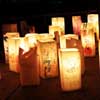
Frechette, who works in advertising in Boston, wanted to make a film, but he didn’t have any real plan when he went on Kickstarter to raise money to find a way to recognize Mori’s compassionate achievement and to memorialize the American men whose fates were now known. He called the project “Paper Lanterns” after an annual ceremony at Hiroshima Peace Memorial Park where family members write a message with the name of a loved one killed by the bomb and send the lighted lantern down the river.
Peter Grilli, who grew up in Japan and works at the Japan Society in Boston, an organization that fosters cultural connections between Japan and the United States, happened to come upon Frechette’s proposal. Not only was he intrigued by the subject; he was impressed by the fact that Frechette cared so deeply about this cause that he was using his own money to get started. From that point until the end, Grilli supported the project, and Frechette says he could not have moved forward without the help of Grilli and the Japan Society in Boston.
Helping the enemy
In 2014 Frechette traveled to Japan to meet Mori, who gave him a lot of factual information, gleaned from boxes upon boxes of records he had accessed. He described accounts of eyewitnesses to the downing of the U.S. plane by Japanese anti-aircraft and to the capture of survivors. But he didn’t talk much about why he had devoted 40 years to “helping the enemy.”
On a subsequent trip, Frechette took Brissette’s niece Susan, who had never traveled in a plane before. Waiting in a hotel room to meet Mori, Susan paced nervously. At his home, Mori kept looking out the window, nervous about his first encounter with a relative of one of the POWs he had researched. It was a moving experience to see these two people come together.
It wasn’t until Frechette’s next trip that he felt he got to see a more emotional side of Mori, and he attributes that to Ralph Neal, namesake of his uncle who was killed in the atomic explosion. Ralph is an empathetic, gregarious, and emotional preacher, who was able to get Mori to go beneath the facts and talk about why he had spent four decades doing this research. Mori admitted that it wasn’t only to find the historical truth. He saw these American men as fellow victims of the war. While there were 300 memorials to Japanese and others killed by the bomb, there was absolutely nothing for the Americans. On that Aug. 6, Mori could have been right next to where the prisoners were jailed, and he felt a connection to them. He had compassion for the relatives who never knew the truth, especially the Neals and the Brissettes, about whose loved ones he had the most information.

Director Barry Frechette (let), and co-producer Peter Grilli. (Courtesy photo)
The documentary, in which Mori leads Susan and Ralph through his discoveries about the horrors and truths of the war, had its debut in Boston in Feb. 2016. After months of screenings in different parts of the county, something occurred that temporarily halted the showings.
There had been talk of President Obama attending an economic conference in Tokyo and possibly speaking at Hiroshima Peace Memorial Park. On May 27, 2016, Obama did, in fact, go to Hiroshima, the first sitting president to do so since the end of the war. At the end of his speech he spoke about the human cost of warfare and commented that ordinary people understand, calling attention to Mori, who was sitting in the front row. Obama went to shake hands. Mori, so full of things to say, was overcome and couldn’t speak. Instead he cried. Obama hugged him. The press was there to take what has become an iconic photo of the two men embracing across 71 years to become reconciled.
Grilli, watching the event on television, called Frechette and both men agreed—the original ending of “Paper Lanterns” had to be edited.
Shigeaki Mori is well known in Japan, and “Paper Lanterns” has spread his story and won various awards. But that is not what matters most to Mori. Nor is it the way he has brought people together. He considers his greatest victory the recent inclusion of his story in Japanese textbooks, copies of which he sent to Grilli. Before this, history for Japanese students stopped before World War II. Now the kids will know the truth.
“I have always darted about in the darkness of history, intent on trying to show the light … and that has led to a fantastic result,” said Mori of his work.