Editor’s Note: This is the first in a series of articles examining the issues faced by the town and its growing population of seniors. This week the Press reports what we’ve learned about the magnitude and dimensions of that growth and the impact it’s already having on town services. Future articles examine how well the town is meeting the transportation needs of seniors and what is being done to prepare for the future. Later we’ll look at housing, and use available data to compare how generations have moved through Harvard, what the past few years tell us about seniors staying/leaving, and what steps the town is taking or not taking toward providing housing options for this growing segment of the population. Finally, we’ll look at the existing services and programs that make the town more livable for seniors, the efforts of officials and residents to expand them, and what more the town could do. While we’ll use lots of numbers, we’ll also include the voices of seniors who know firsthand what it’s like to grow old in Harvard.
The first baby boomer came into this world sometime in 1946 and the last one arrived 18 years later. That first boomer turned 65 in 2011, marking the start of an unprecedented nationwide demographic shift that is now well underway in Harvard.
The U.S. Census Bureau predicts that increased longevity and lower fertility rates will keep that shift going into 2050 and beyond. And the millennials are coming. In 2046, the first millennials, a group that is predicted to outnumber boomers by the end of this year, will turn 65. The youngest boomers will turn 82 that same year.

Harvard’s share of age 65-plus residents is currently higher than that of the state or the country (see Harvard by the numbers below), and the group of residents poised to turn 65 over the next 10 years is the largest segment of the town’s population (see chart at right). While the Census Bureau is reporting that by 2035, the number of people 65 or over will outnumber the number of people under 18 for the first time in U.S. history, Harvard has already passed that milestone (see Harvard by the numbers below).
Retiring at 65 is so ’90s
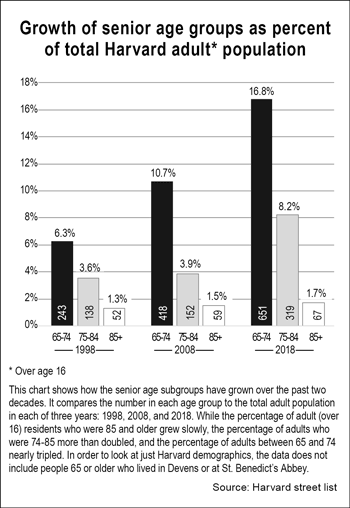

In addition to the growth of the older population, the Census Bureau reports that the over-65 population is healthier and more active than ever before, and the percentage of seniors who continue to work past the age of 65 and remain living in their homes is increasing. Data found in Harvard’s town street listings from 1998, 2008, and 2018 confirms that those senior lifestyle changes are happening here.
The number of working Harvard seniors increased over the past two decades, with 67 percent of the 65-74 age group reporting an occupation in the Town Census, as opposed to only 50 percent in 2008, and 37 percent in 1998. Similarly, the street listings show that the percentage of seniors who stayed in their houses past the age of 65 rose over the same two decades. In 1998, the number of residents aged 65-74 living in a house in Harvard was 233. In 2008, when those residents aged into the 75-84 category, only about 60 percent of that group was still living in a Harvard house. In 2018, 71 percent of residents who aged into the 75-84 category from the previous decade were still living in a Harvard house.
If senior residents continue to stay in Harvard at the same rate as they did in the previous decade, the number of residents over 65 will increase dramatically in the coming years, largely due to the town’s high baby boomer population, 30.8 percent of Harvard’s total population (see Harvard by the numbers below). The oldest boomers turned 72 in 2018 and the youngest turned 54, and data from the town clerk shows that only about a third of Harvard boomers had turned 65 by the end of 2018.
Meet these Harvard seniors:
Chris and Carol Landry: Mostly retired, “super involved” after 60
Bob Benson: Straddling work and retirement after 70
Martha Guptil: Living alone and grateful for town services after 80
Communities need to prepare
An article in the Health Services Research Journal titled “The 2030 Problem: Caring for Aging Baby Boomers” discusses the role communities will need to play as their elder populations increase, including “significant, yet certainly feasible, changes in housing, health care, and human services.” The paper identifies transportation, social connections, and housing options as critical to meet the needs of seniors who move past the healthy, active phase into a less active yet still independent stage.
When does that stage typically occur? In an interview with the Press, Harvard Council on Aging (COA) Director Debbie Thompson said that at a recent senior lunch at Hildreth House, an event that provides seniors with not just a hot meal, but also social interaction with their peers, the average age was 77, and the median age was 74.5. Of the 2,883 transportation requests in fiscal 2018, the largest number (46 percent) came from the 75 to 84 age group, followed by the 65 to 74 group at 30 percent.
Harvard already hitting limits
The COA will bear the brunt of the shifting demographics, and it will need more of everything, according to Thompson: “More space, more safe transportation options, and more staff.” Transportation is already stretched to the limit, she said. Although the COA’s MART van is on the road five days a week, it cannot accommodate all the ride requests that come in. Last year, 320 requests had to be referred to Harvard Help, a volunteer organization that provides rides to residents who don’t require wheelchairs.
As for program space, Thompson said that an event like the weekly men’s coffee group typically fills the living room with 20 people. She added that the dining room could provide added space for more men to enjoy coffee and conversation, but the two groups would be separated. Likewise, the dining room can comfortably hold only about 20 people for a meal with some overflow seating in the living room. But events that draw larger crowds just won’t fit in Hildreth House. Holiday dinners are currently held at area churches, and Thompson said that while she is grateful for their generosity, that arrangement adds a level of dependence and uncertainty. She said, for instance, if the church were to need the space at the last minute for something like a memorial service, the COA event would be bumped.
The birth of ‘age-friendly’
The state has already recognized that work needs to be done sooner rather than later to address the coming senior tsunami. In 2017 Governor Baker signed an executive order establishing the Governor’s Council to Address Aging in Massachusetts. In Dec. 2018 the council issued a report of recommendations in areas such as transportation, housing, health, caregiving, and economic security.
The state has also joined the AARP Network of Age-Friendly States and Communities, the U.S. affiliate of the World Health Organization’s Global Network for Age-friendly Cities and Communities. “Age-friendly” is a term that the Massachusetts Executive Office of Elder Affairs defines as “a movement to make communities more welcoming and livable for older residents and people of all ages.” The state has created an “Age-Friendly Massachusetts” action plan to submit to the AARP network, designed to make the state “more age- and dementia-friendly.” It welcomes input from older residents, communities, and stakeholders.
Harvard’s Director of Community and Economic Development Chris Ryan recently completed an application for Harvard to join the network. He said the Planning Board must first endorse the application and the Select Board must authorize it before it can be submitted. Neighboring Littleton, Stow, Bolton, and Boxborough have already joined; there is no membership fee.
On the planning side, Ryan has many ideas for making Harvard more age-friendly, including looking into more transportation options and housing choices, as well as commercial development options such as a grocery store or pharmacy. He has already forged a relationship with the COA by talking to the board about senior needs so he could incorporate board members’ input into his community and economic development plan. In addition, Ryan said he will likely use pertinent Master Plan action items and past town surveys to get a handle on what needs to be done. “In terms of what I was hired to deal with, making the town age-friendly was not mentioned,” Ryan said in a recent interview, “But,” he added, “it’s a no-brainer to me.”
Next: A look at senior transportation in Harvard, including what options exist, how well they are working, and what additional services might help the town meet its current and future needs.
Sources and acknowledgments
Sources consulted for the data in this article include Harvard street listings, data from the town clerk, “The Population 65 Years and Older in the United States: 2016” published by the U.S. Census Bureau, “Older People Projected to Outnumber Children for First Time in U.S. History” published by the U.S. Census Bureau, and “The 2030 Problem: Caring for Aging Baby Boomers” published by the Health Research and Educational Trust.
Comparing street listings to population data provided by the town clerk
Town Clerk Marlene Kenney told the Press that her sources for population data are the annual town census, voter registration data, and information from the Registry of Motor Vehicles. That data is compiled each year around June 1 to create the annual street listing. Some of the information used in this article came from the 2018 street listing, and some came from data the town clerk compiled on Jan. 2, 2019. The ages used in this article were calculated from birth dates so the date on which the data was compiled is irrelevant. But the town clerk’s data may reflect some moves into or out of town through December 2018, while the street listing data only goes through May 2018.
In addition, the street listings do not contain data for public safety workers and their families and children under 17. Kenney said the previous town clerk also chose many years ago not to publish any town employee’s information in the street listing, but she will take another look at that policy in 2019. Numbers obtained from the town clerk include all residents.
Acknowledgments
The Press would like to thank Director of Community and Economic Development Chris Ryan and Council on Aging Director Debbie Thompson for their help in gathering data for this story. And we would especially like to thank Town Clerk Marlene Kenney for graciously providing data in response to multiple emails from us asking for “just one more number,” for digging through file drawers to find ancient street listings that were not filed in any particular order, and for providing a warm comfortable place for us to pore over them. Thanks, Marlene!
—Joan Eliyesil
Harvard by the numbers
The following data show that Harvard is ahead of the burgeoning 65-plus population in both Massachusetts and the U.S. The data source for U.S. and Massachusetts numbers is the U.S. Census Bureau estimates from 2017, which have a margin of error of +/- 0.1 percent. The data source for Harvard is the town clerk’s population data compiled on Jan. 2, 2019. All the Harvard numbers below include Devens except where noted.
Harvard population in 2018: 5,964 (includes 324 Devens residents)
Number of Harvard residents 65 or older in 2018: 1,146 (includes 24 Devens residents)
Number of Harvard baby boomers (born 1946-1964) in 2018: 1,839
Median age: U.S.: 38.1; Massachusetts: 39.5; Harvard: 48
Percent of population 65 or older: U.S.: 15.6%; Massachusetts: 16.1%; Harvard: 19.2%; Harvard without Devens: 19.9%
Percent of population classified as baby boomers: U.S.: 23%; Harvard: 30.8%
Number of Harvard baby boomers that were:- 65 or older in 2018: 632 • Younger than 65 in 2018: 1,207
Number of Harvard residents that were:- Under 18 in 2018: 1,082 • 65 or over in 2018: 1,146
Chris and Carol Landry
Mostly retired, ‘super involved’ after 60
Chris and Carol Landry were renting in Boxborough in the early ’80s and would often ride their bikes through Harvard, with Kimball’s as a destination. They fell in love with Harvard, but when they were ready to buy a house, what they could afford was in West Acton. After nine years, they bought a house on Littleton Road and started a family. Some years later Chris, who worked for Digital, took the opportunity to move to Texas. The boys attended a very good elementary school there, but as Chris said, “It [Texas] felt like a suit that didn’t quite fit.”

Chris Landry (center left) and Carol Landry (center right) confer with fellow Lions Club judges at the bed races in 2016. (Photo by Lisa Aciukewicz)
When an offer came for a job back in Massachusetts, they jumped at the chance. With Carol and the boys back in Texas, Chris spent a year house-hunting, checking out towns closer to his company on 128. Then he decided he didn’t mind a commute and focused on Harvard and Carlisle. Something perfect became available in Harvard, and it “felt like coming home.” They have “zero interest” in moving away from town.
Carol speculated that if something happened to Chris, she would sell the house but would try to find a smaller house in town. And this is a problem, Carol and Chris agreed. Carol said she would like to see more places like Harvard Green.
Chris retired four years ago and is delighted to have time to spend on woodworking, which he has loved since seventh grade. Carol works in her profession a day and a half a month outside the home and doesn’t plan to stop until circumstances change. She and Chris are “super involved” in town, “very much a part of the community.”
Carol said they don’t participate in anything at Hildreth House and are not really aware of all the activities and services the Council on Aging provides. Chris, who joined the Lions to get to know people after so many years being out of touch because of traveling for work, is familiar with the St. Patrick’s meal the club does for the COA. Carol, who is at Hildreth House for bridge with the Woman’s Club on Wednesdays, said she is in awe of how busy the COA is. When a friend needed a walker for her visiting dad, Carol asked Debbie Thompson, who immediately loaned her one.
Chris said it’s his impression that for the COA, it’s an “uphill battle with the town.” He doesn’t feel the town gives enough support or visibility to the COA, and he doesn’t understand why the town hasn’t purchased another van and stopped relying on the volunteer organization Harvard Help. “The town doesn’t hesitate to buy a new car for the fire chief or a new truck for DPW, but it won’t support a new van” for Harvard’s seniors.
—Carlene Phillips
Bob Benson
Straddling work and retirement after 70
Bob Benson straddles the worlds of work and retirement, of the city and rural Harvard, and he said it’s the happiest he’s been. He worked full time for Technology Transfer, which commercializes inventions in the field of biotech. He said he loves being retired, but he still does some part-time consulting. Frequently he has a business meeting at the General Store.
Benson grew up in New York City and went to NYU. He and his family moved here from Washington D.C. “I love the city,” he said. He would like to move into Boston if he could afford it, but he’s staying in Harvard.
And there are many things about Harvard that he loves: the look of the town, the nice, interesting people, the Cultural Collaborative, the General Store, gardening at his community garden, his walkable neighborhood, and the many hiking trails on conservation lands. He has a child at Bromfield, and his wife, who is younger than he, is still working.
Benson said it has been hard to make friends in town and that he feels somewhat isolated. He has heard about activities at Hildreth House and said that since he is technically a senior citizen, he should explore possibilities there. He has recently joined the tai chi class sponsored by the COA.
Benson goes into the city about every two weeks, to someplace like the Museum of Fine Arts or to meet with clients. “Believe it or not,” he said, “it’s exciting to ride the T.”
—Carlene Phillips
Martha Guptill
Living alone and grateful for town services after 80
“My greatest concern is outliving my money,” said Martha Guptill, voicing a fear of many older seniors living on a fixed income. That would mean having to sell her home of 56 years. Financial problems and serious health issues are the only reasons she can imagine for giving up the home she loves and moving out of Harvard.

Martha Guptill at a previous COA Halloween celebration. (Photo by Katy Sharko)
“I feel safe here; Harvard is a very safe town,” she said. Although, she admitted, now that she’s living alone, she locks her door.
Guptill’s husband, who grew up in Harvard and graduated from Bromfield, died nine years ago. Because she had no children and had worked full time, Martha knew few people in town and had no real connections. It was at that point that things took a positive turn. Maria Holland, outreach worker with the Council on Aging, visited Guptill and encouraged her to come to lunch at Hildreth House and to check out the programs offered there.
Guptill has made friends through the senior center, and she goes on trips and attends those programs that interest her; she particularly likes the Monday movies in Volunteers Hall. She also takes advantage of the tax work-off program for seniors by volunteering at Hildreth House, serving lunch and “performing other duties as assigned,” a term she’s familiar with from her former work at Devens.
She cited the many programs Harvard has that help seniors afford to stay in town and said she is sorry to see changes, like seniors losing their discount at the dump under a new system going into effect. Still, she thinks Harvard does all it can do for seniors with the budget it has.
One thing she would love to have is an overnight trip through the COA—a mini-vacation. She spoke of how wonderful a two-day trip to Maine was a couple of years ago and would like to see that offered again. She can still taste that lobster dinner
—Carlene Phillips