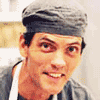
Author, professional bread baker, and banjo player Martin Philip will read from his award-winning, recently released book “Breaking Bread—A Baker’s Journey Home in 75 Recipes” Thursday, Jan. 18, at 7 p.m. in Volunteers Hall. He will share tips and insights on the art and craft of baking and writing, offer audience members bread samples, and play banjo tunes from his birthplace, the Arkansas Ozarks. This library-sponsored event will be followed by a book-signing, with copies of Philip’s book available for $30.

Martin Philip, the head baker at King Arthur Flour, at work in the bakery. (Courtesy photo)
Philip is the head bread baker at King Arthur Flour in Norwich, Vermont. He is also internationally recognized for his mastery as a baker. As such, he was a finalist in the selection process for the coveted bread spot at the Coupe du Monde de la Boulangerie, also referred to as the “Baking Olympics,” held in Paris. In 2013, Philip, along with three other Americans, made up Team USA and competed for the Golden Cup for Bread at the 34th International Exhibition for the Artisan Production of Gelato, Pastry, Confectionery, and Bakery in Rimini, Italy. Their team came in third out of five countries.
But Philip’s passion is not in competition, but rather in sharing his gifts and building community. He has baked with villagers in the Dominican Republic, ex-convicts at Homeboy Industries in California, and with immigrants, new to America, at the Hot Bread Kitchen in New York City. He writes, “I bake because it connects my soul to my hands, and my heart to my mouth.”
In many ways, Philip’s journey into baking broke tradition. Surprisingly for his many achievements in the field, Philip is a relative newcomer to his profession with just 16 years of experience. In his life before baking, Philip was a professional opera singer with a degree from the Oberlin Conservatory, an investment banker on Wall Street, and an ultra-marathoner—at each of which he excelled. Why then, after he and his wife, Julie Ness, were just beginning to grow their family in New York City, did he turn to baking?
In a phone interview, Philip listed a couple of major turning points in his life that converged and shifted his thinking, leading him to become a baker.
The initial groundwork was laid in his choice to return to the banjo and leave opera singing. Philip describes it like this: “It wasn’t until right around 2000 that I was like, ‘You know what? I used to play banjo and that fed me in a way that I had a relationship with that music, that I didn’t necessarily have with singing. It was fresh, and the banjo was tied to my heritage. It felt honest.’”
Feeling the impact of 9/11
This craving of being true to himself in his work and his surroundings was further cemented after living through the shock and aftermath of the terrorist attacks of Sept. 11, 2001. “When 9/11 happened it was further encouragement for me to hold up this measuring stick and say ‘What have you done?’ and not ‘What have you done that’s necessarily measurable?’ but ‘What have you done that is honest and connected to your soul?’ I started baking, and that was like my return home,” said Philip.
A journey homeward
What may have seemed a simple decision was not easy or straightforward. It took Philip another five years to leave the city and three tries to be hired by King Arthur Flour. The move to Vermont in 2006 with his wife and three children was a move back to his roots where his father and grandfather had grown up. It was also a move where Philip was starting over. As a passionate amateur baker, he worked his way up from an entry-level position to head bread baker at King Arthur.

His decision to write a book in 2015, with “zero writing experience,” according to Philip, was a challenge that overlapped his busy work life, his wife’s busy career, and care of their children. A year into his book, his wife was diagnosed and treated for breast cancer. Philip wrote in a 2017 article for Runner’s World magazine, “Thankfully, surgeries, recovery, and treatment went well enough that our whole family could return to worrying about small things.”
In that same Runner’s World article, Philip recounted how he began a daily regimen of running. His “streak” has him out in all weather even if it means only a couple of late-night miles in jeans and Sorel winter boots. He often runs with his children, and wrote, “I’m sharing my love and curiosity. Running has become my daily practice, my ritual, my reward.”
Philip has a talent for mastering new things—and for luck, a sense of curiosity, and the love and support of family and friends. It was a friend who connected him with an agent, who set up the meeting with HarperCollins Publishers. That day, Philip signed a book contract on the basis of just one conversation.
His book evolved into a narrative interspersed with original recipes. “I just wrote what was natural.” But at the beginning, Philip knew he needed a team to help him. He recruited his friend, young-adult author and journalist Sarah Stewart Taylor. They met in the local public library. Philip tells the story: “And I said, ‘What the hell do I do?’, and she said, “Well, I don’t know—maybe just start writing some essays.’ And so I wrote.” Philip described writing the book as a series of memories accented with recipes. Philip’s book “Breaking Bread” was the grand-prize winner of the 2017 New England Book Festival.
And what are Philip’s plans for the future? In 2016, Philip was awarded a fellowship at the MacDowell Colony, a selective artists’ colony in New Hampshire where artists can work and be creative. Leonard Bernstein, Aaron Copland, E.L. Doctorow, Audre Lorde, Alice Walker, and Faith Ringgold are among the more than 8,000 artists who have benefited from MacDowell fellowships. Just this week, Philip finished his second MacDowell application. His proposal is to bicycle through the rural South, inviting conversation and finding common ground through music and baking.