
The last days of fall have arrived. Daylight saving time is a distant memory, likewise the reds and yellows of autumn, and all at once we realize just how short the days have become and how long the nights.
Cue the culinary cornucopias of Thanksgiving and subsequent holidays. Food, and lots of it, is how we push back on the dying of the light, to borrow a line from Dylan Thomas. Unlike the poet, however, we sky walkers are quite content to go gentle into that good and lengthening night, the starry night, that is. And what a cornucopia of nighttime treasures is upon us. From my vantage point in Harvard center, star clusters, galaxies, and nebulas spill out of Oak Hill into the sky above and lie in one glorious arc that comes to rest on Prospect Hill and the Nashua River beyond.
Fellow sky walkers, let us ramble along this arc of starry wonders.
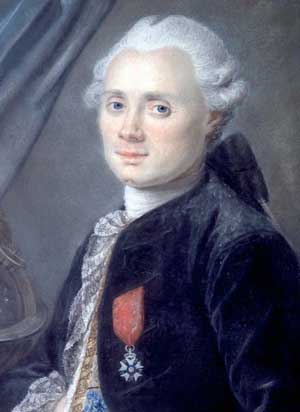
French astronomer Charles Messier, as painted by Nicolas Anseaume. (Credit: Wikimedia Commons)
But first some astronomical history. The gentleman pictured at the right is Charles Messier (1730–1817), whose professional preoccupation was the systematic search for comets. The scientific innovation he brought to this, however, was actually to catalog noncomets. Over the course of a life of observations, Messier identified 110 noncomet nebulosities with fixed positions in the sky. These were fuzzy patches of light that could easily be confused with an early sighting of a comet’s tailless nucleus. While some of what we now call the Messier objects were known to earlier astronomers, most were first reported by Messier and his assistant, Pierre Méchain.
As it turns out, Messier had unwittingly cataloged the brightest and most spectacular galaxies, star clusters, and nebulae visible with amateur telescopes or binoculars.

The route of our celestial fun run. Credit: Marc Vilain (chart); NASA, ESA, M. Robberto, STSI/ESA, HST Orion Treasury Project Team (Orion); NASA, ESA, AURA/Caltech, Palomar Observatory (Pleiades); Rawastrodata (Double Cluster), Adam Evans (M31).
Not a marathon, but a fun run
Amateur astronomers have long drawn from Messier’s catalog for their nighttime observations. And since it is a human foible that anything worth doing is worth doing to the max, behold the Messier marathon, wherein stargazers challenge themselves to view all 110 Messier objects in one night, typically the night of the new moon in late March or early April.
While I admire this observational athleticism, I prefer more leisurely sky walks. What I propose here is thus less of a marathon and more of a 5K, or perhaps a fun run. The figure above charts our route for an unhurried but astronomically rich night. Starting a couple hours past sunset, this route begins with Orion in the east, and arcs overhead through Taurus, the Pleiades, Perseus, Cassiopeia, the brightest region of the Milky Way, and ends with Cygnus in the west. A side trail leads us to the Andromeda Galaxy.
Longtime readers may note that some of these sights were covered in previous installments of this column. The full details are still available to subscribers on the Harvard Press website (just search for “Sky Walker”); what follows are pocket travel guide highlights. You will want to bring binoculars on this journey, as well as a telescope such as the library’s StarBlast lend-a-scope.
Orion. The hunter peeks over the horizon shortly past sunset and is in full stride by 9 p.m. Our destination is the Great Nebula, or M42 for being the 42nd entry in Messier’s catalog. M42 is the middle star of Orion’s sword, which lies below the familiar three-star arrangement of Orion’s belt. This is a fine binocular sight, but it’s an even greater marvel in the telescope (originally covered in “Birthplace of the stars,” 1/14/2016).
Taurus. You can’t miss this constellation’s distinctive V shape, usually taken as Taurus’ horns. The bright orange star on the one horn is Aldebaran, the bull’s anatomically misplaced eye (for additional colorful stars, see “Night of orange stars,” 12/17/2015).
The Pleiades. The seven sisters of the Pleiades shimmer just past Taurus. This cluster would never be mistaken for a comet, but Messier still listed the Pleiades as M45. In our day, light pollution and haze conspire to hide from the naked eye all but five of the stars in this cluster. On a good night you can see six, and on an exceptional night seven or eight. Binoculars will reveal many more dim stars, but the real magic is a naked eye view on a dark night (“The Pleiades…daughters of the night,” 2/2/2017).
Perseus and the Double Cluster. Perseus the hero looks vaguely and unheroically like a kitchen funnel. This constellation is a fine place to linger with your binoculars, full of stars and small clusters, but the real treasure is the Double Cluster, hanging like two jewels from a necklace between Perseus and Cassiopeia. Though more cometlike than the Pleiades, the Double Cluster did not make Messier’s catalog. Binoculars give the best effect: Scan from the tip of the funnel two-thirds of the way toward the long branch of Cassiopeia (see also the detailed chart in figure 3). A telescope shows more detail (“Introducing Harvard’s northern night sky,” 10/8/2015).
Cassiopeia. Queen Cassiopeia is our second constellation shaped like a letter of the alphabet, the letter W. She is easy for novice sky walkers to recognize; if you have trouble locating nearby constellations like Perseus or Andromeda, find Cassiopeia first.
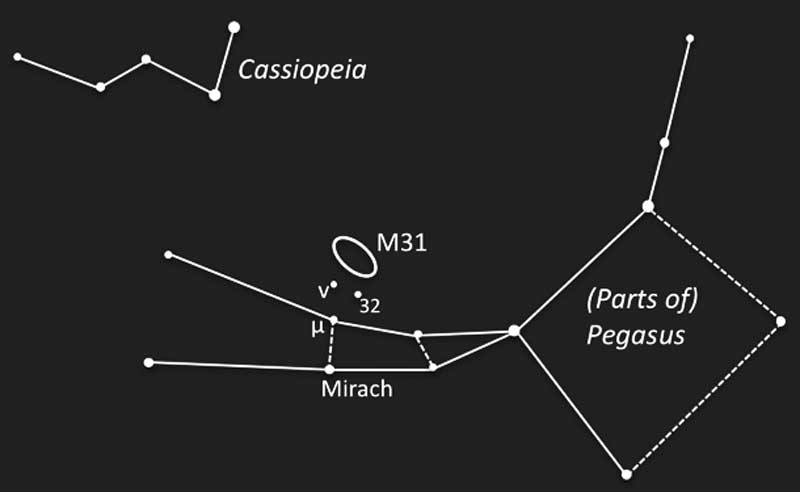
Details of the region between Cassiopeia and Andromeda. (Credit: Marc Vilain)
The Andromeda Galaxy. M31 is our nearest neighbor galaxy, lying just off the Andromeda constellation, which also doubles as the hind legs of flying horse Pegasus. To find M31, follow Pegasus’ hind legs outward. You will see two pairs of aligned stars; the top star of the second pair forms a small triangle with two other stars, and just past that triangle is the galaxy (see figure 4). M31 is very obvious in binoculars and can even be seen with the naked eye on a dark night (“Andromeda—a galaxy far, far away,” 11/5/2015).
The Milky Way. If you are going to see any part of the Milky Way in spite of our local light pollution, it will be the stretch between Cassiopeia and Cygnus. On a clear moonless night, go to the darkest place you can find and allow time for your eyes to adjust. With some luck, you will start seeing some of the myriad stars that make up this segment of our galactic home (more on the Milky Way in a forthcoming column).
Cygnus and Albireo. Cygnus, the swan, also looks like Charlie Brown’s kite. Swan or kite, Cygnus hosts the spectacular Albireo, a double star comprising color-contrasting companions, one orange and the other blue. The pair forms the head of the swan (the pointy end of the kite), and requires a telescope to see (more on Cygnus in a future column).
And with this last stop, we bring our celestial fun run to the finish line. We stopped at only three of the 110 spots that make up a Messier marathon, but who among us is counting, fellow sky walkers, since it is the travel and not the destination that brings us back to the night sky?