It’s not your father’s MCAS—or even your older brother’s. Most students who took the Massachusetts Comprehensive Assessment System tests last spring faced a new version of the exam, sometimes called the Next Generation MCAS or MCAS 2.0. Across the state, scores on the new test were sharply lower than the 2016 results on the older version, now known as the Legacy MCAS.
Like other students in the state, Harvard students mostly scored less well on the new version than on the old. The state set the benchmark higher on the new MCAS, with only 50 percent of students expected to fall in the top two categories, Hildreth Elementary School Principal Josh Myler said. Essentially, the state changed the curve on which it was grading. So comparing results from 2016 and 2017 is not an apples-to-apples comparison, he said.
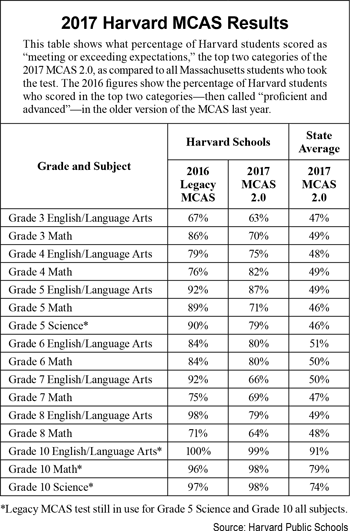
A better measure of how Harvard schools are doing, agreed Myler and Bromfield Principal Scott Hoffman, was to see how Harvard students compared with others in the state, rather than how they did this year as compared to last year. Those numbers show Harvard students well ahead of their peers. (See table at left for both comparisons.)
In Harvard as elsewhere, students in grades 3 through 8 took the MCAS 2.0 in math and English/language arts. Tenth-graders, however, took the legacy version. Because students must pass the 10th-grade MCAS to graduate, state officials delayed the changeover for that grade until 2019, when students will have had experience with MCAS 2.0 at earlier grades. And the science exams, which Harvard students take in fifth and ninth grades, are also the older model, as new versions have not yet been developed.
At Monday’s School Committee meeting, Myler explained that although both the new test and the old have four scoring categories, the categories do not align. The new test ranks results as exceeding expectations, meeting expectations, partially meeting expectations, and not meeting expectations. The categories in earlier years were advanced, proficient, needs improvement, and warning.
Raising the bar for college readiness
The history of the MCAS exams shows that scores rose, both in Harvard and statewide, as schools aligned their curricula with the tests. The tests were first developed in 1993. To take fourth-graders as an example, by 1998 only 49 percent of Harvard fourth-graders, and 20 percent in the state, scored advanced or proficient on the English section of the test. But by 2001, that number had risen to 78 percent for Harvard and 51 percent for the state. And the percentages generally stayed in that range or higher thereafter.
In a later interview, Myler explained that Massachusetts’ new standard comes in part from the National Assessment of Educational Progress (NAEP), sometimes called “the nation’s report card.” The NAEP tests evaluate whether students in fourth and eighth grade are on track to be ready for college, without needing remedial coursework when they get there. Massachusetts ranks highest in the nation on the NAEP, but even so, only about half its students are on target for college readiness. So, with most students now doing well on the older version of MCAS, the state decided to set the bar higher, Myler said.
So far, only the schoolwide results for the 2017 MCAS 2.0 have been released. In the coming weeks, schools will receive more detailed results, showing scores for individual students and item-by-item breakdowns indicating which questions proved difficult for them. When those results are available, Superintendent Linda Dwight told the School Committee, she will be able to present a fuller report on student achievement.