In a nearly unanimous vote Thursday afternoon, June 8, the School Building Committee decided that building a new elementary school was a wiser choice than renovating the existing one. Nine of the 10 voting members on the committee opted for new construction.
Superintendent of Schools Linda Dwight, who chairs the building committee, called on members one by one to announce their vote and explain their choice. Most of those in the majority explained that they had originally favored renovation. But, they said, the very high price for even the smallest renovation package, combined with the risk that more problems could crop up in the 1988 building even after renovation, convinced them new construction would be a better value.
Although committee member Rick Maiore opted for a new building, he voiced the fear that others had also expressed, saying he was concerned the project would be voted down at the 2018 Annual Town Meeting or at the election thereafter. “We have to alter our tax base,” Maiore said, and he urged the town to look at Devens as a possible solution.
Don Ludwig, who represented the Finance Committee, agreed it was a very difficult decision. “I came into this kicking and screaming,” he said, and had originally preferred one of the renovation options. “But the numbers don’t line up. It’s hard to justify a renovation, given the numbers,” he concluded, casting his vote for new construction.
Several members remarked that they did not want to repeat what they considered a mistaken decision in the 1980s to combine older and newer parts of the school. The decision then to keep the 1950s kindergarten wing, they pointed out, was at the root of the need for substantial reconstruction now. Mary Traphagen, John Lackner, SusanMary Redinger, and Alice von Loesecke referred to the risks inherent in adding a new wing, cafeteria, and other changes to the 1988 building. Traphagen, who is both a member of the building committee and chairwoman of the School Committee, said, “The cycle of connecting old to new has to end.”
Committee member Ron Ostberg acknowledged that the decision was a difficult one, but in his written statement he listed the advantages he saw to new construction that justified its higher cost. A new design, he wrote, would “foster—rather than inhibit—the practice of multiple teaching and learning activities.” Contemporary building technology, he said, would lead to lower operating costs in the new building. And new construction would create less disruption for students and teachers than a renovation, while also avoiding the high cost of leasing and installing modular classrooms.
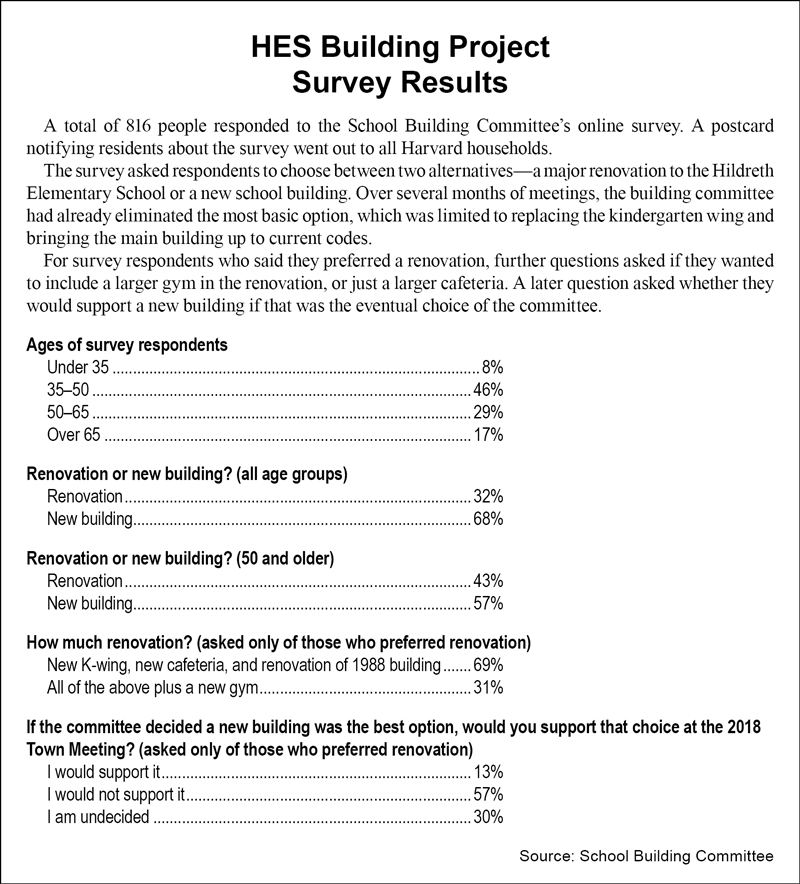
David Fay represented the Harvard Energy Advisory Committee on the building committee, but he said energy was not the decisive issue in the choice between renovation and rebuilding. The important point, he said, “is to be in sync with the people in town.” A new building “seems to be the will of the town,” he said, citing responses to the online survey that showed 2-to-1 support for that decision (see below). He expressed concern, however, that the town might move away from that position between now and the 2018 Annual Town Meeting.
The only committee member to vote for renovation rather than new construction was Marie Sobalvarro, who is assistant town administrator. “I sit here wearing the hat of the town,” she said, explaining that Harvard faces a number of other important capital projects. Choosing renovation, Sobalvarro said, would allow the town to move ahead with some of those other projects as well.
Voting last, Dwight also supported new construction, saying, “I’m very excited about the possibilities of how a new building can contribute to education.” She also said she was pleased that the near unanimity meant the committee had spoken in a united voice.
After voting was completed, project manager Tom Murphy roughed out the next steps in the process leading up to the decision at next year’s Town Meeting. At the building committee’s next meeting on June 22, he explained, the architectural firm Arrowstreet will bring a proposal to be submitted to the Massachusetts School Building Authority at its June 29 session. (The MSBA is expected to reimburse about $15 million of the estimated $51 million cost of a new building.)
If the MSBA approves that proposal, the HES project will move from its current feasibility stage into the schematic design stage, with designs scheduled to go to the MSBA in February 2018. That February meeting will cover the project scope and budget, with a complete design and detailed cost estimates. Once that budget is set, Murphy said, it cannot change; if costs increase, the project would be trimmed back to keep within the approved budget. And those designs and costs will go to Harvard voters next spring.
Committee member Maiore, who is a veteran of several building projects, asked Murphy, “How confident are you that we will get bids that meet the budget?”
“Very confident,” Murphy replied.
Ludwig raised another concern: What if the K-wing were to fail while the new building was under construction? He pointed out that the new building would be going up on the fields north of the school, and there would be no place for modular units to replace the K-wing classrooms.
Dwight said school officials had planned for that contingency. For example, the computer lab could become a classroom, as could the rooms now used for “specials” such as art and music, with those subjects then taught in children’s regular rooms.