The next stop in our Cuban quest for the bee hummingbird and other species was the Bay of Pigs area in the Zapata Peninsula. We spent three nights there to give us plenty of time to explore Cuba’s richest and most important birding destination.
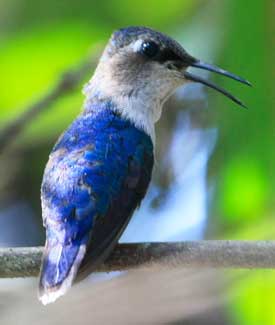
A bee hummingbird.
The first day we headed into a nature reserve where a blind had been set up in the vicinity of a lek (a gathering, courting area) known to be frequented by several blue-headed quail-doves (E, endemic). These doves, a little bigger than our mourning doves, have a bright blue head and chest and a bright red lore. Quietly approaching the blind, we saw a couple of these doves as well as a gray-fronted quail-dove (E) in the distance. Both doves are endemic to Cuba, with the gray-fronted having a gray head and chest and iridescent purple-blue feathers on the back, tail, and wings. We were lucky to see both species together.
We returned to the trailhead and crossed the road to a dirt path lined with small trees and shrubs with open fields beyond. Noticing some movement about 20 feet up in a tree, we found several Cuban parakeets (E) quarreling over some fruit. These bright green birds are identified by dots of bright red feathers over their upper body, looking as though someone has spattered them with paint. Watching these noisy birds, someone noticed what looked like a large insect flying around, and sure enough there was a bee hummingbird (E). There were in fact several flying around so fast that it was hard to keep track of them. Now and again one lighted on a branch for a few seconds, giving us a chance to get our binoculars on it and observe the purplish head and throat, white belly, and bluish back and wing feathers. We had finally seen the smallest bird on earth. Overhead a couple of rose-throated parrots zipped by, giving us quick but good views of this bright green parrot with reddish throat and blue primary wing feathers

A Cuban black hawk soars over the water.
Farther on down the road, we stopped at another trail into the woods where our guide had seen a Cuban nightjar (E). This bird, as is typical with all nightjars, is crepuscular (active at twilight) when it hunts insects. We knew the nightjar would be difficult to find because it was the middle of the day and they are well camouflaged. After several minutes of searching, our guide did in fact find the bird. Incredibly, another in the party found a second bird not 6 feet from the first one. The only thing that gave it away was its large eye looking inquisitively at us, the rest of the bird being perfectly camouflaged and pressed horizontally against the tree branch.
Colorful and cute
After lunch we headed to Las Salinas Wildlife Refuge. We stopped at several platforms to observe shorebirds. While we were on one of the platforms, a Cuban black hawk, which had been concealed in the mangroves not 20 feet from us, dove into the water, grabbed a large crab, and flew off to some rocks about 50 feet away to eat its lunch. It was one of those “oh wow” moments!

A Cuban tody perches on a branch.
One of the most colorful and cute birds we have ever seen, and had the good fortune of seeing several times during the trip, was the Cuban tody (E). This diminutive bird (about 4½ inches) has bright green back and primary feathers, red throat, white breast, yellow forehead, and blue cheeks. The male has red-pink flank feathers, which it puffs out when singing. Having all those colors and the way it displays them made the tody one of our most memorable bird sightings ever.
We continued our trip to Cayo Coco, which is a barrier island on the north shore of the island. Approaching the island along a 2-mile causeway, we noticed a string of flamingos in the distance. Although far away, we got good looks through the scope at thousands of these birds strung out for at least a mile while they feasted on shrimp in the shallow water.
Shorebirds
During a visit to the La Rosita research station at Laguna Zaza, we were met by one of the researchers, who invited us to a grass-roofed space where we were offered coffee. If you enjoy good coffee, Cuba is the place to be, and this was a welcome break after a long bus ride on a dirt road.
After coffee we walked across the road to some water where Dr. David Larson (our Mass. Audubon guide) saw what he thought were a few American avocets. We proceeded to a break in the trees where there was a small observation platform over the water. There we saw not one but around 300 of these spectacular shorebirds feeding. There were also black-necked stilts, flamingos, roseate spoonbills, and white ibis feeding—another incredible sight.
We also saw the usual shorebirds, including great blue heron, great white heron, little blue heron, snowy egret, tricolored heron, reddish egret, cattle egret, and green heron.
Overhead were the ever-present turkey vultures, a couple of magnificent frigatebirds, double crested cormorants, brown pelicans, ospreys, and a pair of crested caracaras.
Back to Havana
We left the coast and headed to Havana for our last couple of days. On the way, we stopped at the colorful colonial town of Sancti Spiritus and on to Trinidad where we walked around the city and had lunch.
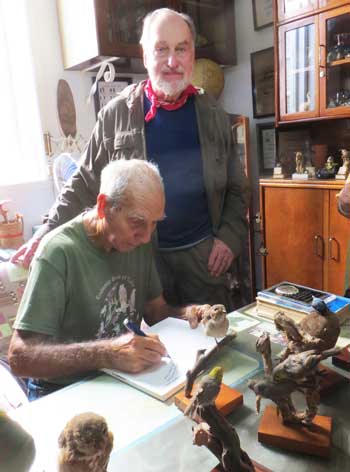
Orlando Garrido signs David Durrant’s field guide. (Courtesy photo)
Arriving in Havana, we checked into our hotel in the old city and had a chance to observe the famous promenade, the Malecón, along the harbor, marveling at all the perfectly maintained 1950s Chevys and other old American iron that are used as taxis. After dinner we headed out to walk the Prado to enjoy the vibrant local scene.
The next day we had the privilege of meeting Orlando Garrido at his home. Garrido is a founder of both the Cuban Academy of Science and the National Museum of Natural History of Cuba, where he served as curator until his retirement. He has described 129 new species and subspecies, and is the author of “Birds of the West Indies,” the field guide we used throughout the trip. Welcoming us to his study, which was crammed with mementos, awards, and a case of specimens including all the endemic birds of Cuba, he offered to sign our field guides.
As we were leaving, he asked what was one of the memorable sightings of our trip. Most said seeing the 200 to 300 American avocets, to which he replied, “In all my years of birding I have only ever seen two in Cuba, and one of those I collected!”
Local update: Spring arrivals
As we are writing this article, the snow is coming down from what we hope is our last spring storm. The ice left our pond on March 2, but the pond froze up again a few weeks later. A pair of hooded mergansers arrived in mid-March, and later in the month two pairs of wood ducks arrived. When Pam was out cutting some kale for the chickens, she heard a phoebe. Our resident song sparrow has returned to serenade us with his familiar call. The goldfinches are beginning to turn yellow, and the cardinals’ red feathers look even brighter against the snow. Bluebirds with their bright metallic blue plumage are beginning to explore our bluebird houses, and high up above our lower pasture a couple of red-shouldered hawks are whirling around in their courtship display.
All this encourages us that spring is on the way. We look forward to the arrival of the warblers and other migrants.
—David and Pamela Durrant
David and Pamela Durrant live on East Bare Hill Road at Micheldever Farm, where they watch birds—their own peacocks and chickens, and visiting wild birds.