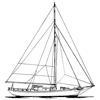
From only a drawing on a piece of paper, to the realization of “Charlotte”—a hand-built 50-foot gaff-rigged schooner—the story of her makers is simply and directly told as it happened over three and a half years in this 90-minute film.
The romance of wooden boats comes to life as part of the Warner Free Lecture Series this Friday at 7 p.m. in Volunteers Hall, giving land-locked Harvard residents the chance to experience “Charlotte: A Wooden Boat Story.” Director Jeffrey Kusama-Hinte and cinematographer and co-director Brian Dowley will share some thoughts about making the film after the screening.
The story: a convergence of events
The film begins with Nat Benjamin, co-owner and co-founder with Ross Gannon of Gannon & Benjamin Marine Railway boatyard on Martha’s Vineyard. The opening scene is of Benjamin installing floors on a massive keel timber that sits atop a salvaged 8-ton ballast. As described on the website www.charlottethefilm.com, Benjamin’s original design for Charlotte used traditional plank-on-frame, all-wood construction. But what is surprising is that Benjamin’s complete plans for the build were based on a simple line drawing created in December 2003.
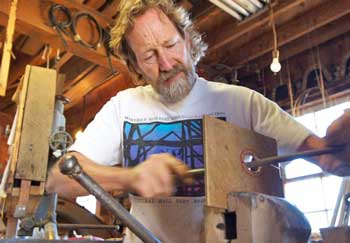
Co-owner and co-founder of Gannon & Benjamin Marine Railway boatyard in Vineyard Haven Harbor, Nat Benjamin works on Charlotte, a 50-foot gaff-rigged, two-masted schooner, and namesake for this Friday’s Warner Free Lecture screening of “Charlotte: A Wooden Boat Story.” (Courtesy photo)
For director Jeffrey Kusana-Hinte, his framework for the film also came ahead of its content. According to a précis written by Kusana-Hinte, he envisioned an “observational film constructed in a cinéma vérité fashion, one that allowed the people, their work, the materials, the boats, and nature to ‘speak’ for themselves.” However, he wrote, “I couldn’t quite figure out how to make the film, and I couldn’t walk away.”
It was a fortunate chance meeting in the summer of 2004 with cinematographer Brian Dowley, a friend of Benjamin, that launched the filming of “Charlotte.” Kusana-Hinte acknowledges that even after beginning the collaboration with Dowley, the “story” of building Charlotte was “more of a justification than an actual story line.”
A filmmaker’s film
“It was wondrous; I was experiencing film as I was filming,” said Dowley in a phone interview. “I was shooting from the inside out.” When asked to expand, he said it was like being an observer with a camera, attempting to be invisible to those around him so that he could capture “life” as it happened. He described his filming as being a “meditative immersion.”
This style of filming is referred to as cinéma vérité: the act of filming real people in everyday situations. There is no script, no narrative, no “directing,” and no reshoots. “A missed shot is simply missed,” wrote Dowley in his cinematographer’s statement. He uses a handheld camera and makes an art of using natural lighting.
However, there are costs to shooting vérité: Over the five years in active production, he shot for about 87 days, using 275 rolls of film measuring “thousands and thousands of feet,” with more than 75 hours of footage, he said. “I was never sure it was going to be a completed film.”
Another “cost”—though a cost he and director Kusana-Hinte willingly chose—was that of using film over digital tape. The major drawback with film was its expense. “We felt that imagery exposed on an emulsion-based medium would best capture the natural feel of sculpted wood grain, the artistry of the builders, and the details of their environs,” wrote Dowley. “Film feels like a natural product.”
He explains further that if one can see past the complexity of lots of chemistry in treating film, then film can be understood as “visually organic.” He makes the parallel between the commitment a boatwright makes with a cut of wood and the shots he takes that must be timely and correct, with little margin for error.
A community of boatbuilders
The film is also about the Gannon & Benjamin Marine Railway boatyard, the hub of Charlotte’s evolution. Owners Ross Gannon and Nat Benjamin’s mission was to design, build, restore, and maintain traditionally built wooden boats. And in the process of doing so, they brought together a community of volunteers, enthusiasts, apprentices, and boatwrights from near and far.
Local resident Mario Cardenas, a sound recordist, friend, and colleague of Dowley, was the catalyst behind the screening of “Charlotte.” Knowing that Warner Free Lecture Series committee member Tim Clark had a passion for wooden boats, he brought the film and the opportunity for its screening to his attention. In an email Clark wrote, “[This is a] true Massachusetts story. I thought it was an opportunity to share my passion with others who may not be so lucky to have built a boat by hand and those who simply dream about that possibility.”